Thursday, September 25, 2008

Paris 2008: Faster, Sharper, Cleaner: The New Golf GTI Concept


In 1976 the Mk I Golf GTI was launched as a low volume addition to the Golf range. Thirty two years, five generations and 1.7 million sales after that car established the breed, the sixth generation of the GTI has been unveiled in concept form ahead of its public debut next month at the Paris Motor Show.

The core attributes of the original GTI – sharp dynamics, style and practicality – remain in the new GTI concept. Yet the new car uses the latest advances in drivetrain and chassis technology designed to enhance rather than detract from the purity of the driving experience.

The strut-type front and multi-link rear suspension architecture from the conventional Golf are adopted in modified form on the GTI. Specially tuned springs, dampers and anti-roll bars are joined, for the first time on the GTI, by the option of Adaptive Chassis Control (ACC) which comprises adjustable pneumatic dampers. With three settings ranging from ‘comfort’ to ‘normal’ and ‘sport’ the ACC system also remaps the steering and throttle response to give a vehicle that can strike a balance between sharp dynamics and body control and comfort while driving in urban areas or on motorways.

For the first time the new GTI features an electronic limited slip differential (XDS) linked to a sophisticated ESP (Electronic Stabilisation Programme) system in order to maximise traction and improve responses.

Powering the GTI concept is a 2.0-litre four cylinder TSI engine developing 210 PS – a gain of 10 PS over the Mk V GTI. Despite this gain the new engine is both more efficient, returning 37.6 mpg on the combined cycle while emitting 178 g/km of CO2 compared to 189 g/km for the outgoing car. Installed in the new Golf GTI concept the 2.0-litre TSI engine allows the vehicle to accelerate from standstill to 62 mph in 7.2 seconds before reaching a top speed of 148 mph making it the fastest standard production GTI yet produced.

A team of three designers are responsible for the new GTI concept: Walter de Silva (Director, Group Design), Klaus Bischoff (Director, Brand Design) and Marc Lichte (Director, Exterior Design). The new car bears clear visual links with the original. ‘We wanted a consistently clear GTI design, a car that has power, but style as well,’ commented Walter de Silva.

This is apparent in the red grille surround that echoes the original, along with the horizontal grille fins and elegant yet purposeful new headlights featuring individual lamp pods behind a translucent cover. In profile the side skirts of the Mk V Golf that extended the length of the sill are replaced by subtle wraparound versions that extend only partially along the lower edge of the vehicle. At the rear a set of GTI smoked rear light lenses are joined by a rear diffuser channelling air from beneath the vehicle that’s in turn framed by a pair of chrome tailpipes.

The distinctive 18-inch ‘telephone dial’ wheels from the Mk V GTI make a reappearance, albeit in subtly evolved form on the Mk VI GTI concept. Finished in milled silver with gloss black inserts, the new wheels are reminiscent of those first fitted to the GTI W12-650 concept.

Continuing the unique modifications to the GTI over the conventional Golf is a new interior. Drawing on the all-new interior of the Mk VI Golf the GTI features a flat-bottomed steering wheel finished in black leather with contrasting red stitching. A set of contoured sports seats finished in grey tartan cloth reminiscent of the Mk I and Mk V models are joined by unique instruments and gloss black dashboard and door trim inserts framed by silver highlights.

As with all Golf models the new GTI concept is fitted with a high level of standard equipment including seven airbags, a CD stereo, climate control and ESP.

The GTI concept is intended as a first step towards the Golf GTI which will start production in spring 2009. UK sales are expected to start in early summer, with prices and specifications announced closer to this date.


Wednesday, September 24, 2008

Paris 2008: World Premiere of BlueTDI label


At the 2008 Paris Motor Show Volkswagen will show its new BlueTDI engine label that meets the stringent Euro 6 emissions rating which comes to effect in 2014.

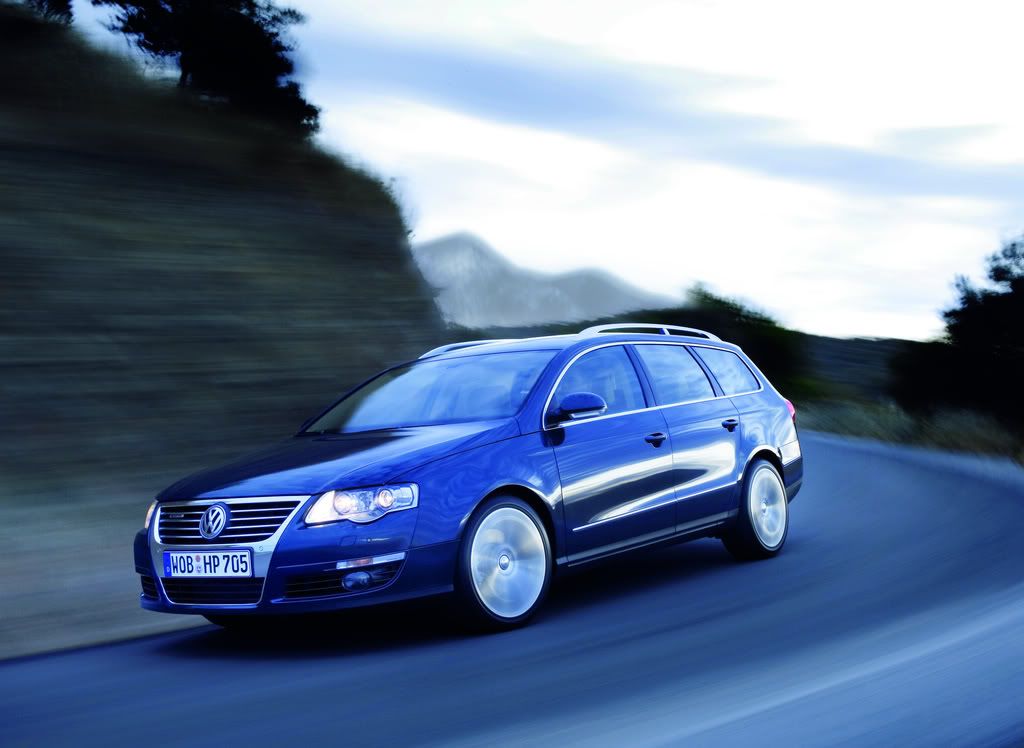
Thanks to technologies such as SCR, AdBlue and Common Rail the BlueTDI has a fuel consumption that is 0.6L better than the current 2.0 TDI; in the Passat Variant it gets 5.5 l/100 km (144 g/km CO2) and the Passat Sedan gets 5.2 l/100 km (139 g/km CO2).

The engine has 143hp (105kW) and is optioned with DSG or 6 speed manual.

Expect BlueTDI to hit the market in 2009.

Editor Note: BlueTDI will debut at the LA Auto Show In the Touareg this October.

Tuesday, September 23, 2008

Wanderlust-ready – Caddy for the globetrotter


-Caddy PanAmericana concept car was designed for real-life giants
-All-terrain 16-inch tires, full-time all-wheel drive, leather interior

For generations, commercial vehicles from Volkswagen in the style of a Bulli, Multivan or California have been the first choice of globetrotters. That is because they are virtually indestructible and infinitely versatile. Exactly 23 years ago, in the summer of 1985, Volkswagen treated globetrotters (and users of the Transporter models) to the first vehicle with all-wheel drive. A short time later, one of these vans drove around the globe in 131 days – faster than any other car before it.

Since that time, the talented and versatile vans from Volkswagen Commercial Vehicles have been demonstrating their mastery of long journeys as well as the great construction sites of this world – even making passages that were previously the exclusive domain of off-roaders. A model under the “VW” label especially designed for duty off the beaten path is the Multivan PanAmericana. Essentially, this is a specialist among specialists. In a world premiere at the IAA 2008 in Hanover, Volkswagen Commercial Vehicles is now presenting the second vehicle under this legendary name – the Caddy PanAmericana concept vehicle.

From a technical perspective, the concept car – like the new Caddy 4MOTION – sports the latest generation of 4MOTION all-wheel drive with electro-hydraulic Haldex clutch. It distributes power from the 250 Newton-meter strong TDI (77 kW / 105 PS) between the front and rear axles so that optimal traction is always guaranteed.

Visually, the concept car – outfitted with two sliding doors – is identified by typical PanAmericana insignias such as “Salt Lake Grey Metallic” body paint, large 16-inch wheels with all-terrain tires (here in size AT 215/70 R16), robust black plastic bumpers, recessed side skirts in aluminum look, protective underbody components in the front and rear also in aluminum look, as well as PanAmericana signatures on the engine hood and its two-section door-style tailgate. Specially framed in aluminum trim are the dark tinted side windows in the rear (privacy windows). In contrast to the production Caddy, tinted taillights and black-background headlight housings were applied to the concept van.

The interior has been upgraded by the use of luxurious and durable leather in the “Cricket” pattern. Similar to the “large” PanAmericana, the seats are designed in a natural brown tone. The individual leather sections are joined by distinctive cross-stitching; for contrast the piping is designed in a light gray tone. Also color coordinated here are the air vents in the instrument area with the metal look of their bezels. Also designed in leather are special pockets in the rear seating area that serve as extra storage compartments.

Incidentally, the PanAmericana name is an homage to two record drives on the route between Alaska and Tierra del Fuego. First, one extreme athlete rode a bicycle over the 22,880 kilometer long stretch between Prudhoe Bay and his destination Ushuaia in support of Aids relief. In another, Volkswagen Commercial Vehicles set a world record in the year 1999: the Multivan Syncro of that time completed the Pan-American Highway – the world’s dream road – in just 15 days, 14 hours and 6 minutes. Without all-wheel drive this passage would have been unthinkable


Look toward the future – Crafter BlueMotion study with AdBlue technology


-Crafter BlueMotion with high roof consumes just 9.1 liters on average
-Concept car already fulfills Euro-5 standard thanks to SCR catalytic converter with AdBlue technology

In a world premiere, Volkswagen Commercial Vehicles is presenting the Crafter BlueMotion concept vehicle at the International Automobile Show in Hanover (September 25 to October 02). For the first time, the company has applied the pioneering economical BlueMotion concept to a high-roof van of the 3.5 tonne class. Powered by a 80 kW / 109 PS strong common rail turbo-diesel, the Crafter BlueMotion as a panel van with high roof and long wheelbase (4.33 meter) consumes just 9.1 liters diesel per 100 kilometers on average. This value represents a savings of 1.0 liter compared to the production version. Of course, the van with its high-tech diesel engine satisfies the Euro-5 emissions standard that becomes law in Fall 2009.

Compared to the production vehicle, CO2 emissions were reduced by 10 percent to 241 g/km. Engine developers were able to lower nitrogen oxide emissions (NOx) by 43 percent. Making a significant contribution here is the SCR catalytic converter with AdBlue technology being implemented in a Crafter for the first time.

The engineers and designers of Volkswagen Commercial Vehicles achieved these first-class fuel economy and emission values on two levels that merge under the BlueMotion badge. First level: aerodynamic optimization. Second and decisive level: high-tech powertrain and emissions control system. The concept car is also equipped with tire pressure monitoring and cruise control system, so that these parameters that have a significant impact on fuel economy can always be ideally calibrated too.

Furthermore, the engineers utilized regeneration – generation of electrical energy during braking – to reduce fuel consumption. Background: thanks to regeneration, battery recharging can be reduced in certain operating phases, or it may be deactivated entirely. Instead, the battery is efficiently recharged with “cost-free” braking energy in overrun operation. This specific energy management system saves on fuel. Use of a variable-control pump (VDP) for power steering also reduces fuel consumption.

The large frontal area of the Crafter’s structural design together with its high roof, made designers seek fine tuning in details. These details include a new radiator grille profile that gives the wind less surface area to catch hold of. In addition, a rear spoiler offers further aerodynamic improvements.

Modifications to the Crafter powertrain and a high-tech emissions control system had a crucial impact on the vehicle’s low fuel consumption and emission values and made it possible to decisively fulfill the Euro-5 standard.

Engine: Here Volkswagen Commercial Vehicles chose a common-rail five cylinder with 109 PS and 2,461 cm3 displacement. The production version of this 280 Newton-meter strong engine is paired with a 6-speed transmission and a diesel particulate filter as standard equipment. On the Crafter BlueMotion concept car, the engine – coupled to a rear axle with a high gear ratio (3.923:1, ECO axle) and a transmission optimized for fuel economy – is an engine version that was specially adapted, by internal
engine modifications, to a supplemental emission control system that utilizes a so-called SCR catalytic converter together with AdBlue technology.

The acronym SCR stands for “Selective Catalytic Reduction”, an internationally recognized term. “Selective” refers to the fact that this catalytic converter has a very special task: its purpose is to selectively convert nitrogen oxide (NOx) components of the exhaust gas to nitrogen and water without forming undesirable side products. It was developed precisely for this highly specialized task. Important: despite the SCR catalytic converter, in parallel the Crafter BlueMotion concept vehicle will be equipped with an oxidation catalytic converter and a diesel particulate filter.

Back to the SCR catalytic converter: conversion of the nitrogen oxides is accomplished by use of a synthetically produced, water-based urea solution by the name of AdBlue that is stored in an auxiliary tank on the Crafter. This substance consists of 32.5 percent urea and is continuously sprayed into the exhaust gas upstream of the SCR catalytic converter. It is metered according to the mass flow rate of the exhaust gas; engine management – informed by a NOx sensor downstream of the SCR catalytic converter – precisely controls the process.


Atomized into a fine vapor through a screen, the urea reacts in the SCR catalytic converter with the nitrogen oxides and splits them into nitrogen and water. The water-based AdBlue additive is nontoxic, odor-free and biodegradable.

Individualized – the most luxurious Caddy of all times


-Exclusive Style Edition has leather interior, 16-inch aluminum wheels and Climatronic

First Caddy with removable cargo floor arrives on market in November
Volkswagen Commercial Vehicles is presenting a fireworks show of new products at the IAA in Hanover. Debuting in one world premiere is the exclusive Style Edition of the Caddy Life. This new top model extends the model range upward, above the Caddy Style already launched on the market. That is to say, the Style Edition delivers more exclusivity and greater comfort than any Caddy before.

Like the Caddy Style, the Edition also includes features such as body-colored bumpers, door handles and outside mirror housings. Other features shared by both models are their leather steering wheel, overhead cargo net, ESP electronic stabilization program, RCD 310 audio system with MP3 functionality, MEDIA-IN port for MP3 player with USB plug, Park Distance Control, seat heating in front and cruise control plus multifunctional display.

Yet, the new Style Edition adds an entirely new level of features to this already exclusive package. And it includes refinements with which the Caddy Life surpasses boundaries to the next higher van segment without stretching price limits. On board the Style Edition are details such as a leather seat system in “Date” pattern (in front with sport seats), matching leather door trim, color coordinated floor mats, now with height adjustment for the center armrest for the first time, inside door handles in silver-aluminum look, steering wheel badge in the same material, “Climatronic” automatic dual-zone climate control and – a new Caddy feature – a practical, removable cargo floor.

The exterior of the Style Edition was also extensively customized. Beyond the cited features of the familiar Caddy Style, the Style Edition offers painted add-on parts along its side profile, 16-inch alloy wheels, a radiator grille with so-called chrome lip, chassis lowered by 30 millimeters, spoiler at the rear wheel housings and unique “Style Edition” signature on the sliding doors. The new Caddy Style Edition will be launched on the market in Fall 2008.


The first Caddy with four-wheel drive


-The newest generation of four-wheel drive
-World premiere at the IAA Commercial Vehicles

Hanover, 16 September, 2008: Volkswagen Commercial Vehicles writes a new chapter in the success story of the Caddy with the world premiere of the Caddy 4MOTION at the IAA in Hanover. For the first time, permanent four-wheel drive is available for the talented all-rounder. The tractive force of the Caddy 4MOTION is distributed by an electronically regulated Haldex coupling of the newest generation.

Volkswagen Commercial Vehicles has modified the Caddy 4MOTION in numerous points compared with the front-wheel drive version and equipped it with new technical elements. In addition to the electronically regulated fourth-generation Haldex coupling, changes include the propshaft, an exhaust system adapted to the rear final drive and propshaft, a newly designed fuel tank and reinforced longitudinal members in the rear. A manual six-speed gearbox, standard hill-hold assist as well as the electronic stabilisation programme ESP, also standard, are ideal for use in the Caddy 4MOTION. While the front axle could be completely carried over from the front-wheel drive Caddy, the rigid axle at the rear had to be modified extensively for use with four-wheel drive.

Standard equipment in Germany for the Caddy 4MOTION includes, among other things, fog lights, heat-reflective glass, 15-inch wheels with 195/65 R15 tyres, a multifunction display and a sliding door in the back on the right (and also on the left in the Life version). The Caddy 4 MOTION can also be ordered with an upward-opening hatch or split doors in the rear, as desired.

The Caddy 4MOTION is powered by a four-cylinder turbo diesel with 77 kW (105 PS). The thrifty TDI has a diesel particulate filter (DPF) as standard and fulfils the Euro 4 emissions standard.

The power train combination of a TDI with DPF and 4MOTION attains CO2 values of 172 g/km in the panel van version and 176 g/km in the window van and Life versions, very good values for vehicles of this size. The Caddy 4MOTION attains accordingly low combined fuel consumption, using 6.6 and 6.7 litres of diesel per 100 km for the panel van and Life versions respectively. All versions of the Caddy 4MOTION have a top speed of 164 km/h. Prices for the Caddy 4MOTION will be announced at the IAA.


Volkswagen Commercial Vehicles seeks continued growth with new products


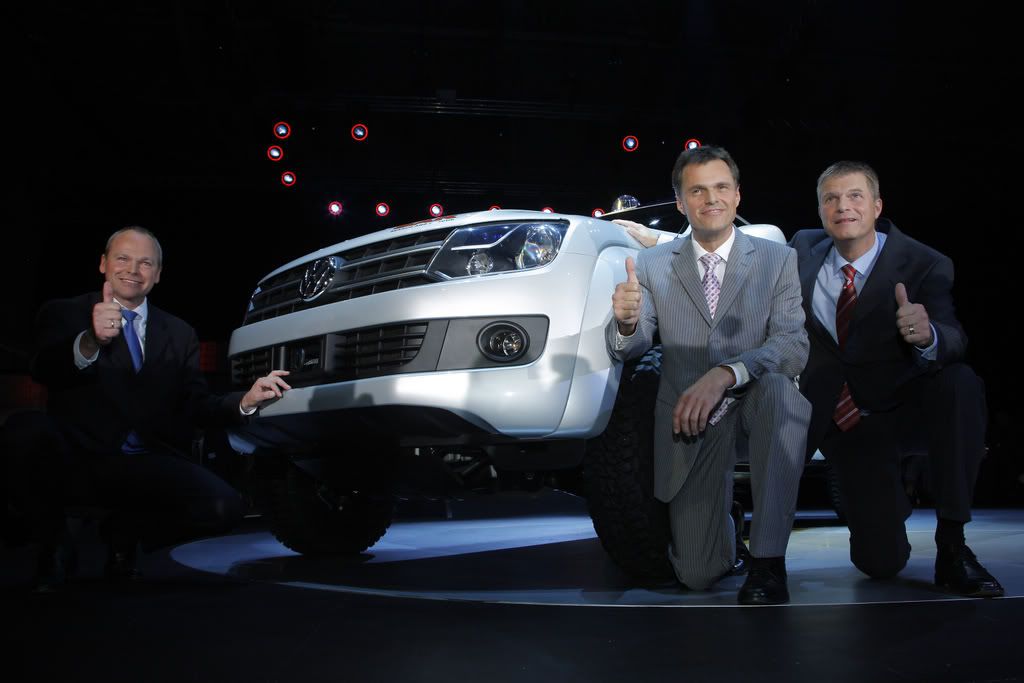
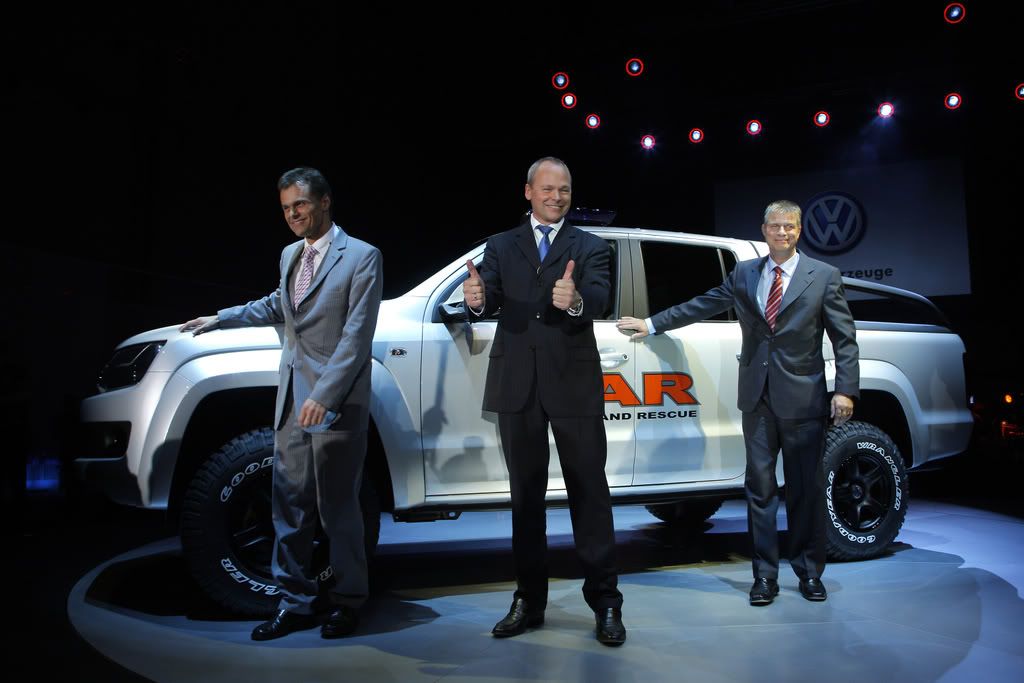
Pictured left to right of screen VWCV Board Members Stephan Schaller (CEO), Dr Wolfgang Schreiber (Product & Development) and Harold Schomburg (Sales & Marketing).

• Five world premieres at IAA Commercial Vehicles
• New series: Volkswagen Pickup show car
• Worldwide deliveries up 9.3 per cent to end of August

Hanover, 23rd September 2008. Volkswagen Commercial Vehicles is presenting five world premieres at IAA Commercial Vehicles, including a preview of the Volkswagen Pickup which will be launched as the fourth new series of light commercial vehicles towards the end of 2009. The Volkswagen Commercial Vehicles brand is on a growth track – deliveries to customers on a worldwide basis rose by 9.3 per cent to 343,100 light and heavy commercial vehicles by the end of August.
“New products, new markets, new technology – the Volkswagen Commercial Vehicles brand continues to experience sustainable and profitable growth”, emphasised Stephan Schaller, CEO of Volkswagen Commercial Vehicles at today’s press conference.

The brand intends to increase its worldwide deliveries of light commercial vehicles to 800,000 units by 2018. According to Schaller, this growth is to be achieved by introducing new products and by developing variants of the existing product range, some of which can be seen for the first time at IAA Commercial Vehicles.

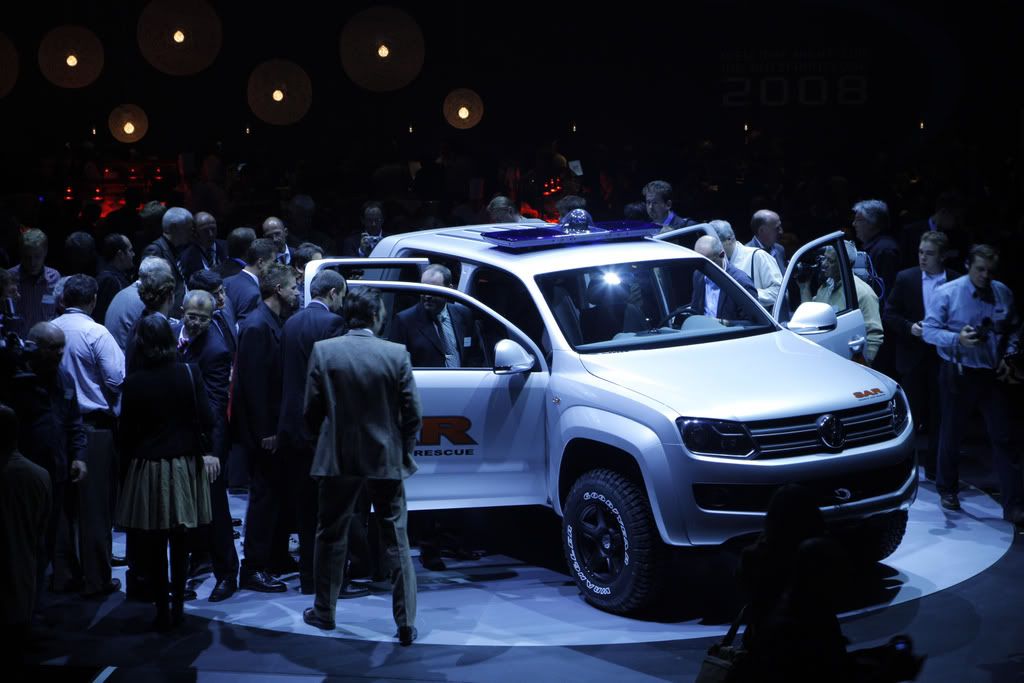
The most spectacular highlight of the trade fair from VWCV’s perspective is its first ever presentation of a Volkswagen Pickup show car. This adds a fourth series (in addition to Caddy, T5 and Crafter) to the brand's range of light commercial vehicles, which already boasts an extensive set of variants.

This means that Volkswagen Commercial Vehicles will be the first volume manufacturer in Europe to enter the 1-tonne Pickup segment, with its high growth global potential. According to Schaller, the key markets for the Volkswagen Pickup are the countries of South America – especially Brazil. He also sees South Africa, Australia and South East Asia as being important markets for this universally adaptable commercial vehicle. And the vehicle will also be introduced into the European market. Overall sales projections for the new Pickup amount to around 100,000 units per year.

Schaller was confident of achieving worldwide total deliveries of over 500,000 light and heavy commercial vehicles in 2008. He was optimistic of achieving this annual target, despite difficult economic conditions at the present time in certain European countries.

Schaller: “Markets are getting harder – but Volkswagen Commercial Vehicles will continue to grow this year.”

This is borne out by sales figures from the most significant markets.

• In Germany deliveries of vehicles in the Caddy, T5 and Crafter series grew by some 7.5 per cent between January and August – a total of approximately 79,800 vehicles.
• In Western Europe product delivery numbers grew by 3.2 per cent to 190,900 units.
• In the booming eastern European markets, deliveries rose by nearly 30 per cent to more than 32,900 light commercial vehicles. In Russia alone the brand sold 6,630 units, up 87 per cent.
• In South America deliveries of light and heavy commercial vehicles increased by around 25 per cent to 82,300 units.

The President of Volkswagen Trucks and Buses, Roberto Cortes, predicted that 2008 would see a new worldwide delivery record of 60,000 heavy commercial vehicles and buses. Volkswagen has been the market leader in Brazil for the last six years, and now has a market share of some 31.6 per cent.

In addition to the Volkswagen Pickup show car, the brand is presenting four other world premieres in Hall 12 at this year’s IAA Commercial Vehicles, taking place between 25th September and 2nd October.

• The Caddy 4MOTION opens another chapter in the success story of this series. With the sales launch planned perfectly for the start of winter, it will at last be possible to buy a delivery van with a permanent four-wheel drive option. In the Caddy 4MOTION, power is distributed via an electronically controlled latest generation Haldex gearbox.

• The Caddy PanAmericana Studie is a variant of the Caddy 4MOTION for globetrotters. With its 16 inch all-terrain wheels, off-road look and feel, not to mention its high-quality yet robust leather interior upholstery, the Caddy PanAmericana Studie turns heads.

• With the Caddy Life Style Edition, Volkswagen Commercial Vehicles is presenting the most exclusive series Caddy of all time – a top-of-the-range Caddy variant due to be launched in November 2008.

• Another world premiere is the Crafter BlueMotion Studie. This 3.5-tonne diesel estate has a fuel economy rate of 31.04 mpg and already complies with the Euro 5 emission standard due to come into force in autumn 2009.

As Schaller said, with the Volkswagen Pickup, with the world premieres and also with other models adapted to meet the needs of global growth markets, Volkswagen Commercial Vehicles is well positioned to continue along the track of profitable growth.