|
|
|---|


Showing posts with label Concept. Show all posts
Showing posts with label Concept. Show all posts
Friday, September 25, 2009

Sunday, January 11, 2009
NAIAS 2009: Concept BlueSport World Premiere
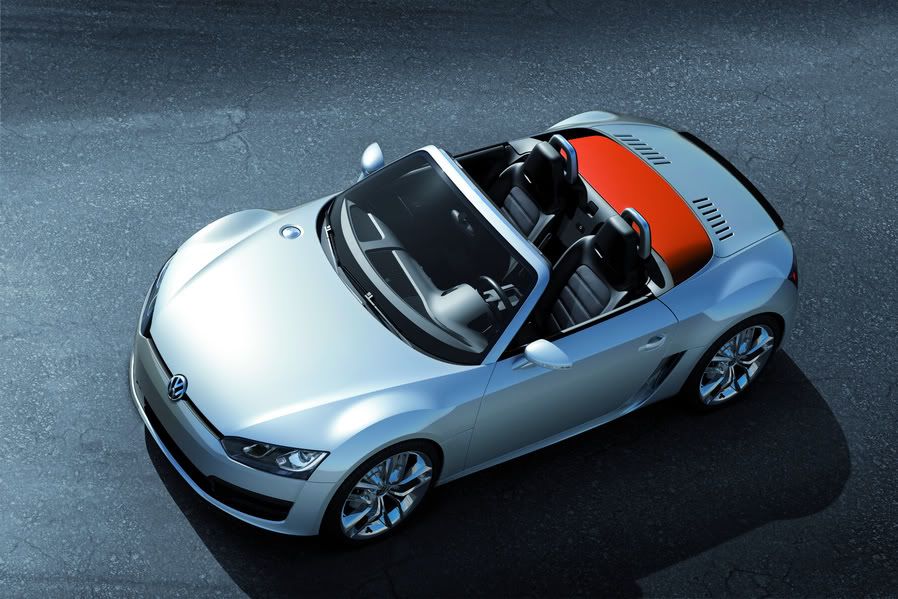
World premiere of the Volkswagen Concept BlueSport:
Sports car offers the most driving fun with the least fuel
140 mph fast Concept BlueSport has exceptional 42 mph fuel economy
Made in Germany – Concept car is a reflection of modern carmaking
Wolfsburg / Detroit, 11 January 2009 - Volkswagen is starting the new year by presenting an automotive dream – an affordable, uncommonly economical and highly agile mid-engine roadster. Its name: Concept BlueSport. Status: concept. Dynamics: pure. Fuel consumption: an average of 55 mpg / 4,3 l/100 km; less than any other sports car. Positioning: genuine, low-emissions roadster (113 g/km CO2) that makes every kilometer, every mile a driving experience. World premiere: Detroit, Michigan, on January 11, 2009.
Comeback of compact agility
Behind the two sport seats of the 3.99 meter long Concept BlueSport (axle load distribution: 45:55) is an exclusively charged TDI or TSI engine that delivers dynamics – these are high-tech engines that consume little but put out a lot. In the case of the Concept BlueSport version now being presented in the USA it is a 132 kW / 180 PS strong Clean Diesel (TDI) with common rail injection and downstream NOx storage catalytic converter. At a low 1,750 rpm – i.e. right from the engine speed ‘cellar’ – the 2.0 liter turbo engine develops its maximum torque of 350 Newton-meters. That matches the power response of an approx. 300 PS strong six-cylinder gasoline engine! A 6-speed dual clutch transmission – the most economical and agile transmission system in the world – transfers this power to the rear wheels. It is shifted either automatically or via shift paddles on the steering wheel. In just 6.2 seconds the sports car is moving at a speed of 60 mph (0-100 km/h: 6,6 seconds); its top speed is 140 mph (226 km/h).
These are the key parameters of a new and at the same time classic European sports car philosophy. The Concept BlueSport is evolving into a car that is a lot of fun to drive and at the same time makes an unmistakable statement in terms of sustainability. The fact is: if the Concept BlueSport were to go into production it could herald in a renaissance of the compact roadster. Another fact: this car handles just as well in the urban environment of metropolises as it does on very curvy country roads and long expressway routes.
Concept without compromises
Volkswagen defined just two objectives in the car’s development: maximum driving fun and minimal fuel consumption. And so a mid-engine sports car was implemented that makes no compromises, that aims at low weight and maximum agility right from the start. Although it is best in its class when it comes to body rigidity, the Concept BlueSport weighs in at less than 1,200 athletic kilograms. The results: performance that is more than impressive for every life situation, in addition to the cited fuel economy and emissions advantages. Low weight was attained by consistent application of lightweight construction methods (among other things, the soft top – at 27 kilograms – is the lightest in its class, and the hoods are made of aluminum), and by a body layout with crisp and compact dimensions.
Despite all of the sports car fascination included on board, it still offers a respectable level of everyday utility. In the cargo area under the front hood, for example, the Concept BlueSport can stow 112 liters of luggage; its counterpart in the rear can handle an additional 70 liters of cargo volume. Altogether that makes 182 liters – enough for working documents or an extended weekend trip for two. Also extended, by the way, are the distances between any two fuel fillups. With a fuel tank volume of 50 liters and the noted fuel economy of 42 mpg (consumption of 4.3 liters per 100 kilometers), the theoretical range is greater than 710 miles (1,150 kilometers).
Making a positive impact on the car’s range, fuel economy and emissions are two technologies that could become more and more commonplace in the future and are part of the so-called Eco mode on the Concept BlueSport: an automatic start-stop system and braking energy regeneration. The place where automatic start-stop shines is in city traffic. When the Concept BlueSport stops at a red traffic light, for example, it automatically shuts off its engine. As soon as the light turns green again, just tapping on the gas pedal is enough to start the engine lightning fast. Its entire operation is absolutely intuitive and saves up to 0.2 liters of fuel per 100 kilometers in the city. Furthermore, primarily when the Concept BlueSport is braked, energy is generated by the alternator (regeneration), which relieves the engine and further improves fuel economy.
Design without gimmickry
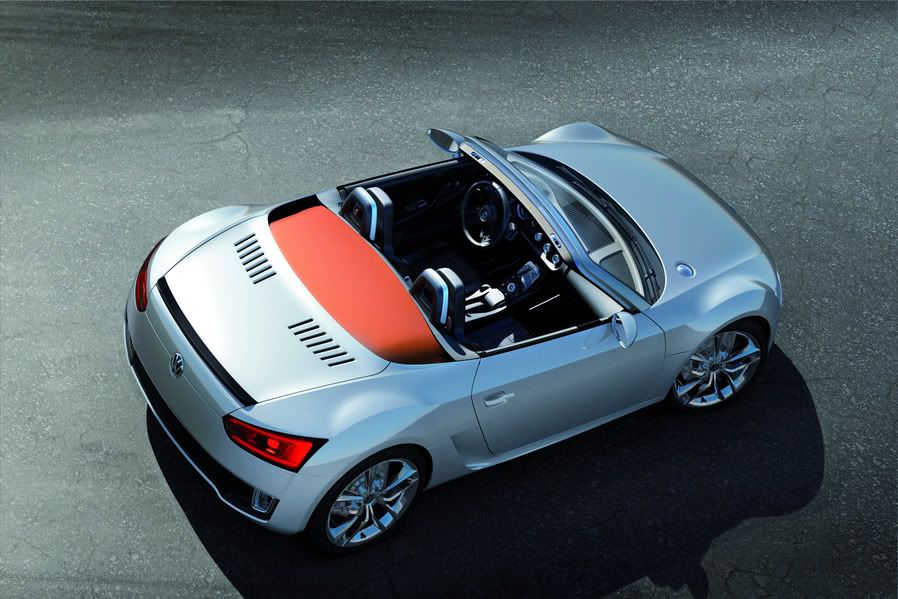
The Concept BlueSport – painted in Flex Silver painted and sporting an orange colored fabric roof – was designed by the team led by Klaus Bischoff (Director of Design for the Volkswagen Brand) and Thomas Ingenlath (Director of the Design Center in Potsdam). "The design of the Concept BlueSport," says Klaus Bischoff, "represents a perfect synthesis of technology and aesthetics. Its form is very clear and is reduced to essentials; the car body itself has a lean and linear structure." Thomas Ingenlath adds: "Emanating powerfully from this car body are the circular wheel housings, flared out in three dimensions as in a sculture. The radial surfaces, edges and blending of forms emphasize the wheels and thereby the agility of the BlueSport concept car. The lateral air intakes are identifying features of the mid-engine layout, their volume-reducing design offers visualization of the car’s sporty low weight."
Powerful proportions
The proportions of the Concept BlueSport give it an exceptionally powerful and impressive appearance. Besides its low height of 1.26 meters, the car’s image is shaped by the fact that the wheelbase (2.43 meters) appears large compared to the car’s overall length of about four meters, and the sumptuous track widths that are large relative to the car’s width (1.75 meters). In front, the sports car exhibits a track of 1.49 meters; in the rear it is 1.52 meters.
In the sum total of its dimensions, it is clear, first of all, that the powerfully styled body of the Concept BlueSport is significantly shorter and flatter than that of the Scirocco already launched in Europe, yet it is longer and a lot wider than the current Polo, for example. And with precisely these proportions, the roadster makes an especially powerful impression on its custom designed 19 inch alloy spoke wheels.
Front end design
At its front, the Concept BlueSport is characterized by a new Volkswagen design language introduced for the first time on the Scirocco and the new Golf. It is based on a ‘design DNA’ that will leave its mark on all new Volkswagens. This design DNA was developed by Walter de Silva (Director of Design for the Volkswagen Group), Flavio Manzoni (Director of Creative Design for Volkswagen AG) and Klaus Bischoff. On the one hand, it preserves historical elements, but on the other it represents a re-interpretation of Volkswagen design. Familiar from the Golf and Scirocco are the dominant dual cross beams that are formed by the narrow radiator grille and the painted bumper. In the lower area, large air inlets in black extend across the entire vehicle width, and integrated in them – under translucent, dark-tinted plastic covers – are the LED flashers.
Meanwhile, the car’s interpretation of individual features shows just how broad the range of vehicles is, in which these style elements can be implemented. Take the headlights and taillights, for example: Although the Concept BlueSport with its bi-xenon headlights and LED taillights is obviously a Volkswagen of contemporary times, it is still extremely independent. The roadster look is evident in details such as the daytime running lights designed as a narrow, C-shaped light strip (in the main headlamp housing) or – in the style of high-performance sports cars – the distinct outward flare of the fenders whose forms are charged with energy.
Thomas Ingenlath, lead project designer for the BlueSport concept car, sums it up this way: "The concept car looks into the viewer’s eyes with a powerful, masterful look; everything is clear and precise. Standing here is an agile athlete who has no need to display an aggressive attitude."
We have taken a systematic approach to everything here, emphasizes Flavio Manzoni: "Unique, simple, universal – that is the authentic spirit of Volkswagen: clear design features in a complex world – this is the philosophy currently guiding Volkswagen design. These are cars like the Up! and Space Up! concept cars or the Scirocco and Golf, which reflect the concept of aesthetic clarity without compromise. And we are now carrying this forward with the Concept BlueSport."
Rear end
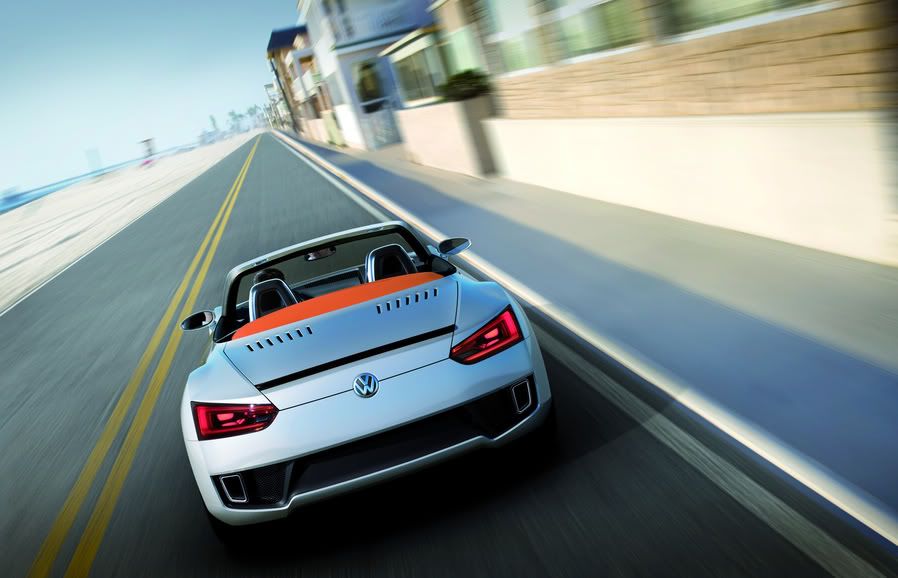
The rear end is distinctive at first glance. Lines emanating from the contour of the rear fender here frame a shoulder section that would be hard to imagine any greater dynamism or clarity. In the center, there is a large strip painted in car color, and in the upper section a narrow black line that separates the bumper from the engine or trunk hood. Prominent on this line, which also joins the taillights, is the VW logo. The shapes of the taillights themselves were intentionally designed to be similar to those of the headlights. Inside, the lights both have a C-shaped LED component that radiates far and extremely brightly into the night with each brake actuation. The third brake light was integrated in the rear trunk lid, above the VW logo.
In the lower section, a horizontal surface in black is the defining visual element; the tailpipes are located at its outer edges – right next to the contour of the fender lines. The end of the bumper – together with the lateral fender and wheel housing panels – forms a virtual surface painted in car color. At its center the bumper exhibits an area that is aerodynamically designed as a diffuser.
Side profile
On its sides, once again it is the circular-shape of the wheel housings and outer fender edges – typical of Volkswagen – that are part of the clear, precise, powerful and highly aesthetic line-work. In addition, the extremely short overhangs define the car’s side profile styling. Moreover, the ten-spoke alloy wheels with tires in the sizes 235/35 ZR19 (front) and 245/35 ZR19 (rear) – that completely fill out the large wheel housings – create a look that would otherwise only be offered in the realm of super sports cars.
Interior
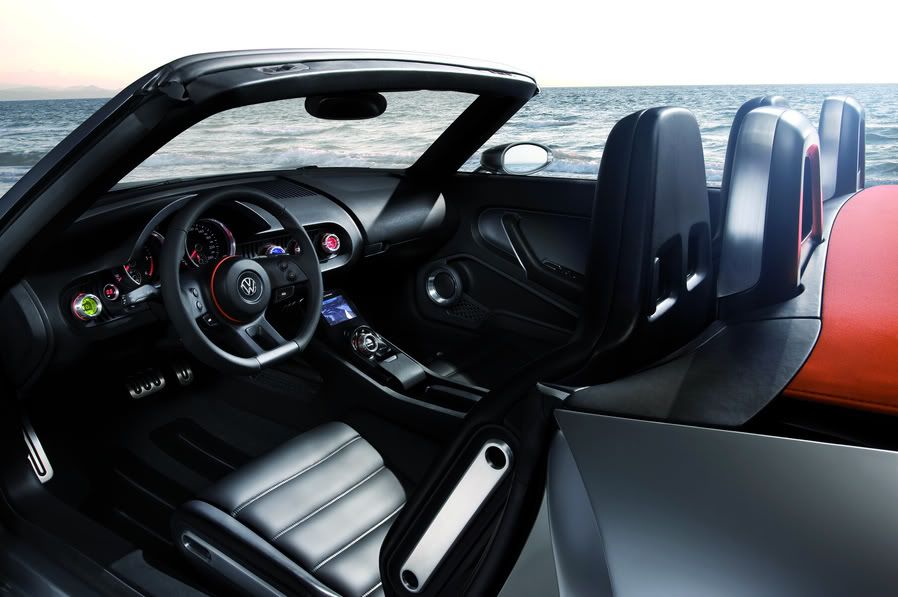
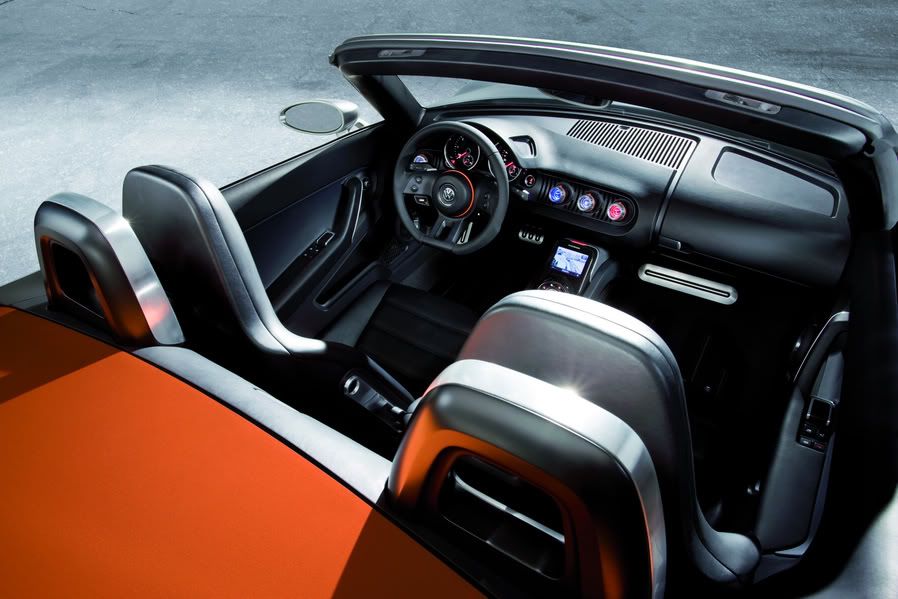
The interior of a sports car should fit as though it were tailor-made. Everything must be ideally set up to reach, operate, control, and must exhibit a high level of aesthetics. This is precisely what Volkswagen has done with the Concept BlueSport. Klaus Bischoff: "The interior shows finesse in details and conveys a high level of technological fascination. The special flair of the interior expresses itself in the architectonic purity of its components."
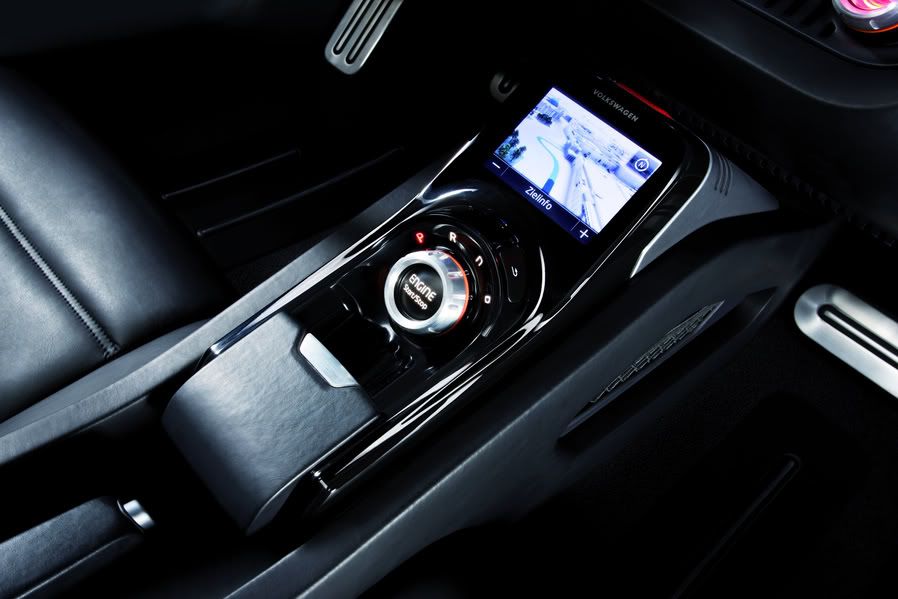
Climb in: Immediately eye-catching is the touchscreen – an intuitively operated human-machine interface in the style of its counterpart in the Volkswagen Up! concept car. It is located right at the imaginary transmission tunnel. All information and entertainment functions are controlled from the touchscreen. Right in front of it – on the level where a gearshift lever would be – there is now a multifunctional steering wheel that is used to intuitively operate the dual clutch transmission.
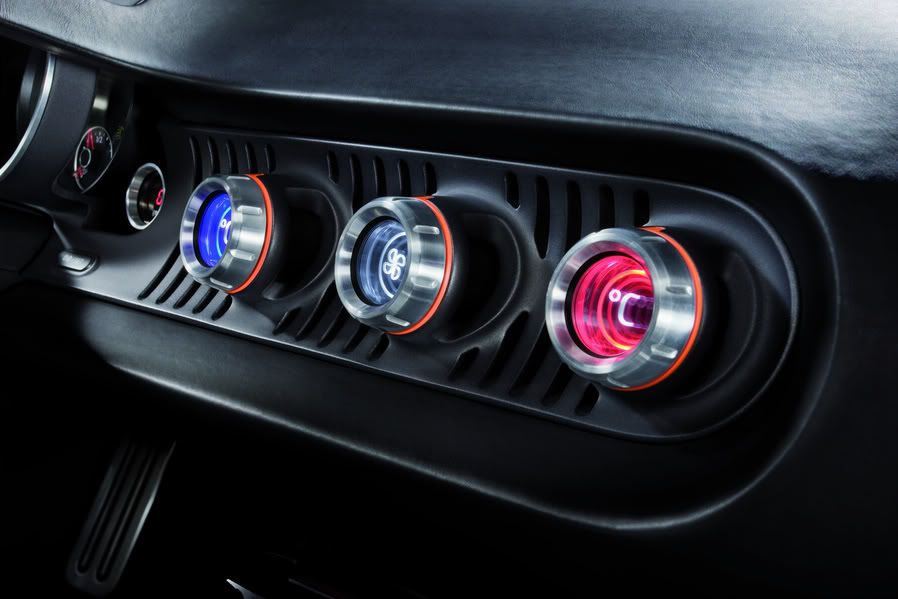
Above the touchscreen are the three large control dials for the dual-zone automatic climate control system. They are located on a cockpit section traversed by vertical slats. These slats simultaneously serve as both air vents and style features. When the control dials of the automatic climate control system are turned to the left, in the "colder" direction, the control unit’s display becomes increasingly more blue; when higher temperatures are set the display turns "reddish".
Visually similar to the climate controls is the light switch located to the left of the steering wheel. In terms of color, the orange of the convertible top is repeated in the basic illumination of the cockpit switches. The designers also redesigned the large round instruments and the multifunctional steering wheel. It is equipped with keys for controlling the audio system, telephone, on-board computer and dual clutch transmission (DSG).
Perfectly adapted to the interior are the lightweight, leather-upholstered sport seats with their one-piece seatbacks. Behind the integrated head restraints with embossed VW logo is the Concept BlueSport’s roll bar. Directly behind this is the opened convertible top; the soft top is actuated manually here. Thanks to a classic Z-fold and low top weight, this can be done in a matter of seconds – sometimes less is more.
Technical data of the Volkswagen Concept BlueSport
Body / Chassis
Length: 3,990 mm
Width: 1,745 mm
Height: 1,260 mm
Track, front: 1,490 mm
Track, rear: 1,520 mm
Front suspension: McPherson suspension
Rear suspension: Multi-link system
Engine
Configuration: 4 cylinder TDI, 2.0 liter displacement
Max. power at engine speed: 132 kW / 180 PS at 4,200 rpm
Max. torque at engine speed: 350 Nm at 1,750 rpm
Drivetrain / Wheels
Transmission: 6-speed direct shift
Final drive: Rear-wheel drive
Tyres, front: 235/35 ZR19
Tyres, rear: 245/35 ZR19
Performance / Economy
0-100 km/h: 6.6 seconds
0-60 mph: 6.2 seconds
V/max: 140 mph / 226 km/h
Fuel consumption: (Euro 6) 4.3 liter/100 km / 55 mpg
CO2 emissions* 113 g/km
* in Eco mode: Start-stop & regeneration
Colors
Exterior paint: Flex silver
Convertible top: Orange
Volkswagen at NAIAS 2009
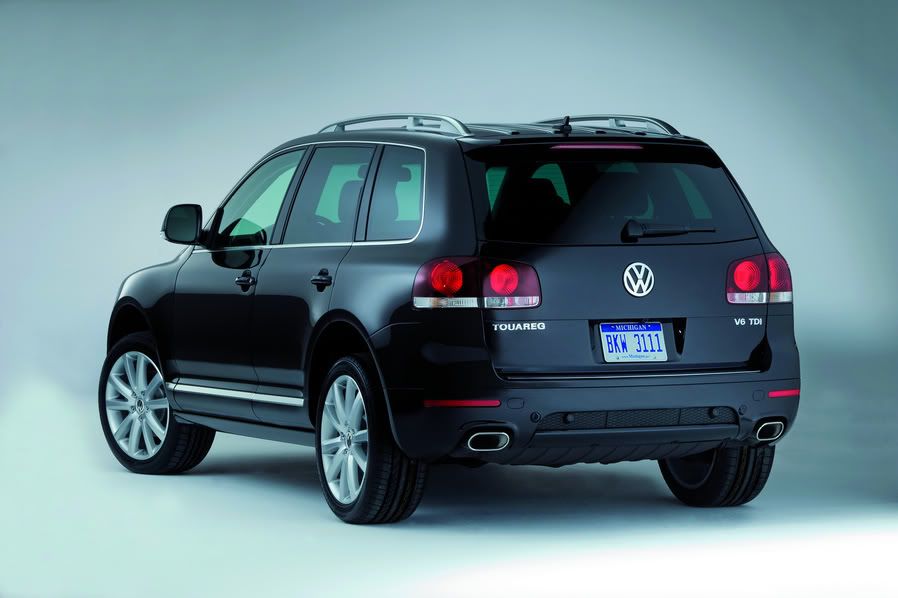
Touareg Lux Limited
-Touareg V6 TDI drastically reduces fuel costs with high-tech engine
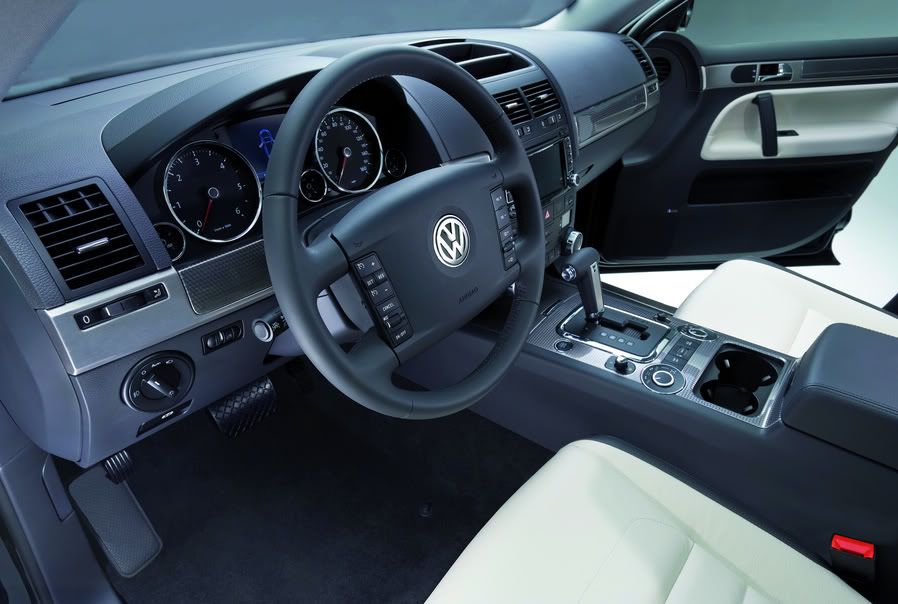
-Touareg “Lux Limited” has an exclusive interior and upgraded exterior
-Clean diesels from Volkswagen will be sold in all 50 states of the USA
-Jetta and Touareg take the lead in VW Diesel Offensive in the USA
Wolfsburg / Detroit, 11 January 2009 - Volkswagen is presenting an innovative lineup of extremely economical and low-emissions drive technologies at the North American International Auto Show in Detroit (NAIAS). Featured there from January 11 to 25 are the German carmaker’s Clean Diesel engines (TDI). Many experts consider these diesel engines to be the most advanced of our times. The reasons could not be clearer: high fuel efficiency and extremely low emissions combined with maximum performance. It is precisely this formula that has already won over millions of car drivers in Europe and a growing number of people in America.
It is in this context that Volkswagen is presenting the new Touareg V6 TDI in Detroit with its powerful 165 kW / 225 PS Clean Diesel. The high-tech engine is taking the stage with a city fuel economy of 18 mpg. On the highway it even attains 25 mpg. The Touareg V6 TDI is defining a completely new generation of extremely economical and low emissions SUVs. Since the Touareg V6 TDI is equipped with the most advanced catalytic converter system in the world, it impressively fulfills the BIN5 emissions standard, and with it the legal requirements of all fifty states in the USA. In parallel, the V6 TDI will satisfy the highest expectations in dynamic response and comfort: the turbocharged V6 TDI is just about as quiet as a gasoline engine, but it is far more powerful. Starting at a low 1,750 rpm – i.e. from the ‘cellar’ of engine speed – it already develops its empowering maximum torque of 550 Newton-meters.
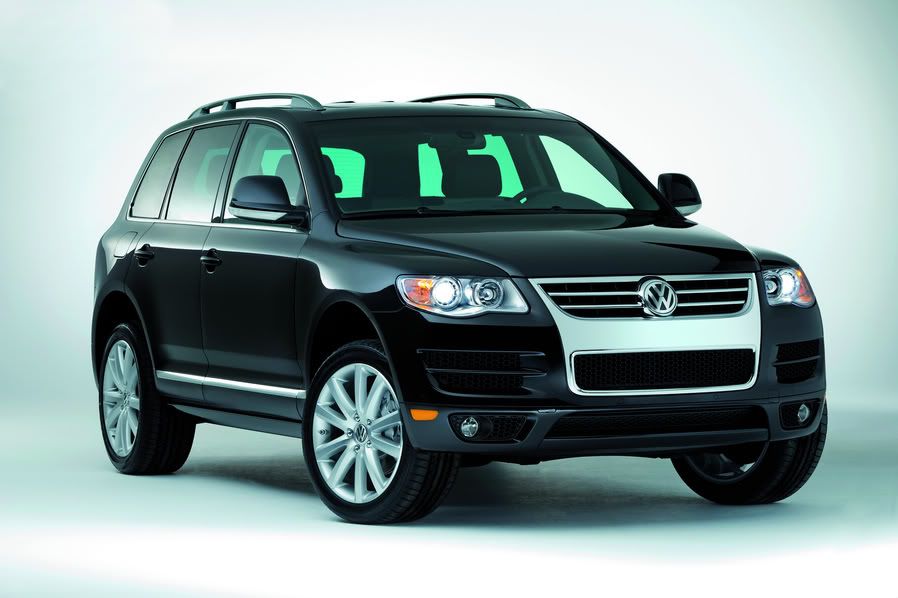
Right at the launch of the new Clean Diesel SUV, Volkswagen is also presenting a world premiere of the special "Lux Limited" edition of the Touareg. Identifying features: an upgraded exterior with exclusive 20-inch alloy wheels and two-tone leather interior designed especially for the Touareg "Lux Limited". The series – limited to 1,940 units – may be ordered with one of the Cricket leather color combinations "Latte Macchiato / St. Tropez White" or "Anthracite / St. Tropez White". Two gasoline engines (V6 FSI, V8 FSI) and the new V6 TDI (Clean Diesel) will be offered on the Touareg "Lux Limited".
Since August, the Jetta TDI and Jetta SportWagen TDI have been marketed as Clean Diesels in the USA. They too are taking the stage at the NAIAS 2009. Their 103 kW / 140 PS strong four-cylinder turbo-diesel is so fuel efficient (30 mpg city / 41 mpg highway / manual transmission) and clean that a 1,300 dollar tax credit is being offered on these models. That is because from the very first day they are driven, cars like the Jetta TDI make a contribution toward drastically reducing emissions. Compared to gasoline engines of similar power, the fuel efficiency of the Jetta TDI and Jetta SportWagen TDI is up to 35 percent better! That helps the environment. Immediately. All across America.
Friday, December 5, 2008
Bologna Motor Show 2008 - Scirocco Studie R – world premiere
From the Nürburgring race track to the street:
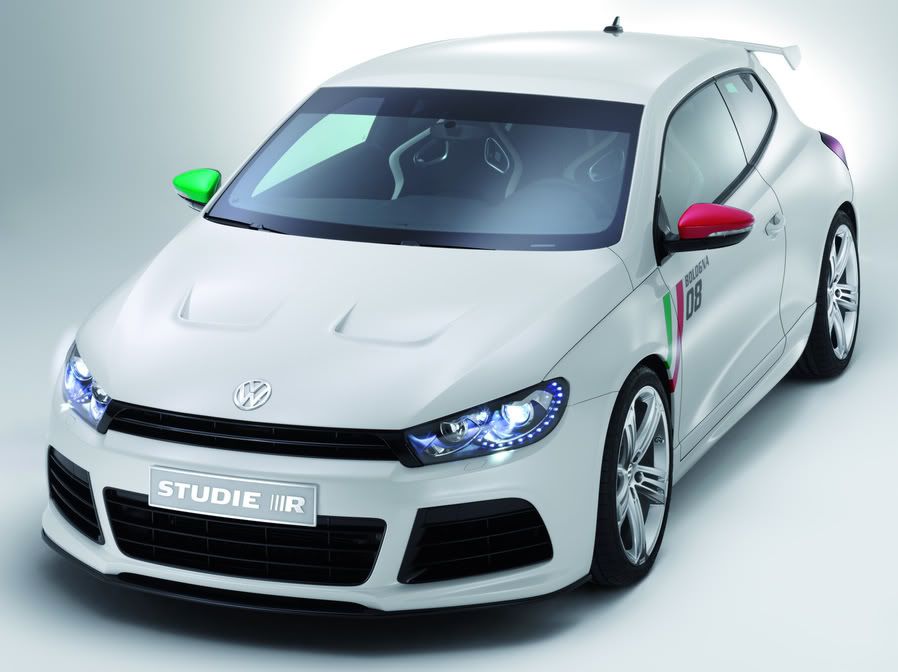
Volkswagen presents street version of the Scirocco GT24
Scirocco Studie R brings race car technology to the streetDesign of the Scirocco Studie R emulates endurance race car
Wolfsburg / Bologna, 03 December 2008
It was a triumphant drive: in May 2008, three Scirocco GT24 cars lined up at the start of the 24-hour endurance race on the Nürburgring track. At the wheel: driving legends the likes of Hans-Joachim Stuck and Carlos Sainz. The teams drove two 238 kW / 325 PS strong race cars to a dual victory at the finish line, first and second in their class. Now Volkswagen is presenting a street version of the race car at the Bologna Motor Show: the Scirocco Studie R. A genuine Grand Tourismo with a 198 kW / 270 PS engine that delivers aggressive propulsive power. This power is distributed by a 6-speed dual clutch transmission. Adapted directly from car racing are the coilovers, the four-piston brake calipers and a sound-optimized exhaust system with its oval, polished tailpipes.
Visually, in many respects the concept emulates the race car version. Take the front end, for example: here the design adheres to the motto “Form follows function”; it features three large air inlet openings that guarantee optimal cooling of the brakes and engine. The front splitter that was added minimizes aerodynamic lift of the front axle. Also adopted from the racing version is the engine hood with its auxiliary air vents.
The rear end is dominated by an integrated rear wing and distinctive diffuser in the lower section of the bumper. These two components reduce lift at the rear axle substantially. Despite the aerodynamic design derived from car racing, a clear stylistic resemblance to the production Scirocco was preserved. Identifying characteristics of its side profile are the new side skirts and polished 19-inch alloy wheels with five sets of triple spokes. The wheels were specially developed for the Scirocco Studie R.
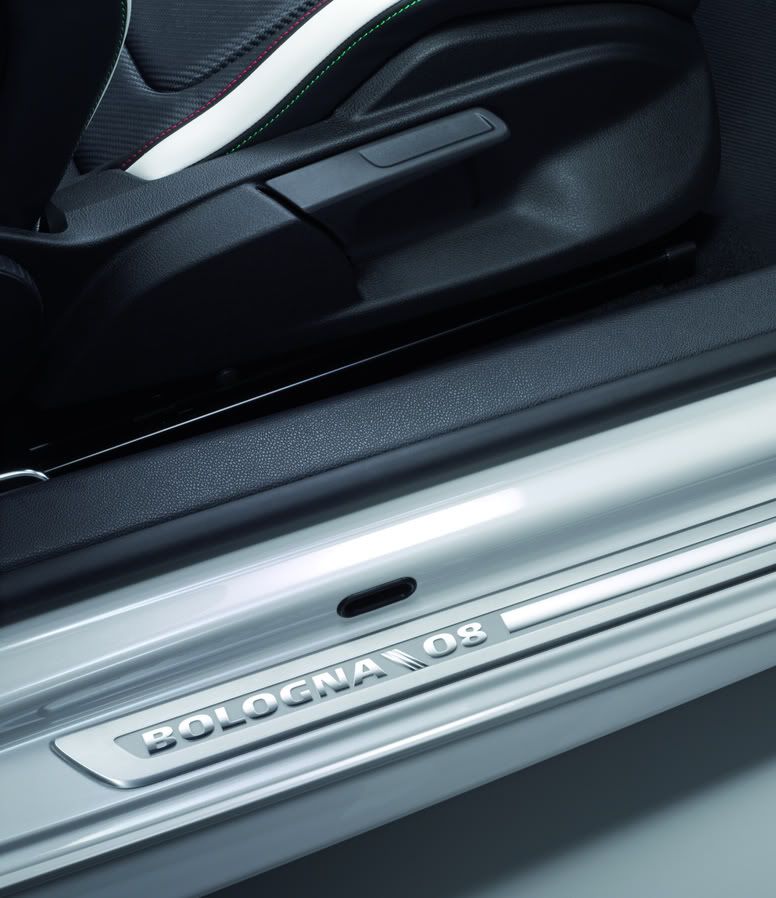
The radiator screen, diffuser and underside of the rear spoiler are treated in high-gloss black, and this provides a strong contrast to the white exterior paint. Supplemented by a “Bologna 08” badge, red and green stylistic elements on a white background create an Italian tricolor. The outside mirrors are also coordinated with this color scheme.
Interior
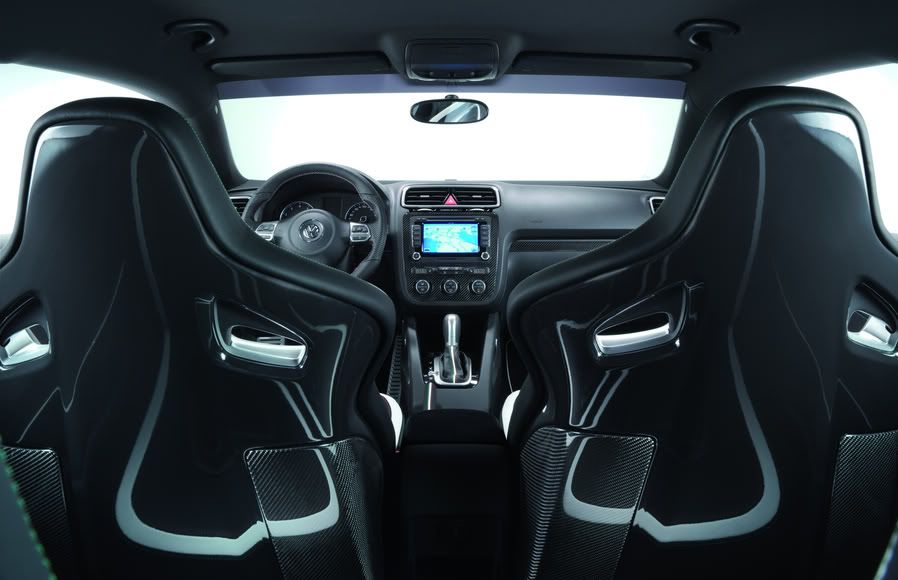
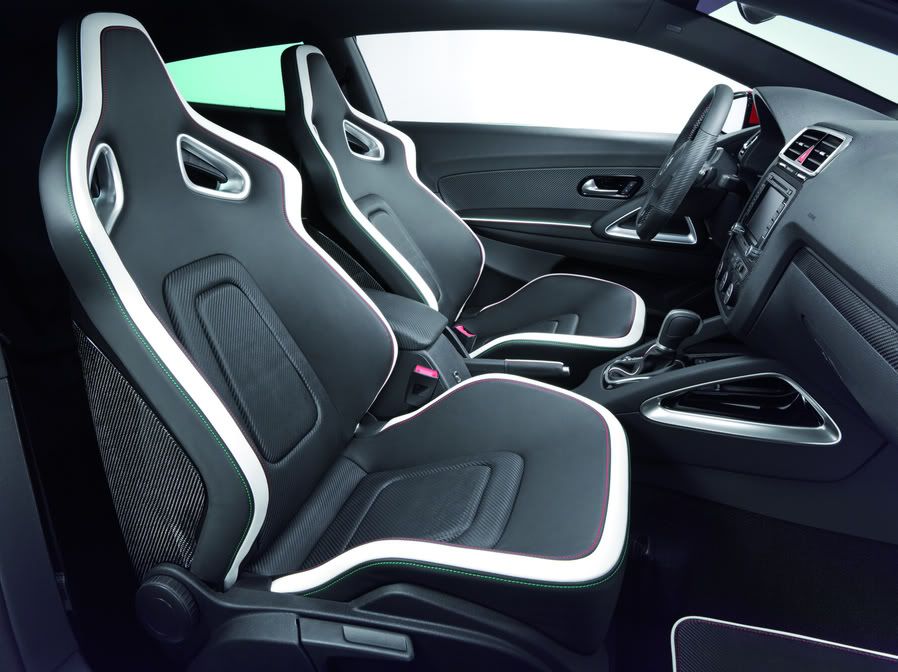
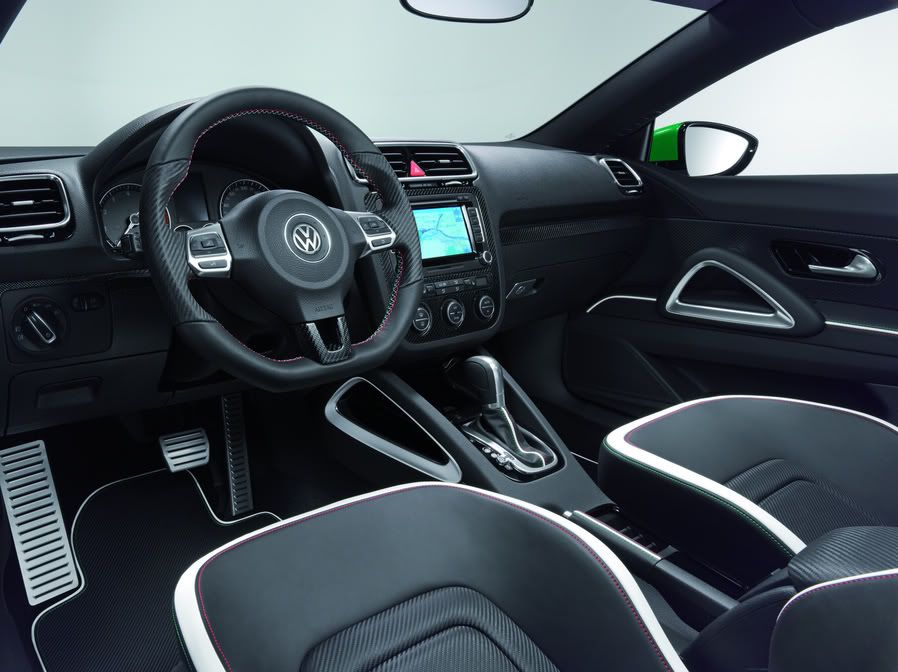
Italy’s national colors are also represented in the interior. White and black create the basic theme, similar to the exterior car color. The seams of the Recaro racing shell seats, steering wheel, front armrest, gearshift lever trim and floor mat edging are designed in the colors of the tricolor. Inside, nappa leather in “Deep black” and “Berry white” is applied to the uncompromisingly designed racing shell seat.
The shell seats are upholstered with a deep black leather in carbon look. An eye-catching feature here is the conspicuous yet refined contrast of low and high-gloss elements of the carbon structure. Interior accents also consist of genuine carbon composites. The footwell features aluminum pedals specially designed for this vehicle.
Volkswagen at the Essen Motor Show 2008 - Eos "White Night"
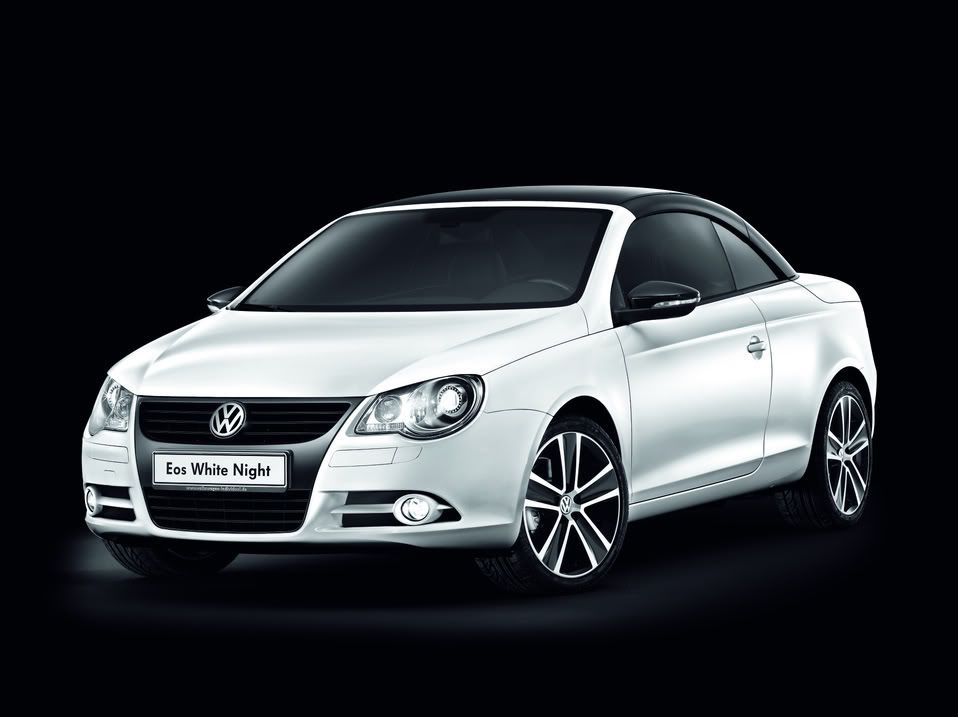
Eos "White Night"
Wolfsburg, 28 November 2008 – The 41st Essen Motor Show will open the gates today to the biggest German tuning Fair. Volkswagen presents itself with two exclusive models - in shiny white, with exclusive and high quality equipment details.
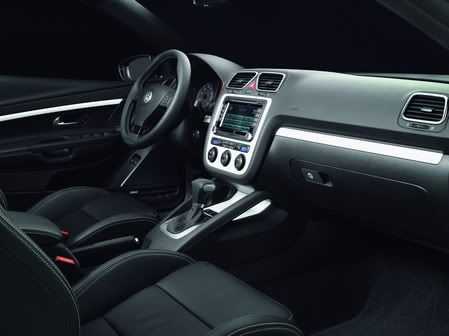
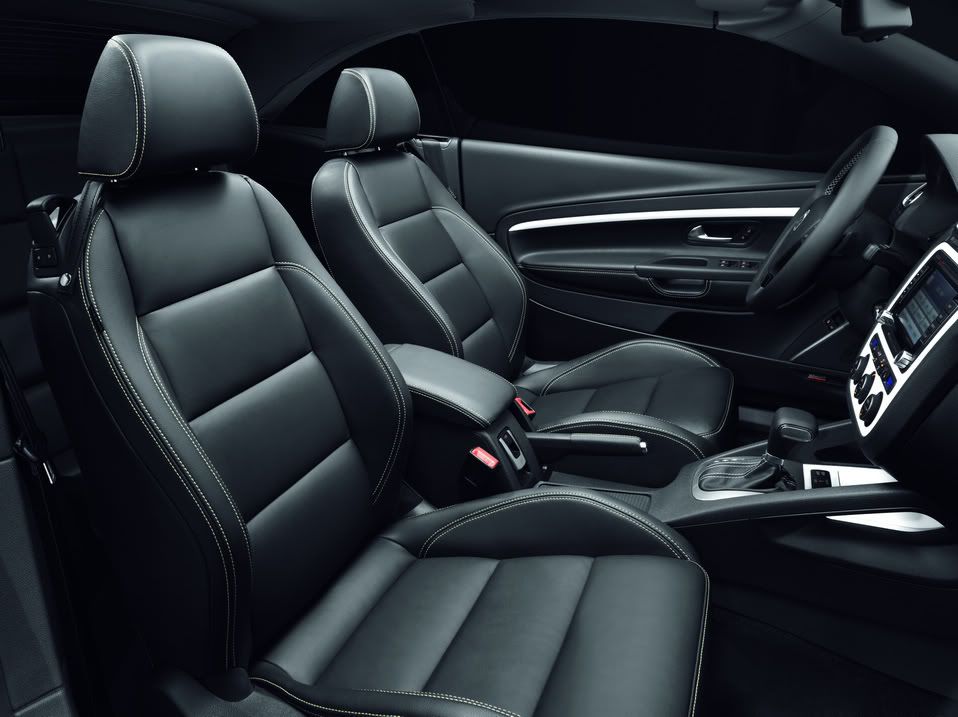
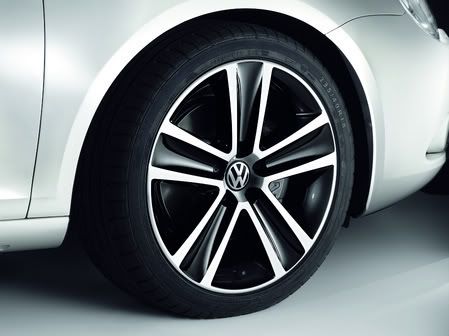
The study Eos "White Night" is the passion of the convertible fans awake. The Eos surprised with an elegant black-white contrast. This is the body in "Candy White" painted, the roof, the grille and mirror caps, are among other details in "Deep Black Pearleffect".
Also inside is the contrast continued: black Nappa leather with bright ornamental edgings meets moldings in "Campanella white". The study Eos "White Night" is a complete and equipped with a 3,2 l V6 184 kW (250 hp ) motor.
Wednesday, October 1, 2008
Paris 2008: World premiere of the second Passat BlueMotion generation
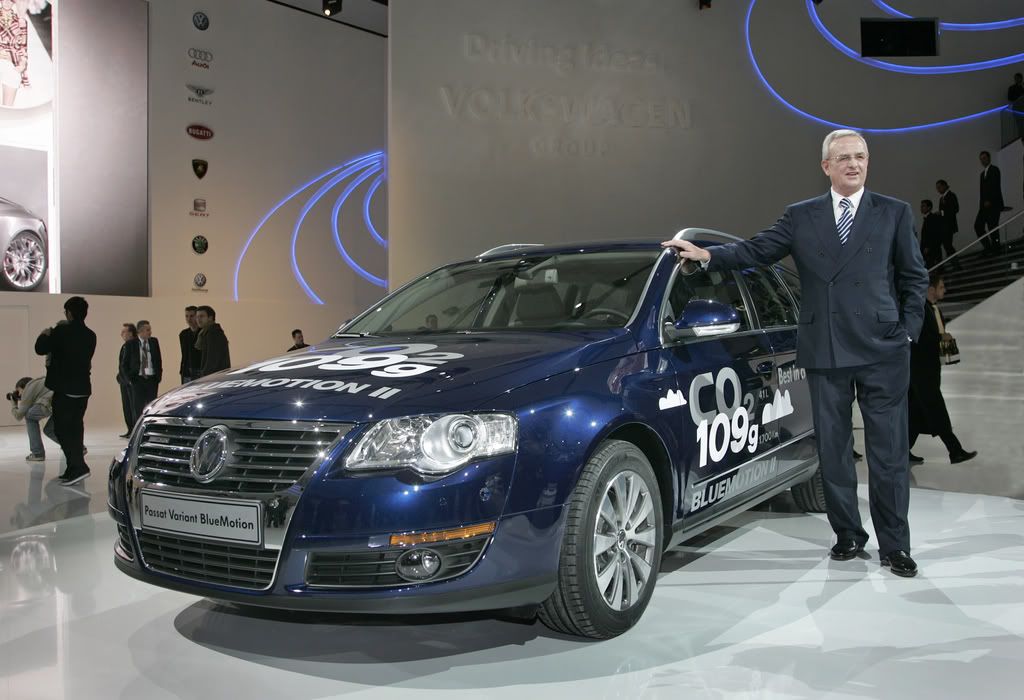
-New engine: 110 PS strong common rail TDI consumes just 4.9 Liter*
-Automatic Start/Stop: Engine automatically shuts down when car is stopped
Wolfsburg / Paris, 01 October 2008
BlueMotion is the Volkswagen label for the brand’s most economical cars. All BlueMotion models – from the Polo to the Passat – share this quality: their fuel-saving technology is absolutely affordable. The Passat is especially successful as a BlueMotion version. That is why Volkswagen is launching the second generation of BlueMotion technology on this model. The first Passat BlueMotion “2” cars will already arrive at dealers sometime this year. The new version of the Passat BlueMotion, once again offered as a sedan and Variant wagon, is powered by a highly advanced common rail turbo-diesel. It consumes just 4.9 liters* of fuel per 100 kilometers when powering the Passat BlueMotion sedan; accordingly, its CO2 emissions are also low at 128 g/km (* = Variant: 4.9 liters and 129 g/km).
New Automatic Start/Stop
Furthermore, an Automatic Start/Stop system is being used that is highly effective especially in city driving. Also new on board the most economical Passat of all times: low-friction propshafts, so-called super “rowi” tires (rollwiderstandsre¬duziert = reduced roll resistance) and very light wheels made of a light flow-forming steel. The material thickness of these wheels is less in certain areas to save on weight. The Blue¬Motion technology package can be ordered in combination with the four equipment variants Trendline, Comfortline, Highline and Sportline. Always included: the diesel particulate filter.
New 2.0 TDI consumes just 4.9 liters
The 2.0 liter displacement common rail TDI of the Passat BlueMotion develops a power of 81 kW / 110 PS (at 4,200 rpm) and replaces the 1.9 TDI with 77 kW / 105 PS. Its maximum torque of 250 Newton-meters is available from 1,500 rpm. Engine power is directed to a manual 5-speed transmission. Meanwhile, the proven gear recommendation was adopted; it is integrated in the standard multifunctional display.
Fuel consumption was successfully reduced by changing over to the new TDI and the Automatic Start/Stop system. It is now just 4.9 liters instead of 5.1 liters per 100 kilometers (sedan figures). Similarly, the low CO2 emissions of 136 g/km, already pioneering, were reduced to 129 g/km. The new Passat BlueMotion satisfies the Euro-5 emissions standard that takes effect in September 2009 and attains a top speed of 198 km/h (Variant 196 km/h).
Operation of Automatic Start/Stop is fully intuitive
Interesting is a look at the new Automatic Start/Stop system’s functionality. It is intuitive in operation and after just a few kilometers it becomes as natural a part of car driving as shifting or steering.
The driver drives to a red traffic light, brakes the Passat BlueMotion to a stop, shifts to neutral (ideally this is also done without the system) and takes the foot off the clutch. This causes the engine to be stopped momentarily. The message “Start Stop” now appears on the multifunctional display. As soon as the traffic light shows amber before green, the driver pushes the clutch, the engine starts, the “Start Stop” display goes out, and the drive continues. Essentially, the driver does not need to perform any extra operating steps compared to a conventional car, but in city driving Automatic Start/Stop can save up to 0,2 liters of fuel per 100 kilometers.
Paris 2008: BlueTDI – World premiere of the cleanest Passat of all times
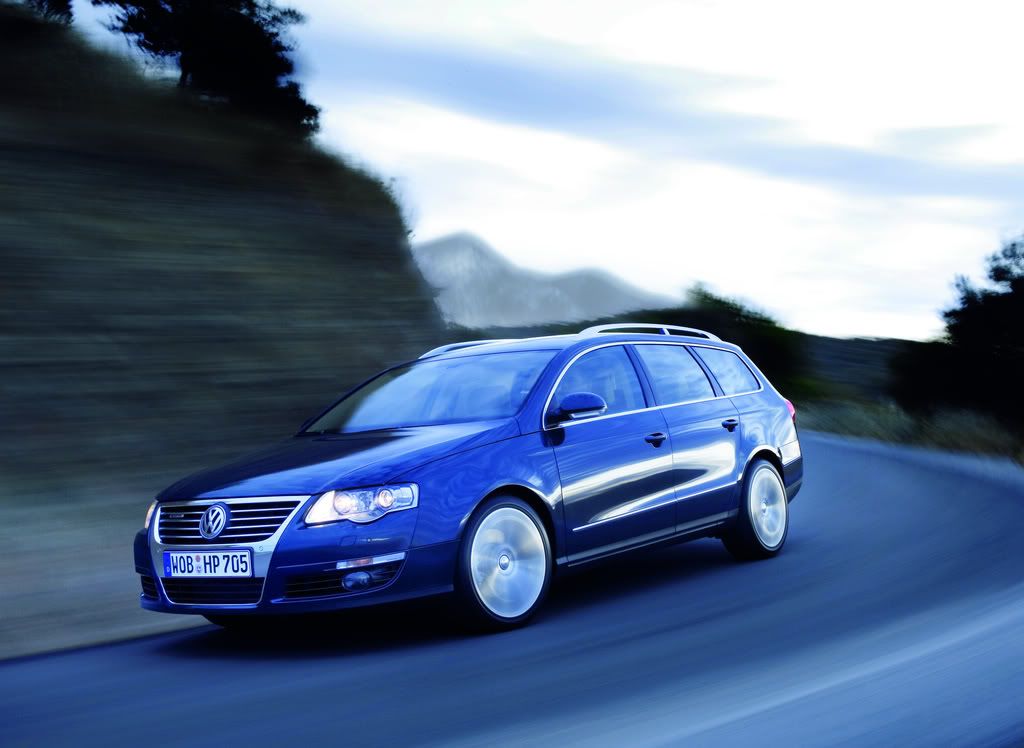
-Passat BlueMotion with SCR catalytic converter already fulfills Euro-6 standard
-143 PS strong Passat BlueTDI to arrive on market early in 2009
Wolfsburg / Paris, 01 October 2008
In a world premiere at the Paris Motor Show, Volkswagen is presenting the cleanest Passat of all times and with it a new engine label: BlueTDI. The Passat BlueTDI should already be launched in the first European markets in 2009, as a sedan and as a Variant. It is a harbinger of a whole series of innovative BlueTDI models to come. They fulfill the most stringent emissions standards in the USA (“BIN5”) and Europe (Euro-6 standard for the year 2014). They are Volkswagens that are once again doing great credit to the quality seal “Made in Germany”.
SCR catalytic converter and AdBlue are the keys to fulfilling the Euro-6 standard
In the case of the Passat Variant BlueTDI being shown in Paris, a highly complex SCR catalytic converter together with the additive AdBlue serve to significantly reduce nitrogen oxide emissions in the exhaust. The acronym SCR stands for “Selective Catalytic Reduction”, an internationally recognized term. “Selective” refers to the fact that this catalytic converter has a very special task: its purpose is to selectively convert nitrogen oxide (NOx) components of the exhaust stream to nitrogen and water without forming undesirable side products.
The SCR catalytic converter was developed precisely for this highly specialized task. However, the car will continue to have an oxidation catalytic converter and diesel particulate filter on board to reduce the full spectrum of emissions.
Technically, the BlueTDI of the Passat is based on the 103 kW / 140 PS strong 2.0 liter common rail engine. The BlueTDI, however, develops a power of 105 kW / 143 PS. Despite the slight performance gain, the Passat BlueTDI consumes up to 0.3 liter less than the conventional TDI, depending on the body version. In the case of the Passat Variant BlueTDI, fuel consumption is 5.5 liter per 100 kilometers (144 g/km CO2); for the sedan the value is 5.2 liter (137 g/km CO2). Power transmission is via a 6-speed manual transmission. As an option, after the production launch there will also be a Passat Blue TDI with 6-speed DSG (most efficient auto¬matic in the world). The Passat BlueTDI will essentially be offered in all familiar equipment versions.
BlueTDI – the technology in detail
The most important technical building blocks of the BlueTDI system are the SCR catalytic converter and the AdBlue additive for reducing nitrogen oxides. Conversion of the nitrogen oxides is accomplished using a synthetically produced, water-based urea solution: AdBlue. This substance consists of 32.5 percent urea and is continuously sprayed into the exhaust gas upstream of the SCR catalytic converter. It is stored in an auxiliary tank. It is metered according to the mass flow rate of the exhaust gas; engine management – informed by a NOx sensor downstream of the SCR catalytic converter –controls the process precisely.
Atomized into a fine vapor through a screen, the urea is converted in the hot exhaust gas upstream of the catalytic converter. In the SCR catalytic converter, it reacts with the nitrogen oxides and splits them – as mentioned – into nitrogen and water. The water-based AdBlue additive is nontoxic, odor-free and biodegradable. AdBlue consumption will be about 0.1 liter per 100 kilometers on average. Plans call for refilling as part of each regular service cycle.
Tuesday, September 23, 2008
Volkswagen Commercial Vehicles seeks continued growth with new products
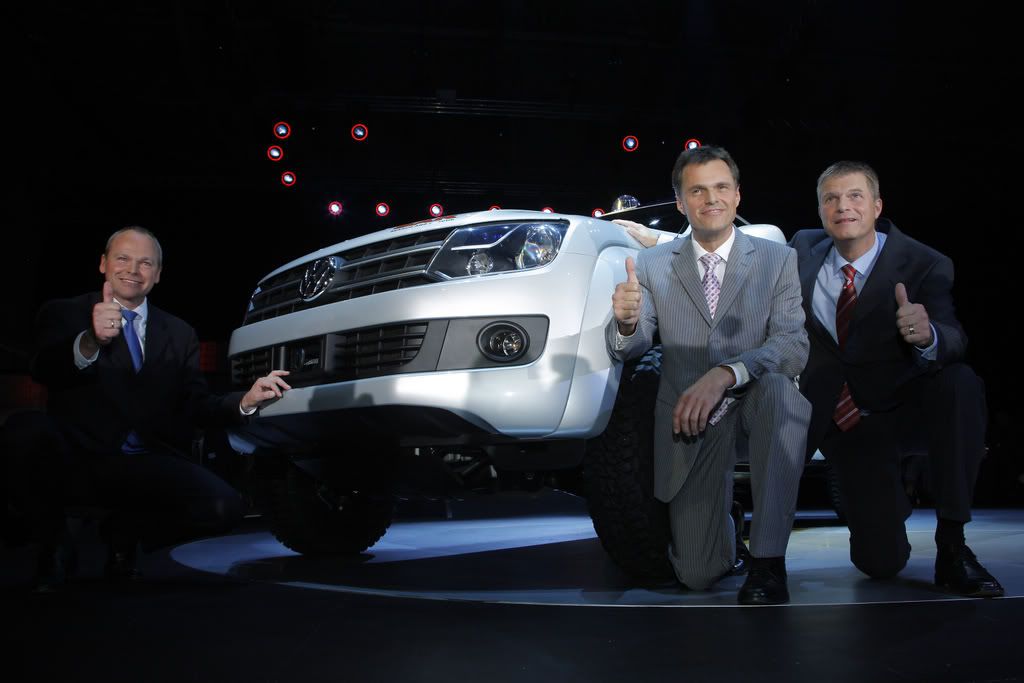
Pictured left to right of screen VWCV Board Members Stephan Schaller (CEO), Dr Wolfgang Schreiber (Product & Development) and Harold Schomburg (Sales & Marketing).
• Five world premieres at IAA Commercial Vehicles
• New series: Volkswagen Pickup show car
• Worldwide deliveries up 9.3 per cent to end of August
Hanover, 23rd September 2008. Volkswagen Commercial Vehicles is presenting five world premieres at IAA Commercial Vehicles, including a preview of the Volkswagen Pickup which will be launched as the fourth new series of light commercial vehicles towards the end of 2009. The Volkswagen Commercial Vehicles brand is on a growth track – deliveries to customers on a worldwide basis rose by 9.3 per cent to 343,100 light and heavy commercial vehicles by the end of August.
“New products, new markets, new technology – the Volkswagen Commercial Vehicles brand continues to experience sustainable and profitable growth”, emphasised Stephan Schaller, CEO of Volkswagen Commercial Vehicles at today’s press conference.
The brand intends to increase its worldwide deliveries of light commercial vehicles to 800,000 units by 2018. According to Schaller, this growth is to be achieved by introducing new products and by developing variants of the existing product range, some of which can be seen for the first time at IAA Commercial Vehicles.
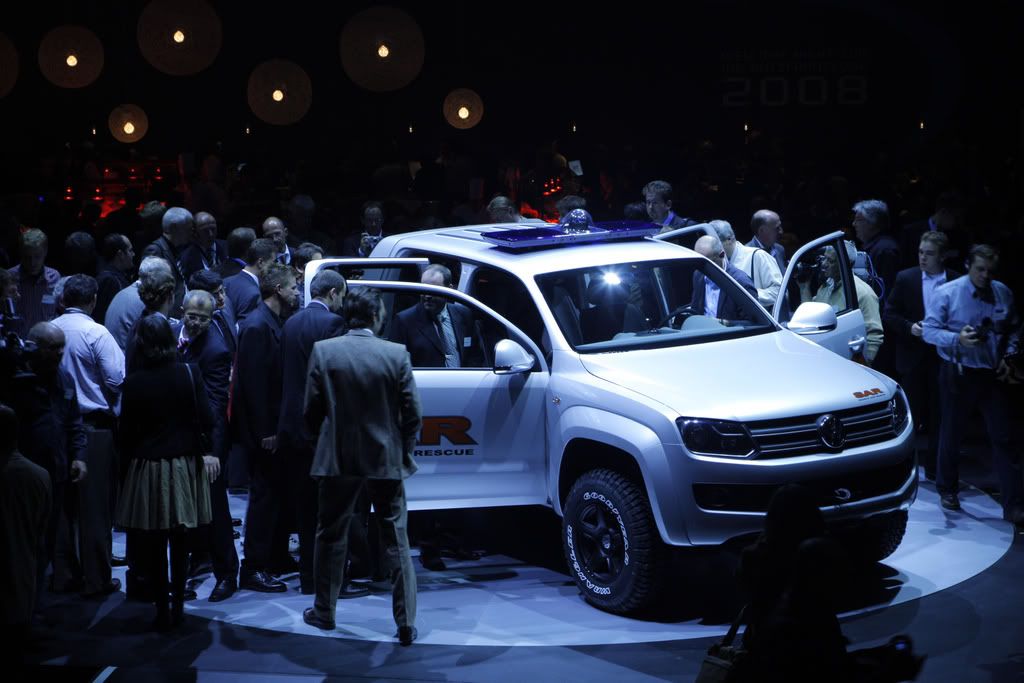
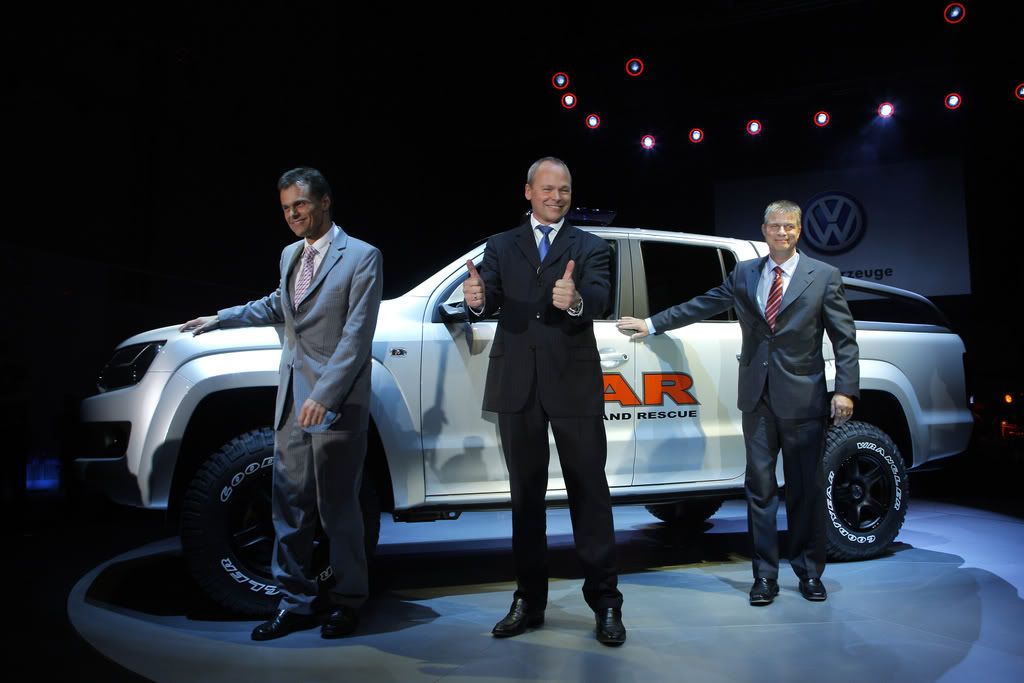
The most spectacular highlight of the trade fair from VWCV’s perspective is its first ever presentation of a Volkswagen Pickup show car. This adds a fourth series (in addition to Caddy, T5 and Crafter) to the brand's range of light commercial vehicles, which already boasts an extensive set of variants.
This means that Volkswagen Commercial Vehicles will be the first volume manufacturer in Europe to enter the 1-tonne Pickup segment, with its high growth global potential. According to Schaller, the key markets for the Volkswagen Pickup are the countries of South America – especially Brazil. He also sees South Africa, Australia and South East Asia as being important markets for this universally adaptable commercial vehicle. And the vehicle will also be introduced into the European market. Overall sales projections for the new Pickup amount to around 100,000 units per year.
Schaller was confident of achieving worldwide total deliveries of over 500,000 light and heavy commercial vehicles in 2008. He was optimistic of achieving this annual target, despite difficult economic conditions at the present time in certain European countries.
Schaller: “Markets are getting harder – but Volkswagen Commercial Vehicles will continue to grow this year.”
This is borne out by sales figures from the most significant markets.
• In Germany deliveries of vehicles in the Caddy, T5 and Crafter series grew by some 7.5 per cent between January and August – a total of approximately 79,800 vehicles.
• In Western Europe product delivery numbers grew by 3.2 per cent to 190,900 units.
• In the booming eastern European markets, deliveries rose by nearly 30 per cent to more than 32,900 light commercial vehicles. In Russia alone the brand sold 6,630 units, up 87 per cent.
• In South America deliveries of light and heavy commercial vehicles increased by around 25 per cent to 82,300 units.
The President of Volkswagen Trucks and Buses, Roberto Cortes, predicted that 2008 would see a new worldwide delivery record of 60,000 heavy commercial vehicles and buses. Volkswagen has been the market leader in Brazil for the last six years, and now has a market share of some 31.6 per cent.
In addition to the Volkswagen Pickup show car, the brand is presenting four other world premieres in Hall 12 at this year’s IAA Commercial Vehicles, taking place between 25th September and 2nd October.
• The Caddy 4MOTION opens another chapter in the success story of this series. With the sales launch planned perfectly for the start of winter, it will at last be possible to buy a delivery van with a permanent four-wheel drive option. In the Caddy 4MOTION, power is distributed via an electronically controlled latest generation Haldex gearbox.
• The Caddy PanAmericana Studie is a variant of the Caddy 4MOTION for globetrotters. With its 16 inch all-terrain wheels, off-road look and feel, not to mention its high-quality yet robust leather interior upholstery, the Caddy PanAmericana Studie turns heads.
• With the Caddy Life Style Edition, Volkswagen Commercial Vehicles is presenting the most exclusive series Caddy of all time – a top-of-the-range Caddy variant due to be launched in November 2008.
• Another world premiere is the Crafter BlueMotion Studie. This 3.5-tonne diesel estate has a fuel economy rate of 31.04 mpg and already complies with the Euro 5 emission standard due to come into force in autumn 2009.
As Schaller said, with the Volkswagen Pickup, with the world premieres and also with other models adapted to meet the needs of global growth markets, Volkswagen Commercial Vehicles is well positioned to continue along the track of profitable growth.
Subscribe to:
Posts (Atom)


