Showing posts with label Golf Plus. Show all posts

Friday, March 27, 2009

AMI Leipzig 2009: World Premiere Golf Plus BiFuel


Low-emissions Golf Plus BiFuel offers significant cost advantages
New Golf Plus BiFuel is safer and more durable than aftermarket solutions


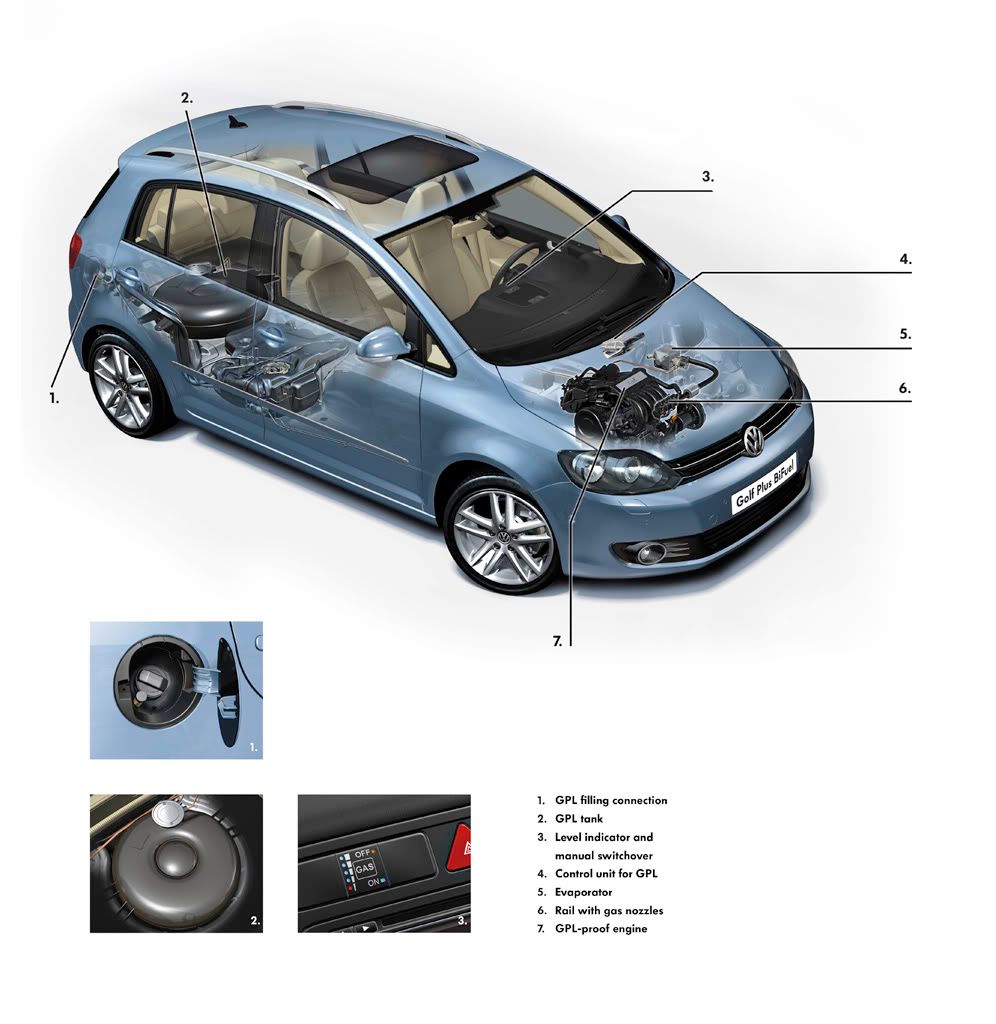
Wolfsburg / Leipzig, March 2009. In a world premiere at the Auto Mobil International in Leipzig, Volkswagen is presenting the new Autogas (LPG) version of the Golf Plus. Its bivalent drive – it is easy to switch over to gasoline driving – reduces costs and emissions. When the Golf Plus BiFuel is powered by LPG (Liquefied Petroleum
Gas), its environmen tal balance sheet shows a greater than 10 percent reduction in CO2 emissions when matched up with a comparable gasoline engine.

Safer and more durable than aftermarket solutions
The system being presented in the Golf Plus BiFuel offers significant advantages compared to aftermarket Autogas systems. For one, unlike aftermarket solutions the car has been crash tested together with allof its fuel tanks – so it is safer. Second, the engine was specificallydesigned for LPG operation and is more durable than engines originally developed for just gasoline. The long-term quality of the Golf BiFuel has been verified in extensive durability testing. A full warranty and
access to the large Volkswagen service network are pluses too. All of this is being offered at the same price as an aftermarket retrofit. In Autogas mode, the Golf Plus BiFuel’s 1.6 liter four-cylinder engine outputs a power of 72 kW / 98 PS and consumes an average of 9.8 liters of LPG per 100 kilometers (159 g/km CO2). In gasoline mode, the Golf Plus BiFuel consumes a still economical 7.5 liters Super per 100 kilometers (179 g/km CO2).

1,100 kilometer range
In addition, the Autogas tank (43 liter effective volume at storage pressure of 8 to 10 bar) – with its space-saving installation in the spare wheel recess – and the gasoline tank (55 liter) together propel the car to a theoretical range of greater than 1,100 kilometers. In pure LPG mode, the car’s range is about 440 kilometers. The network of LPG filling stations is tightly interwoven across Europe; in Germany alone there are over 4,700 filling stations. Incidentally, the filling tube for the
LPG is easy to access right next to the familiar location of its gasoline counterpart.

Tuesday, March 3, 2009

Geneva 2009: Golf Plus BlueMotion


Golf Plus BlueMotion consumes 0.5 liter less than the prior model

Most fuel efficient Golf Plus will already launch on the market in September
Range of well over 1,100 kilometers on just one tank of fuel

Wolfsburg / Geneva, 03 March 2009

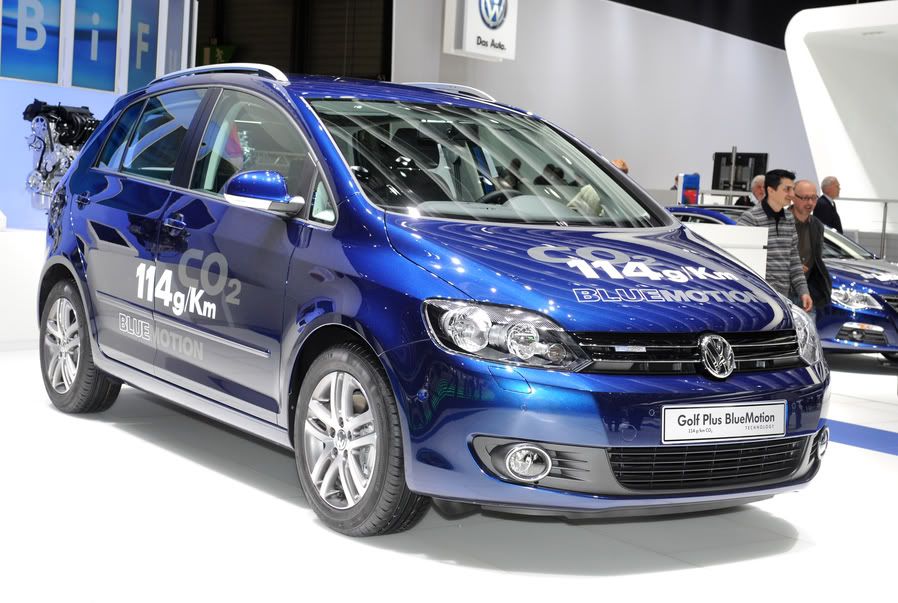
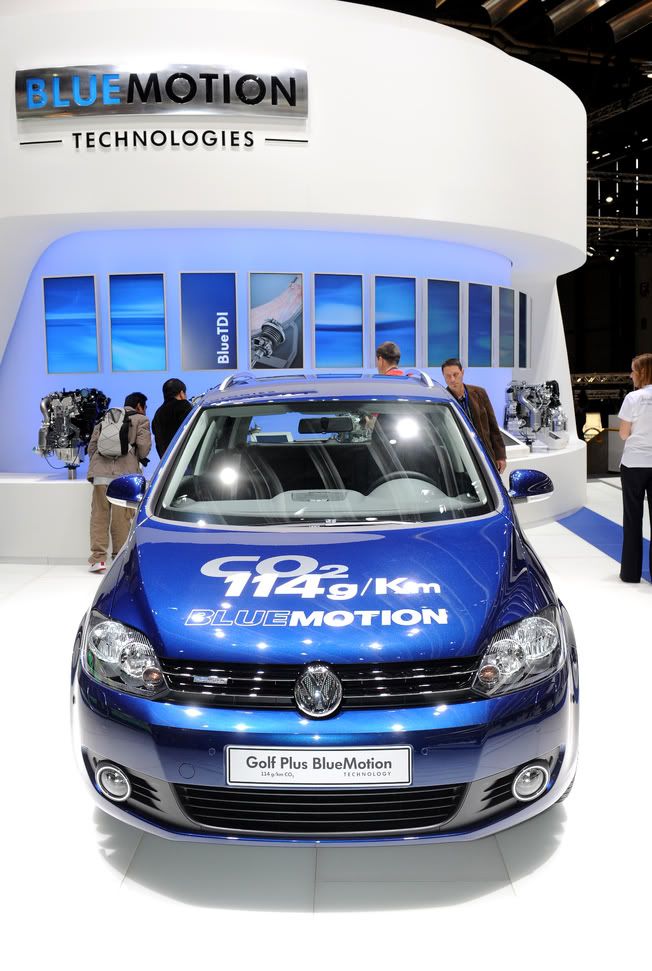
Volkswagen will be bringing the new generation of the Golf Plus BlueMotion to European markets in September. Compared to its already extremely fuel efficient and low-emissions predecessor (4.8 liters per 100 km and 127 g/km CO2), the new model successfully improves fuel economy and emissions even more. And indeed to 4.3 liters diesel and 114 g/km CO2 – the new benchmark in the segment of high-roofed compacts. This progress was made possible by the second generation of a completely new engine that also appears in the Golf BlueMotion making a parallel debut in Geneva: the 1.6 TDI with common rail injection.

Especially in city traffic, an automatic start-stop system ensures that fuel consumption is kept in check. Also new aboard the new Golf Plus BlueMotion is regenerative braking – where energy is recovered during braking and deceleration. This reduces engine load during acceleration, since less power is required by the alternator – which can even be turned off completely – thereby saving fuel.

Not only is the new Golf Plus BlueMotion economical; it is fun too. A key performance parameter here is the excellent torque curve. The new 1.6 TDI develops a maximum torque of 250 Newton-meter at a low 1,500 rpm. Fuel delivery is handled by common rail injection. Four injectors spray the fuel directly into the combustion chambers at a maximum pressure of 1,600 bar. A very precise multi-injection system has a noticeably beneficial effect on emissions and combustion noise.

Other details of the 186 km/h Golf Plus BlueMotion include rpm-reducing gear ratios in its 5-speed transmission. Like the other BlueMotion versions in the Golf range, the primary visual features on the exterior of this latest and most economical Golf Plus are the new logos at the front and rear and a lowering of the ride height by 15 millimeters. Other modifications, such as a partially closed-off radiator grille and a special aerodynamic airflow panel at the rear axle remain hidden from view. Nonetheless, their aerodynamic effects make themselves felt: the drag coefficient of this model, optimized for fuel consumption, has been reduced to cW = 0.298, a top value in this vehicle class. The BlueMotion package for the Golf Plus is completed by tires with low rolling resistance.

The new Golf Plus embodies visual references to the classic design style of the sixth Golf generation. This is especially apparent at the front end. The rear bumper and roof rails were also redesigned. New steel and alloy wheels of various sizes complete the package of exterior visual modifications. Inside, details like new upholstery fabrics and other features introduced on the new Golf Plus also distinguish the new Golf Plus BlueMotion. These include its instruments, steering wheel and controls for the automatic climate control system (Climatronic).


Text Volkswagen
Images United Pictures

Monday, February 2, 2009

To the Point: BlueMotionTechnologies

A new umbrella brand for the world of efficiency

Wolfsburg, 02 February 2009 - Passat BlueMotion – new 110-PS TDI consumes just 4.9 liters

-Passat BlueTDI – new 143-PS TDI with SCR catalytic converter attains limits of Euro-6 standard

-Passat TSI EcoFuel – first car with direct-injection natural gas engine

-Touareg Hybrid – new V6 TSI and E-motor drive consumption below 9 liters


In the first part of this year, Volkswagen will simultaneously launch three extremely fuel-efficient Passat versions with low emissions to the market: the second generation of the Passat BlueMotion, the Passat BlueTDI and the Passat TSI EcoFuel. Each of these new Passats represents an individual solution tailored to meet the challenges of our times. Volkswagen is presenting all three Passats under a new umbrella brand: BlueMotionTechnologies. This label covers all production-mature or near-production technologies and products that significantly reduce fuel consumption and CO2 emissions.

BlueMotionTechnologies These are developments such as the new start-stop system, regenerative braking and the highly innovative SCR catalytic converter and the NOx storage catalytic converter already implemented successfully in the USA electric drive and hybrid systems. Also included are the innovative drive systems of the new TSI EcoFuel. These technologies are proof that Volkswagen is once again leading the way with innovative, efficient and cost effective solutions for the future. Recent beginnings of this process can be seen in the Polo BlueMotion, which in 2006 was the first five-seater to reduce fuel consumption below 4.0 liters per 100 kilometers.

The extent of today’s BlueMotion range currently extends from this Polo to the Golf, Jetta, Caddy, Touran, Sharan, and up to the new Passat BlueMotion. A recent survey by the organization "Deutsche Automobil Treuhand DAT", the renowned and world’s oldest institution for automotive market research, demonstrates just how successful the BlueMotion label has become today. In a representative survey, the esteemed DAT found that 85 percent of German car drivers are familiar with the BlueMotion label. The next best competitor only attained a recognition level of 36 percent. This makes BlueMotion the number 1 among automotive environmental labels in Germany.

The term BlueMotionTechnologies does not define a fixed set of technologies but a range of continually evolving, innovative solutions. Under the same label, Volkswagen is offering an initial look at the prototype of the new Touareg Hybrid. The powertrain technology implemented here will go into production with the next generation Touareg. Average fuel consumption: less than 9.0 liters per 100 kilometers. CO2 emissions: less than 210 g/km. The countdown has already started for this car.

Representative of just how innovative BlueMotionTechnologies are in the 2009 product lineup, is the current Passat – a mid-class model that has long claimed a position as the most fuel efficient, cleanest and most economical car in its class.

Take the Passat BlueMotion, for example: Here a new common rail TDI (81 kW / 110 PS) delivers pioneering 4.9 liter average fuel consumption and CO2 emissions of just 128 g/km (Wagon: 129 g/km). The Passat BlueMotion has a start-stop system as standard equipment and attains the limits of the Euro-5 emissions standard that takes effect in September. Its range of over 1,400 kilometers on one tank of fuel is a sensation as well – travelers starting out in Berlin will not be looking for a gas station until shortly before Rome! This car is already being sold.

Consider the Passat BlueTDI. This diesel is far ahead of its time: it will be the first TDI launched by Volkswagen to attain the limits of the Euro-6 emissions standard that does not become law until 2014. Aboard the Passat BlueTDI, a so-called SCR catalytic converter reduces nitrogen oxides to a level below 80 mg/km. Production of the 105 kW / 143 PS Passat BlueTDI will ramp up at the beginning of March. Fuel consumption of the sedan with standard 6-speed transmission: 5.2 liters per 100 kilometers. This yields CO2 emissions of 137 g/km (Wagon: 5.5 liters per 100 kilometers / 144 g/km CO2). As an option, the Passat BlueTDI is available with a 6-speed DSG. The Passat BlueTDI is positioned above the Passat BlueMotion due to its greater power and more sophisticated emissions control system.

Take the example of the Passat TSI EcoFuel: The TSI EcoFuel, boosted by supercharger and turbocharger, revolutionizes the world of cars powered by natural gas. Never before has there been a natural gas vehicle with this kind of dynamic performance that is so fuel efficient and clean. The Passat TSI EcoFuel breaks the 120 gram CO2 barrier. In natural gas mode its driver pays less than 4.25 Euros* per 100 kilometers; and its engine – with 110 kW / 150 PS – delivers precisely the type of performance one would want in a highly comfortable travel car like the Passat.

Touareg V6 TSI Hybrid in detail – prototype with near-production technology
The Touareg Hybrid prototype being demonstrated incorporates many features of the production vehicle of tomorrow. The car is powered by a new V6 TSI – a highly advanced configuration of a direct injection gasoline engine boosted by a mechanically-driven supercharger – in tandem with an electric motor. It features a newly developed 8-speed automatic transmission. Volkswagen is implementing a parallel hybrid drive on the future Touareg V6 TSI Hybrid. The SUV is able to offer a state-of-the-art all-wheel drive system and up to 3.5 metric tons towing capacity in this version too.

The V6 TSI on the Touareg is clearly happy at high revs and exhibits agile response. It delivers 245 kW / 333 PS. This places the TSI at the same power level as an eight cylinder engine, yet it is considerably more fuel efficient. When used in the hybrid drive, fuel consumption of less than 9.0 liters of fuel per 100 kilometers is attained. The electric motor installed between the V6 TSI and the 8-speed automatic transmission delivers a maximum power of 38 kW / 52 PS. In boosting mode – where maximum torque and power are required, the V6 TSI engine and the electric motor operate together (by kickdown or gearshift selector in "S" position). Under these conditions, a temporary maximum power of 275 kW / 374 PS is available with a maximum torque of 550 Newton-meter. However, it should be stated that the system is primarily designed for excellent fuel consumptions and emissions and that the availability of temporary high performance is just a welcome side benefit.

Passat BlueMotion in detail – the most fuel efficient Passat of all times
BlueMotion is the Volkswagen label for the most fuel efficient cars of the brand. The BlueMotion version of the large Passat is especially successful. That is why Volkswagen is launching its second generation of BlueMotion cars with this model. Dealers are already making first deliveries of the new Passat BlueMotion. This Volkswagen – offered as a sedan or wagon – is now powered by a new highly advanced version of the common rail turbo-diesel with 81 kW / 110 PS. Aboard the Passat BlueMotion, as mentioned, the engine consumes only 4.9 liters fuel per 100 kilometers; accordingly, its CO2 emissions are also low at 128 g/km (Wagon: 129 g/km).

In addition, a start-stop system is being implemented that is highly effective, especially in city driving. Also new in the technology package of the most fuel efficient Passat of all times: longer gear ratios, low-friction drive shafts, super reduced rolling resistance tires and extra lightweight wheels made of flow-formed steel. The material thickness of these wheels is lower in certain sections to save on weight. The BlueMotion package can be ordered in combination with one of the four equipment variants Trendline, Comfortline, Highline or Sportline. Always included: the particulate filter.

Passat BlueTDI in detail – the cleanest Passat TDI of all times
In just a few weeks, the Passat BlueTDI will be launched on initial European markets, serving as a frontrunner for an entirely new series of pioneering BlueTDI models. This new model already attains the limits of the Euro-6 emission standard that does not take effect until the year 2014.

A highly sophisticated SCR catalytic converter – together with the additive AdBlue – ensures significant reduction of nitrogen oxides in the exhaust gases. The acronym SCR stands for "Selective Catalytic Reduction". "Selective" refers to the fact that this catalytic converter selectively converts nitrogen oxide (NOx) components in the exhaust into nitrogen and water without forming undesirable by-products. This makes the Passat BlueTDI the most environmentally-friendly diesel production car in the world.

Technically speaking, the Passat BlueTDI is based on the 103 kW / 140 PS, 2.0 liter common rail engine. However, the BlueTDI develops 105 kW / 143 PS and despite the slight increase in power, it consumes up to 0.4 liter less than the conventional TDI, depending on body version. On the Passat Wagon BlueTDI, fuel consumption is 5.5 liters per 100 kilometers (144 g/km CO2); on the sedan it is 5.2 liters (137 g/km CO2).

Passat TSI EcoFuel in detail – the most dynamic natural gas car of all times
The Passat TSI EcoFuel is ushering in a new era of cars powered by natural gas. Until now, one of the drawbacks of cars powered by natural gas – a fuel that is as environmentally-friendly as it is economical – has been that performance can be rather unexciting. Thanks to its advanced, 110 kW / 150 PS engine, the Passat TSI EcoFuel combines a maximum speed of 210 km/h with excellent fuel consumption and finally puts an end to the myth that natural gas cars are slow.. The natural gas powered Passat accelerates to 100 km/h in just 9.7 seconds.

Despite its great agility, the world’s first turbocharged and supercharged direct-injection engine configured for natural gas operation in the Passat, and equipped with a 7-speed dual clutch transmission (DSG) it requires just 4.4 kilograms (!) of natural gas per 100 kilometers (cost point: just 4.25 Euros* / 100 km). At 119 g/km CO2, the Passat breaks the 120 g/km CO2 barrier. Market launch for both the Passat and Passat Wagon TSI EcoFuel is already scheduled for the first part of 2009.

Friday, December 5, 2008

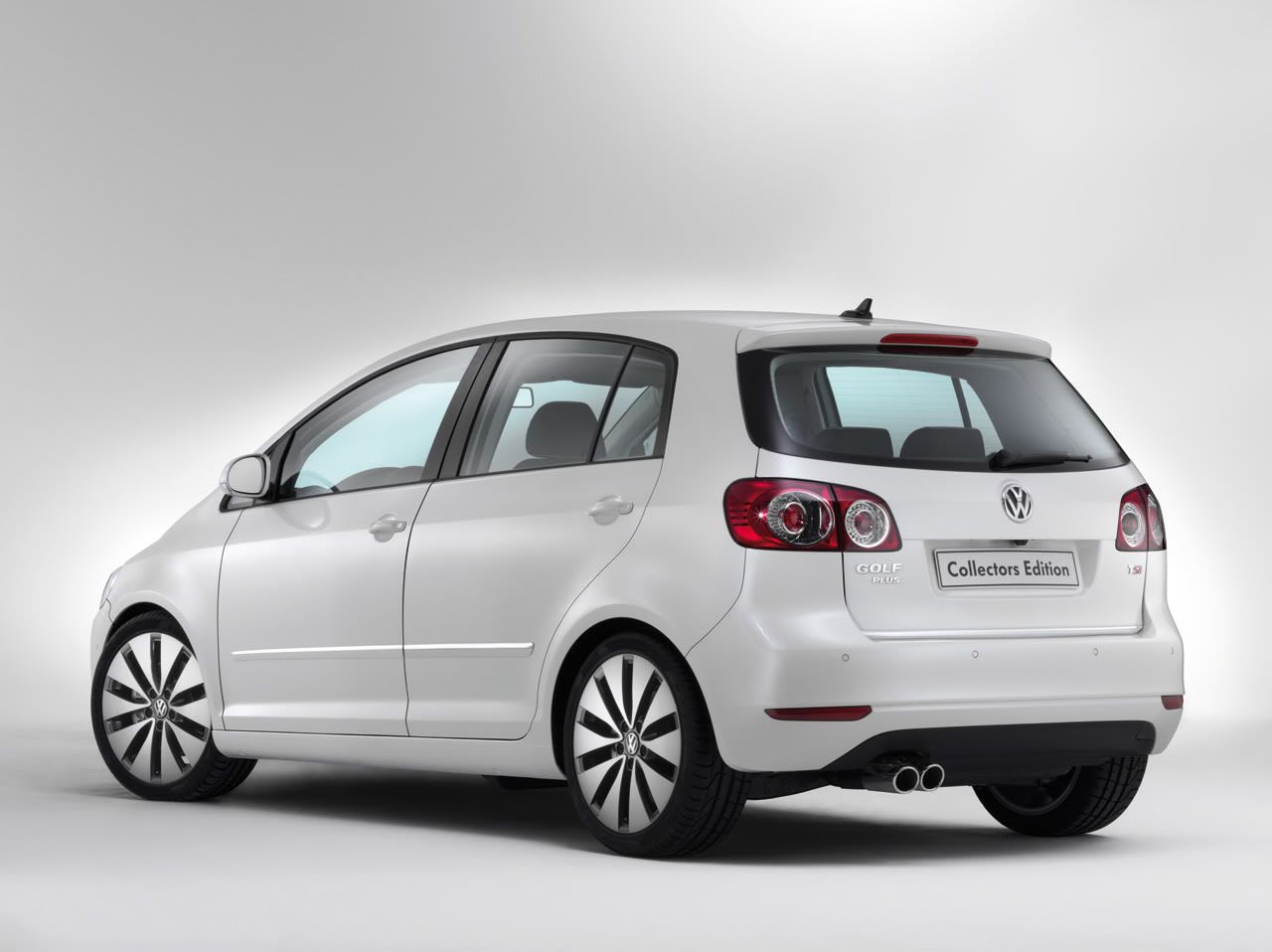
Bologna Motor Show 2008 - Golf Plus / Golf Plus Collectors Edition


World premiere of the new Golf Plus: All-around Golf updated – visually and technically

New design of the Golf Plus will launch in early 2009

New common rail engines reduce fuel consumption by up to 0.8 liter


Wolfsburg / Bologna, 03 December 2008
Within just three and a half years, the Golf Plus has made a name for itself as an established product in the Golf lineup. Its brand identity: clever like a van, compact like a Golf. Over this time period, more than 500,000 car drivers across Europe chose a plus in interior and seat heights, a plus in variability, and finally a plus in comfort. This is now being followed up by a Golf Plus that has been improved in many aspects. Volkswagen is presenting it as a world premiere at the Bologna Motor Show (December 03 to 14). European-wide market launch of the new generation Golf Plus will already take place in March 2009.

Visually, the new “Plus” forges a link to the classic body style of the just introduced sixth Golf generation. This is especially apparent at the front end. Also redesigned are the rear bumper and the roof rails. New steel and alloy wheels in a variety of sizes round out the exterior package of visual modifications. Inside, the further improved Golf Plus sports details like new upholstery materials and details also implemented in the Golf such as its instruments, steering wheel options and user interface for the automatic climate control system (Climatronic).

Technically, the Golf Plus also implements details that the new Golf introduced for the first time in this Volkswagen segment. They include the new, fuel-efficient and very quiet common rail turbo-diesel engines (66 kW / 90 PS to 103 kW / 140 PS). The common rail TDIs reduce average fuel consumption by up to 0.8 liter per 100 kilometers.

As on the classic Golf, the conventional automatic transmission was also eliminated on the Golf Plus and replaced by 6-speed and 7-speed dual clutch transmissions (DSG) that are as fuel efficient as they are agile. Also new aboard the Golf Plus are the optional “Adaptive Cruise Control” (ACC), “Park Assist” parking assistant and rearview camera. Last but not least, the equipment lines were restructured too (Trendline, Comfortline and Highline as top version).
Visual appearance in style of the new “Volkswagen design DNA”

The Golf has always exhibited an unmistakable and linear design. And this not only applies to the original form of the classic car; it is also true of the “specialists” on the Golf team – successful Volkswagens like the “GTI”, “Variant” and certainly the “Plus” as well. With the recent launch of the sixth generation of Golfs, this model series is experiencing a new level of maturity in its timeless and confident styling and design. This is based on the newly developed “Volkswagen design DNA”. A key aspect here is the car’s extremely high level of value. Key elements of the design language developed by the team led by Walter de Silva are now characteristics of the new Golf Plus too. And indeed in the car’s front area:

New front end
Dominant here is the horizontally aligned band of the radiator grille between the new headlight design (with standard daytime running lights); it consists of two high-gloss black cross-bars in which the VW logo is integrated. On the Highline version, each of these bars has a narrow strip of chrome at its upper end. The lines of the new bumper match those of the radiator grille. In the space below the bumper, designed in black, there is another air inlet and the fog lights that are worked into the outer areas as well as a chrome surround around the inlet screen. The fog lights also assume the new function of static turning lights being introduced on this model. This much is certain: the new front end design and distinctive headlights give the Golf Plus a significantly more dynamic and high-end appearance.

Modified rear end
In the rear, designers have restyled the bumper. The results: a plus in dynamics and precision. The bumper is now completely painted in car color. The only exception is the lower area, where there is a high-gloss black segment in the center giving the visual effect of a diffuser. High-visibility reflectors were also integrated in the lower section of the bumper. The taillights with their LED technology were styled in a new dark red (“Cherry red”).

Side profile with new roof rails
The side profile of the Golf Plus has remained largely unchanged. However, new roof rails were integrated more harmoniously into the car’s overall line. Compared to its predecessor, this car is lower in profile, more refined, and it is painted silver starting with the Highline (Trendline and Comfortline: black). In its side profile, the new wheel designs are also conspicuous. Even the base version gets new full wheel covers. In the upscale direction, the lineup of wheel-tire combinations is rounded out by the new 18-inch “Bilbao” alloy wheel design from Volkswagen Individual.

Interior
The Golf Plus, always offered as a four-door with a large hatch is one of the most variable and practical vehicles of its class. Some ways in which these qualities are realized: the slightly elevated and very upright seating position, rear bench seat (split 40:60 and folding, seatback split 40:20:40) with 160 millimeters of longitudinal adjustment, optional folding front passenger seat, variable cargo floor, a storage concept that has been thought through to the last detail and ample space for passengers and their luggage.

New instruments and automatic climate control
The instruments now have the same look as those in the new Golf, Passat and Passat CC. Dominant here are the two round instru­ments in brushed chrome surrounds that are even supplied in the base equipment version. Instru­ment scaling is backlit in white (regardless of whether the headlights are on or off); pointer gauges are designed in red. Also configured in white are the graphics of the multifunctional display (MFA) located between the tachometer and speedometer – standard in all equipment versions effective immediately. Analogous to the Golf and Passat, a new generation of steering wheel is making its way onto the Golf Plus, perfected in touch and appearance.

If the Volkswagen is ordered with automatic climate control (Climatronic), a new user interface developed for control of temperature and ventilation is included.

New technologies I – innovative engines
The new Golf Plus will be offered with five gasoline engines (59 kW / 80 PS to 118 kW / 160 PS) and four new turbo-diesel engines (66 kW / 90 PS to 103 kW / 140 PS). All engines are four-cylinder, all engines are charged starting at 90 PS, all engines fulfill the Euro-5 emissions standard. And with the exception of the base variants, any of the gasoline and diesel engines may be paired with a 6-speed or 7-speed dual clutch transmission (DSG) – this signifies the retirement of the classic automatic with torque-converter lockup clutch in the Golf Plus and its replacement by DSG technology.

For a better understanding of just how efficiently the DSGs work, consider the 90 kW / 122 PS strong Golf Plus TSI (1.4 liter displacement) with 7-speed DSG: This 200 km/h fast Volkswagen is satisfied with just 6.3 liters fuel per 100 kilometers (146 g/km CO2).

New Common Rail TDI
After the Golf, in early 2009 Volkswagen will also fully convert the Golf Plus over to common rail engines with four valves per cylinder. The TDIs output 66 kW / 90 PS, 77 kW / 105 PS, 81 kW / 110 PS and 103 kW / 140 PS. Right at the car’s market launch, TDIs will be available with 110 PS and 140 PS. Always on board with all diesels: a diesel particulate filter (DPF). Besides being fuel efficient and dynamic, the new TDI engines are also characterized by noticeably good low-noise properties.

Also pioneering are the car’s low fuel consumption values: the 189 km/h fast Golf Plus TDI with 110 PS consumes just 5.1 liters fuel per 100 kilometers on average. CO2 emissio­ns of the 2.0 liter TDI are just 134 g/km.

Running at an equally excellent level underway is the Golf Plus TDI with 140 PS. In this 2.0 liter version, exactly 5.1 liters of diesel flow to the common rail injection per 100 kilometers on average: that is 0.8 liter less than on the TDI with pump-nozzle technology, which was already very efficient. In parallel, Volkswagen has reduced CO2 emissions on the 204 km/h fast Golf Plus TDI from 153 to 135 g/km!

New technologies II – Park Assist
For the first time on the Golf Plus, the updated model generation offers the parking assistant “Park Assist”. The system enables nearly automatic reverse parking parallel to the roadway. The driver only needs to actuate the gas pedal, brake and clutch. Meanwhile, the Golf Plus steers into the premeasured parking space, controlled by sensors.

New technologies III – Rearview camera
Also new aboard the Golf Plus is the optional rearview camera – “Rear Assist”. The camera is located in the VW em­blem in the hatch. As soon as reverse gear is engaged, the VW logo swivels upward, together with the camera, to scan the space behind the Golf Plus from this position. The system may be ordered in combination with the RCD 510 and RNS 510 touchscreen radio and radio-navigation systems. Camera images are transferred directly to the touchscreen.

New technologies IV – Visual Parking Assistant
If the Golf Plus is ordered with “ParkPilot” or “Park Assist” – together with one of the radio or radio-navigation systems RCD 310, RNS 310, RCD 510 or RNS 510 – a new visual display may be accessed as an alternative to the rearview camera. The “Visual Parking Assistant” shows a bird’s eye view of the vehicle in the display and symbolically represents potential obstacles in the front and rear areas, precisely where they are actually located.

New technologies V – Adaptive Cruise Control ACC
Another new assistance system on the Golf Plus is “Adaptive Cruise Control (ACC)”. When “ACC” is activated, the Golf Plus automatically brakes and accelerates based on laser measurements. The driver preselects a speed between 30 and 210 km/h. Important: “Adaptive Cruise Control (ACC)” not only maintains the preselected speed, but also the preselected distance to the next vehicle in traffic.

Golf Plus Trendline
Volkswagen will offer this high-roof version of the Golf in the three equipment lines “Trendline”, “Comfortline” and “Highline”. “Highline” replaces the previous top version “Sportline”.

The entry-level “Trendline” is anything but a spartan version. Standard equipment includes safety fea­tures such as six airbags, crash-active head restraints, and ESP on board. Comfort is perfected by such details as a climate control system (Clima­tic), power windows, height-adjustable driver’s seat, new and appealing fabric seat covers (“Flow”), longitudinal adjustment of the rear bench seat, multifunctional display (MFA), a rear window antenna, chrome bezels on the air vents, power steering with speed-dependent control, green tinted glass and central locking. The outside mirrors, door handles and bumpers are also painted in car color. The standard roof rails are kept in black.

Golf Plus Comfortline
The Golf Plus Comfortline is equipped with even more features. Standard equipment supplemental to the Trendline version includes 16-inch wheels with size 205 tires, side guard strips also in car color, chrome accents on the radiator grille, a storage compartment in the roofliner, folding tables and pockets on the seatbacks of the front seats, special seat covers (“Porch Studio F”), comfort seats and height adjustable front passenger’s seat, bag hooks in the cargo area, center armrest in front, cruise control (GRA), ParkPilot in front and rear, leather steering wheel, gearshift knob and parking brake lever, dual cargo floor and the new RCD 210 radio-CD system.

Golf Plus Highline
“Highline” – the top version of a model series – is an equipment designation with a great tradition at Volkswagen. Similar to the Golf, it was adopted again for this model series, to retire the previous “Sportline” versions in parallel with a restructuring of equipment lines. The Golf Plus Highline furnishes additional details such as sport seats (center panels in Alcantara), fog lights with static turn lighting, center armrest in front, Multifunctional Display Plus, automatic climate control (Climatronic), silver painted roof rails, winter package (including heated seats, headlight cleaning system), RCD 210 radio-CD system, multi­functional steering wheel and 17-inch alloy wheels (“Porto” type).

Also available as options on all versions are details such as bi-xenon headlights with curve lighting, multifunctional steering wheels, eight different types of alloy wheels (15 to 18 inch), a sport package (including sport chassis, tire pressure monitoring and tinted side windows), nine metallic and pearl effect colors, three radio-CD and two radio-navigation ­systems, several hands-free systems, a sound system, Mobile Device Interface (MDI) as an interface for audio devices with USB connector and a digital receiver module (DAB) for the radio systems. So this all-around car not only offers a plus in space, but also a plus when it comes to individualization.

Golf Plus Collectors Edition
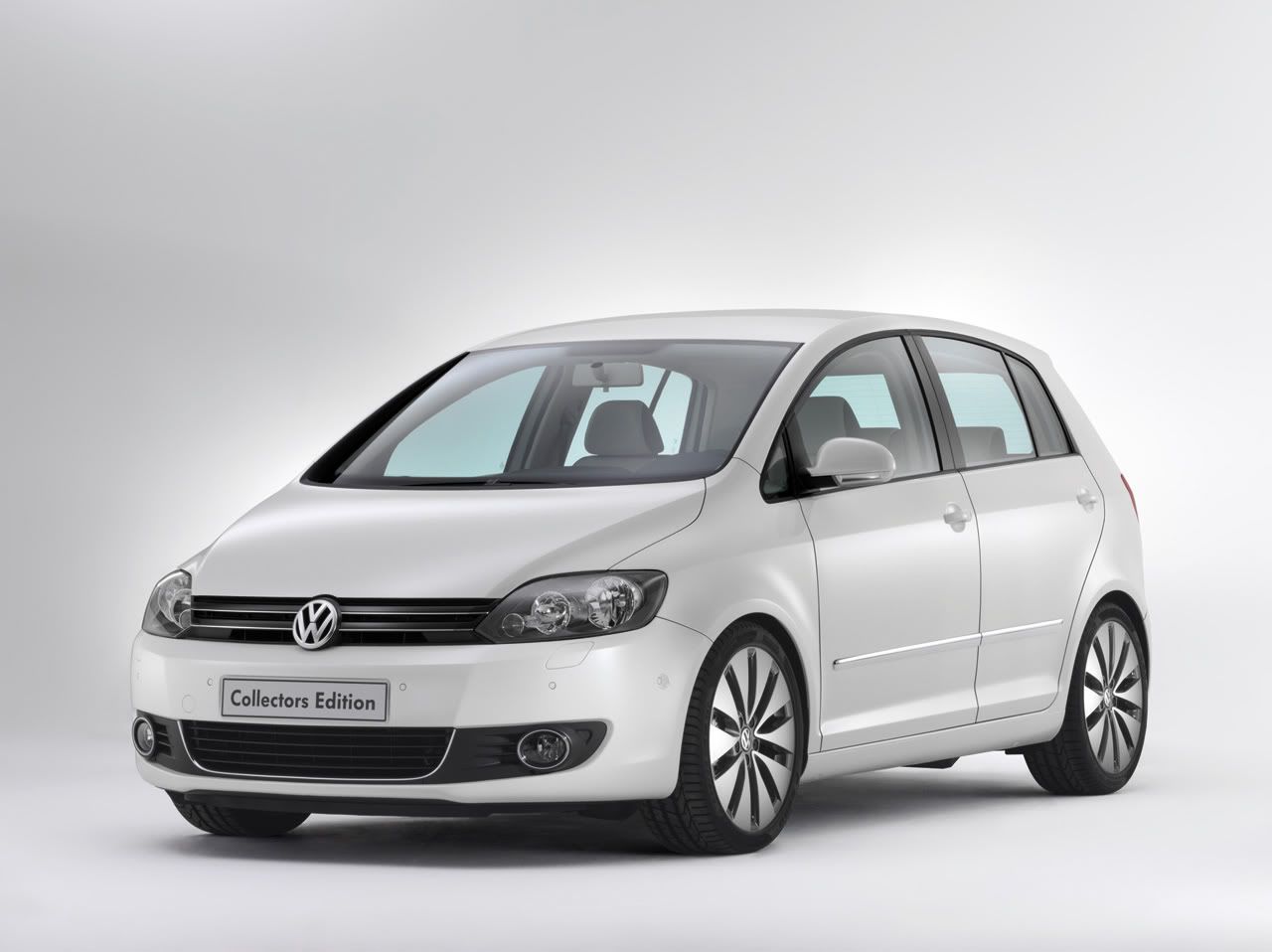
On a concept car based on the new Golf Plus, Volkswagen Individual is providing a demonstration of just how limitless the hidden possibilities of individualization are: the Collectors Edition.

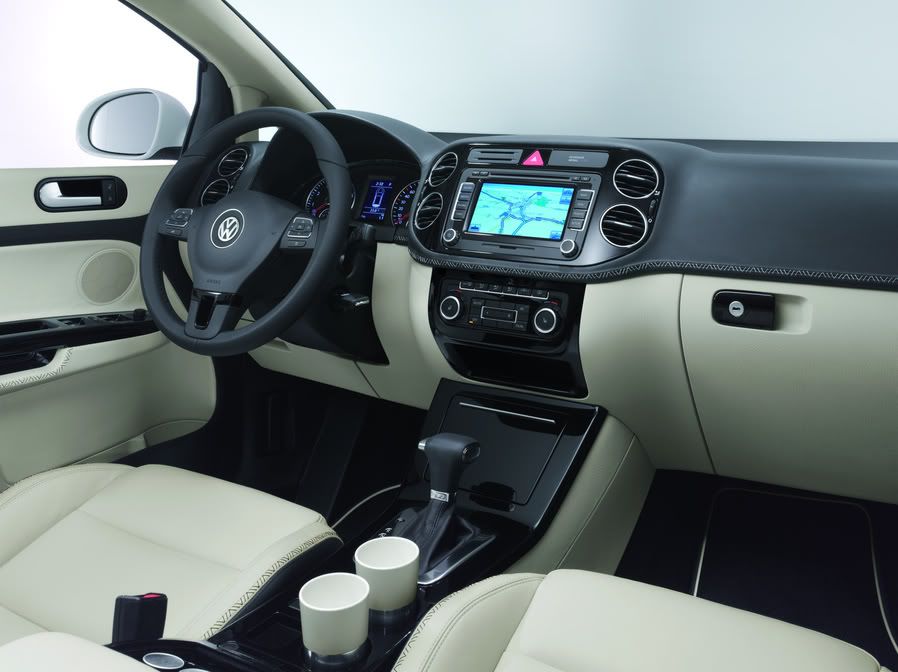
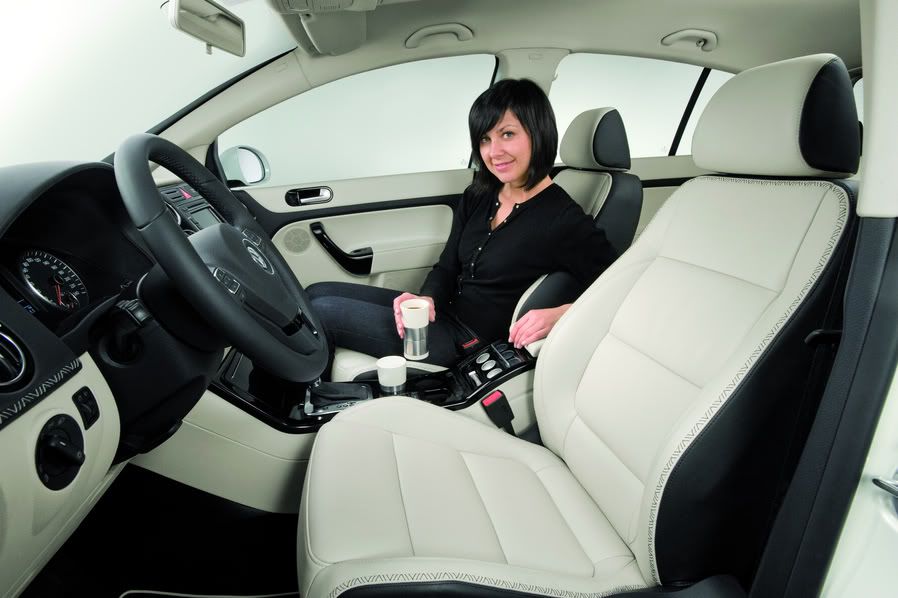
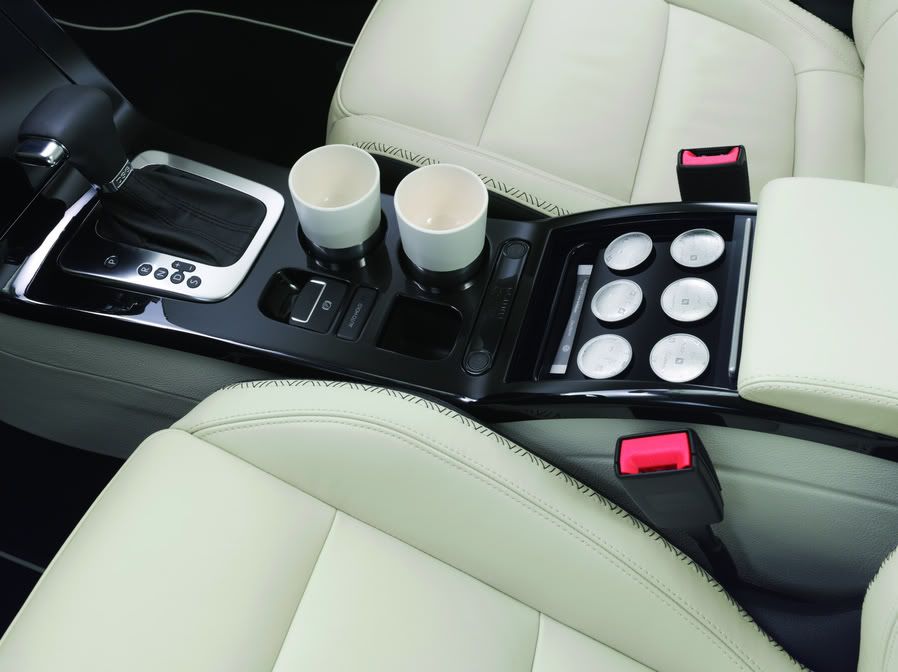
This concept car is outfitted with the exclusive “White pearl effect” body color. Providing the necessary contact to the road are size 225/40 tires on new 18-inch “Bilbao” alloy wheels. Inside and out, the Golf Plus Collectors Edi­tion exudes a kind of lounge ambiance. And not only because of the espresso machine integrated in the center console. The interior is trimmed in high-end nappa leather in “Titanium black” and “St. Tropez” (cream white) – this creates a very contemporary and urbane ambiance. Perfection right down to the last detail is evident in the decorative “Viaggio” seams between the individual sections of nappa leather trim.

Furthermore, it is the contrasts between low and high gloss surfaces that define the interior. All accents, for example, are in high-gloss black piano paint, which encounters the silky matte of the nappa leather in the instrument panel area.