Mr Schomburg, how did you come up with the name, and what is the reason for the wolf analogy?
We were looking for an authentic name that fits the characteristics of our pickup just right and works perfectly around the globe.
The Amarok is a particularly powerful and robust vehicle with great stamina that can adapt to a great variety of situations. All these characteristics can also be attributed to the wolf.
Since our pickup is something special, we also had special requirements with regard to its name. I think we succeeded in finding a good match.
How do you pronounce the name and does it have the same associations everywhere?
All three syllables are equally stressed.
We made a point of choosing a name that also works easily in the Romance languages; that is, specifically in South America. To ensure this, all major markets were closely involved in the entire naming process. The literal meaning of "he loves stones" in the Romance languages fits right in with our pickup.
Will the vehicle be called Amarok in all the markets or are there exceptions?
The use of the name in such a great number of markets will be nearly unrivalled by other Volkswagen models. That is why the global presence and acceptance of the name was important to us. No exceptions are planned.
When will the vehicle be launched?
We are starting the launch in South America. The world premiere will take place in Argentina at the end of the year, starting our launch activities. The Amarok is set to hit South American dealerships from March. The European launch is planned for Summer 2010.
(Harald Schomburg is Chief of Sales and Marketing for Volkswagen Commercial Vehicles.)
To be launched at the beginning of 2010 in South America
Amarok set to come to Europe afterwards
Hanover, 04 June 2009 – The new Volkswagen pickup is called Amarok. In Autumn 2009, the first pickup by a European volume manufacturer in South America is to be unveiled. The South American launch is set for Spring 2010, with the Amarok coming to Europe in the summer. With the Amarok, Volkswagen is seeking to enter global pickup markets dominated for the most part by Japanese manufacturers. Volkswagen Commercial Vehicles already presented an impressive concept truck at last year's IAA Commercial Vehicles, providing a taste of the brand's new fourth model. The Amarok will be produced in Argentina at Volkswagen's "Pacheco" plant near Buenos Aires.The name Amarok comes from the language of the Inuit, who live in northern Canada and Greenland, and means wolf. The Inuit, one of the Eskimo peoples, regard the wolf as the king of the wilderness, an impressive figure due its strength, robustness, endurance and superiority.
This name also means "he loves stones" in the Romance languages, which are spoken in the major markets in Brazil and Argentina. In these markets, pickups are highly in demand as recreational and commercial vehicles due to their versatility. The Amarok's reliability and suitability for off-road driving will make it a very attractive proposition.
"This name fits to a tee the characteristics of our pickup, which will set new standards in its class. We took great care selecting this name, which can be used globally. The Amarok is meant to invoke positive associations in all relevant international markets and make a more convincing argument than its established competitors right from the start," says Stephan Schaller, CEO of the brand Volkswagen Commercial Vehicles.
The Amarok is the first pickup of this kind from a European manufacturer and will face competition in the one-tonne class mostly from Asia. The sixth model from the Volkswagen Commercial Vehicles brand, which follows the Caddy, Transporter (or Multivan) and Crafter as well as the Saveiro and T2, both of which are available exclusively in South America, is a significant component in the Volkswagen Group's growth strategy and opens a new segment for Volkswagen. Schaller comments, "The Amarok lifts our brand into a new, even more international dimension. Volkswagen Commercial Vehicles is proud to develop, build and sell this vehicle, which is extremely important for the growth of the entire Group and constitutes a logical strategic addition to the global range."
Developed from scratch, the Amarok will be launched as a double-cab pickup with four-wheel drive. The single-cab version will be available at a later date. The pickup features not only state-of-the-art, robust engineering but also efficient engines and current Volkswagen styling. The concept car shown at the IAA gives a first impression. State-of-the-art, powerful yet efficient common rail turbo diesel injection (TDI) of the next generation will be used in the powertrain. The fuel consumption and emissions for the Amarok will achieve the new best values for the pickup segment.
The Amarok is set be launched first in South America and Central America in Spring 2010, followed by Russia and Europe as well as Africa and Australia.
5.3 liter fuel economy and 222 km/h redefine the idea of sportiness
New Golf GTD with 170-PS TDI: Advance sales begin early May GTD and new GTI are conceptual soulmates
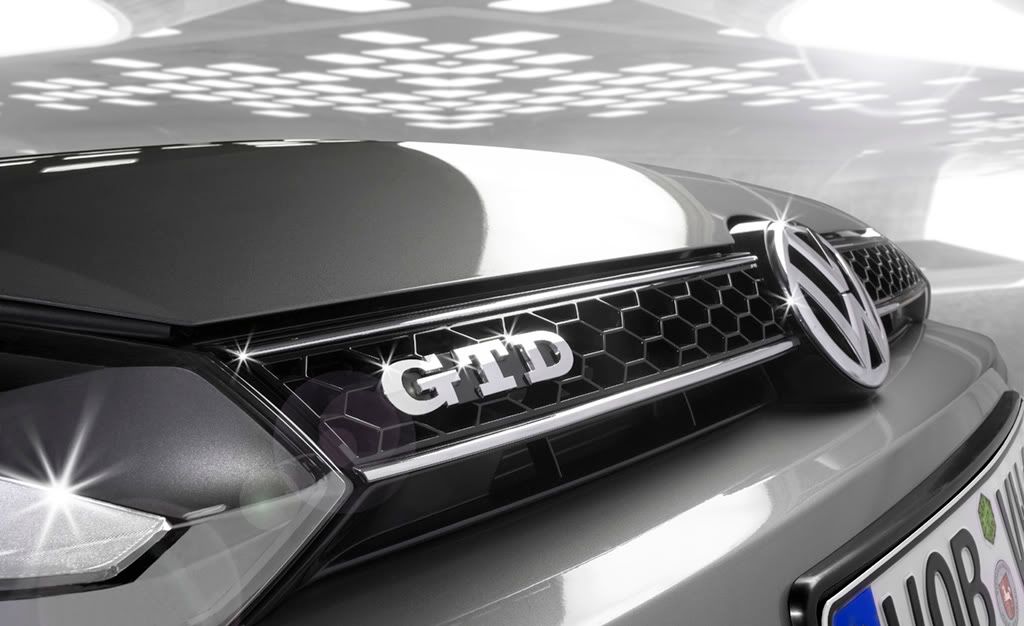
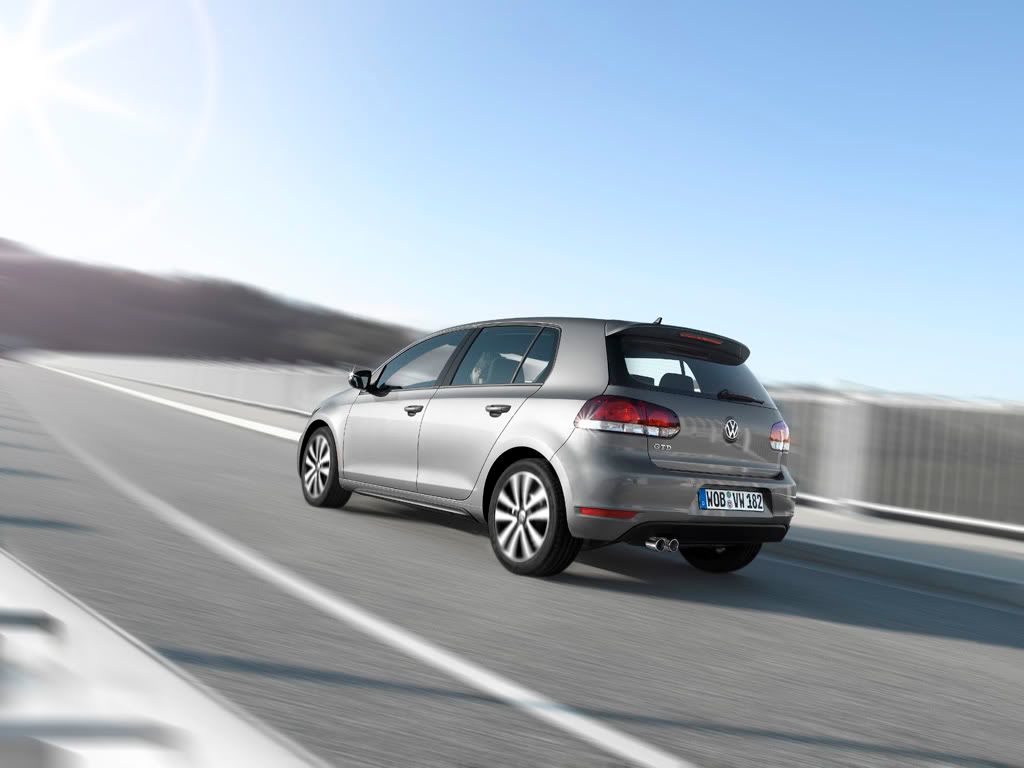
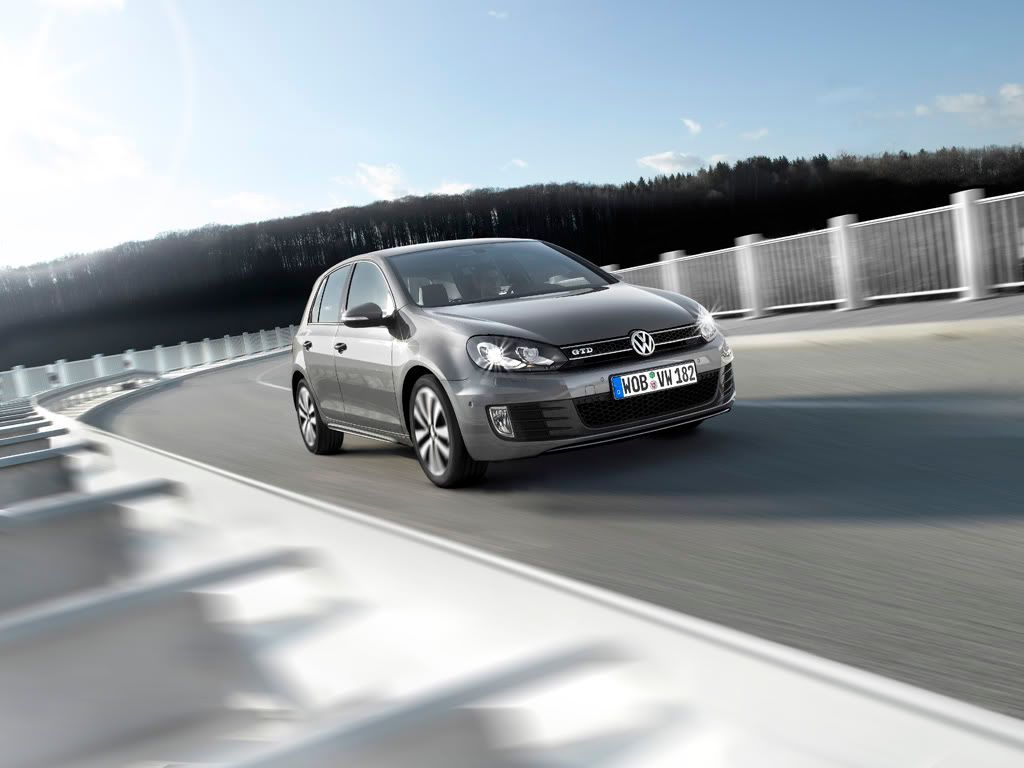
Wolfsburg / Leipzig, 27 March 2009 - After the Polo, the BlueMotion offensive and the Golf GTI, Volkswagen is pulling the next arrow out of its quiver: this time it is the Golf GTD. It is extremely fuel efficient yet exceedingly sporty, and it is debuting as a world premiere at the Auto Mobil International in Leipzig (March 28 to April 05). The GTD code letters carry on a tradition: the first Golf GTD appeared back in 1982 – it was the GTI among diesels. Now Volkswagen has perfected the various aspects of sportiness. The new Golf GTD with its 125 kW / 170 PS is aimed at all diesel fans who value a maximum in dynamic performance. This is where the GTD shows a clear affinity to the new GTI (155 kW / 210 PS). While the GTI is in its own league with an efficient turbo gasoline engine that offers the same performance as far more expensive sports cars, the Golf GTD is making its appearance with phenomenal fuel economy. Every 100 kilometers, just 5.3 liters of fuel flow through the piezo injection valves of the common rail engine that can hardly be pegged as a diesel. That is equivalent to CO2 emissions of just 139 g/km. This contrasts with a top speed of 222 km/h and 8.1 seconds for the sprint to 100 km/h.
Range of about 1,000 kilometer As on the GTI, the GTD’s 6-speed manual transmission may be swapped out for an optional 6-speed DSG – which in the eyes of many experts is the most efficient automatic of our times. The Golf GTD with DSG reaches a top speed of 220 km/h; it accelerates to 100 km/h in 8.1 seconds and consumes 5.6 liters diesel on average (147 g/km CO2). These low fuel consumption values take both GTD variants to distances of about 1,000 kilometers on one tank of fuel (55 liters).
The GTD equipped with standard sport chassis and 17-inch alloy wheels (“Seattle” type) bears a close relationship to the GTI, in its highly agile handling properties as well as in its parallels in appearance and features.
GTD exterior The exterior clearly indicates that this is the sportiest Golf with a diesel engine. Take the front end, for example: the bumper, radiator grille and headlights are a 1:1 match with the GTI. However, the red horizontal stripes in the radiator grille are styled in chrome on the GTD. At the rear, the turbo-diesel sports a modified diffuser. Even though no GTD emblem comes with the car purchase, the diesel version of the Golf can be recognized by its dual chrome tailpipes on the left side of the diffuser (the GTI has one tailpipe on the left and one on the right).
GTD sound Sound – sporty sound – has not traditionally been a particular strength of diesel engines. However, the GTD’s new common rail engine is different. Since it no longer has a superimposed “hammering” sound that was previously typical of diesels, engineers were able to fine tune its acoustics for the first time. This is accomplished by a special sound generator, which outputs a sonorous tone, especially in the lower engine speed range. The electromagnetic sound generator evaluates engine speed, momentary power demand and vehicle speed data obtained via the car’s CAN bus and tunes the engine sound that can be heard in the interior.
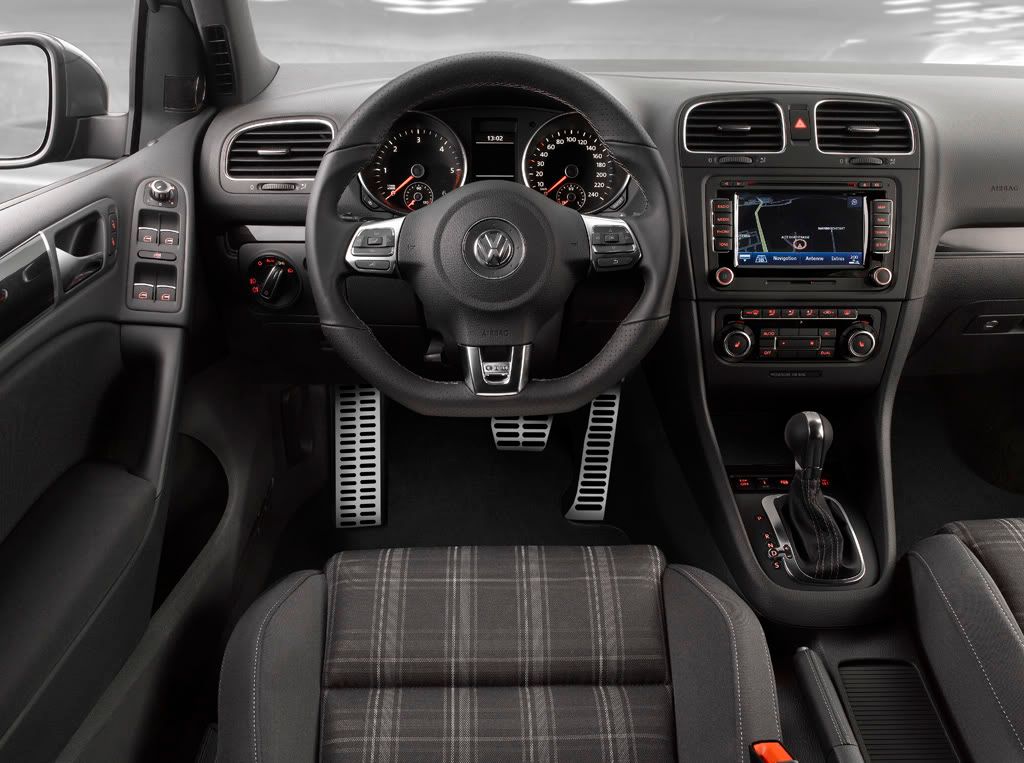
GTD interior Volkswagen’s GT philosophy is also reflected in the interior. It expresses itself in standard high-end sport seats, a 3-spoke leather steering wheel whose curvature flattens at the bottom (GTD signature in the center chrome badge), leather parking brake lever and leather gearshift boot with stitching in contrasting color. However, unlike in the GTI the color is not red but light gray. The same applies to the sport seats in “Jacky” pattern: The color chosen for the flat-felled seams are an elegant light gray (“Art Grey”) instead of red (“Flash Red”). The seats themselves are styled in a “Black-White” color combination.
GTD safety and convenience Other standard features of the Golf GTD include details such as a black roofliner and black roof pillar trim, special interior accents, seven airbags including knee airbag on the driver’s side, automatic climate control (“Climatronic”), front fog lights with chrome framing, daytime running lights, ESP, a winter package (with heated windshield washer nozzles, heated front seats, headlight cleaning system and low washer fluid indicator light) and the RCD 210 radio system. Nonetheless, the most important component of standard GTD equipment is still the Common Rail TDI with 170 PS being used in the Golf for the first time.
TDI technology in detail The 1,968 cm3 displacement engine is from a new TDI generation. It delivers its maximum power at 4,200 rpm. The engine – as sporty as it is fuel efficient – develops its 350 Newton-meter maximum torque between 1,750 and 2,500 rpm. Its specific torque is 177.8 Newton-meter per liter engine displacement. The upshot is that in practically any driving situation, the sixteen-valve four-cylinder engine offers power equivalent to that of a six-cylinder sports car engine.
About the technology: Fuel induction is handled by a common rail system. Fuel injection pressures of up to 1,800 bar and special eight-hole injection nozzles achieve exceptionally fine atomization of the diesel fuel. The eight-hole injection nozzles are driven by what are known as piezo in-line injectors. In this process, electrically controlled piezo crystals – boosted by hydraulics – initiate injection in fractions of a second. Compared to conventional solenoid valves, piezo technology enables more flexible injection processes with smaller and more precisely metered quantities of fuel. The results are a very quiet and pleasantly soft running engine, exceptionally quick response and the excellent fuel economy and emissions values already mentioned.
Another feature having a positive effect on the car’s acoustics is the maintenance-free toothed timing belt for the camshaft. The conversion to common rail technology and many other acoustic measures, such as a noise-damping film in the windshield, make the new Golf GTD one of the quietest diesel models in its class. In addition, the GTD will fulfill limits of the Euro-5 emissions standard. Advance sales of the Golf GTD in Germany will already begin in early May. And the prospects for a successful market launch look good. Because this sporty Volkswagen fits in perfectly with our times.
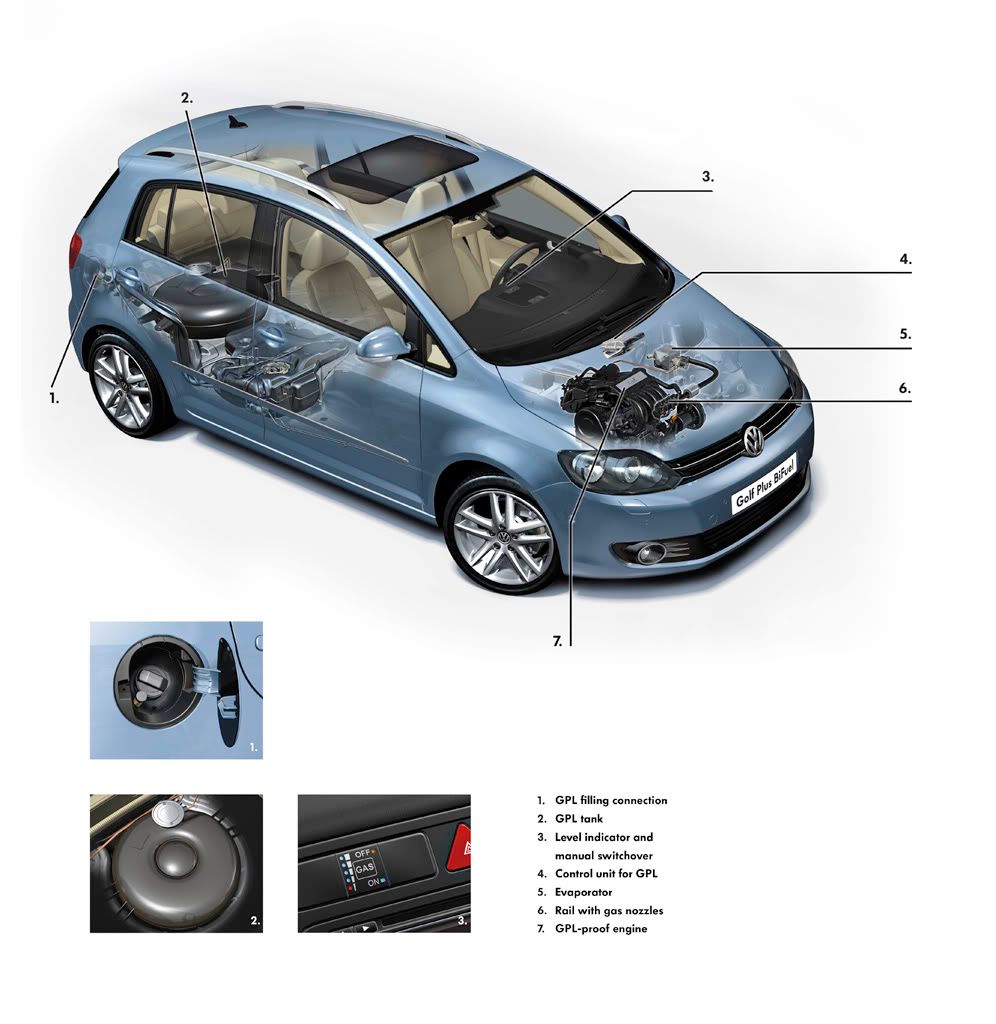
Low-emissions Golf Plus BiFuel offers significant cost advantages New Golf Plus BiFuel is safer and more durable than aftermarket solutions
Wolfsburg / Leipzig, March 2009. In a world premiere at the Auto Mobil International in Leipzig, Volkswagen is presenting the new Autogas (LPG) version of the Golf Plus. Its bivalent drive – it is easy to switch over to gasoline driving – reduces costs and emissions. When the Golf Plus BiFuel is powered by LPG (Liquefied Petroleum Gas), its environmen tal balance sheet shows a greater than 10 percent reduction in CO2 emissions when matched up with a comparable gasoline engine.
Safer and more durable than aftermarket solutions The system being presented in the Golf Plus BiFuel offers significant advantages compared to aftermarket Autogas systems. For one, unlike aftermarket solutions the car has been crash tested together with allof its fuel tanks – so it is safer. Second, the engine was specificallydesigned for LPG operation and is more durable than engines originally developed for just gasoline. The long-term quality of the Golf BiFuel has been verified in extensive durability testing. A full warranty and access to the large Volkswagen service network are pluses too. All of this is being offered at the same price as an aftermarket retrofit. In Autogas mode, the Golf Plus BiFuel’s 1.6 liter four-cylinder engine outputs a power of 72 kW / 98 PS and consumes an average of 9.8 liters of LPG per 100 kilometers (159 g/km CO2). In gasoline mode, the Golf Plus BiFuel consumes a still economical 7.5 liters Super per 100 kilometers (179 g/km CO2).
1,100 kilometer range In addition, the Autogas tank (43 liter effective volume at storage pressure of 8 to 10 bar) – with its space-saving installation in the spare wheel recess – and the gasoline tank (55 liter) together propel the car to a theoretical range of greater than 1,100 kilometers. In pure LPG mode, the car’s range is about 440 kilometers. The network of LPG filling stations is tightly interwoven across Europe; in Germany alone there are over 4,700 filling stations. Incidentally, the filling tube for the LPG is easy to access right next to the familiar location of its gasoline counterpart.