Friday, March 27, 2009

AMI Leipzig 2009: World Premiere Golf GTD


5.3 liter fuel economy and 222 km/h redefine the idea of sportiness

New Golf GTD with 170-PS TDI: Advance sales begin early May
GTD and new GTI are conceptual soulmates


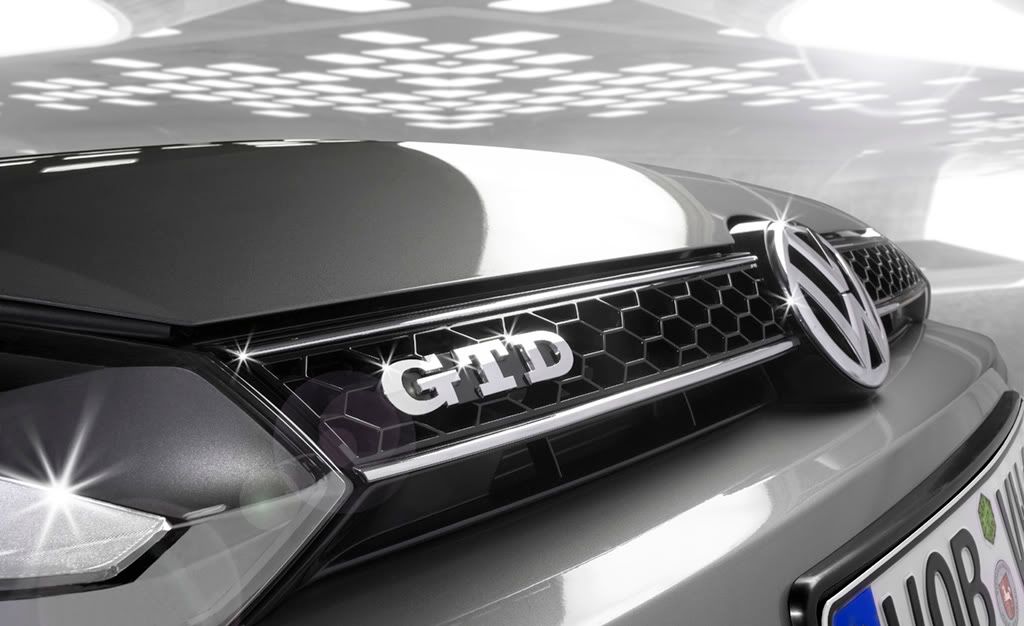
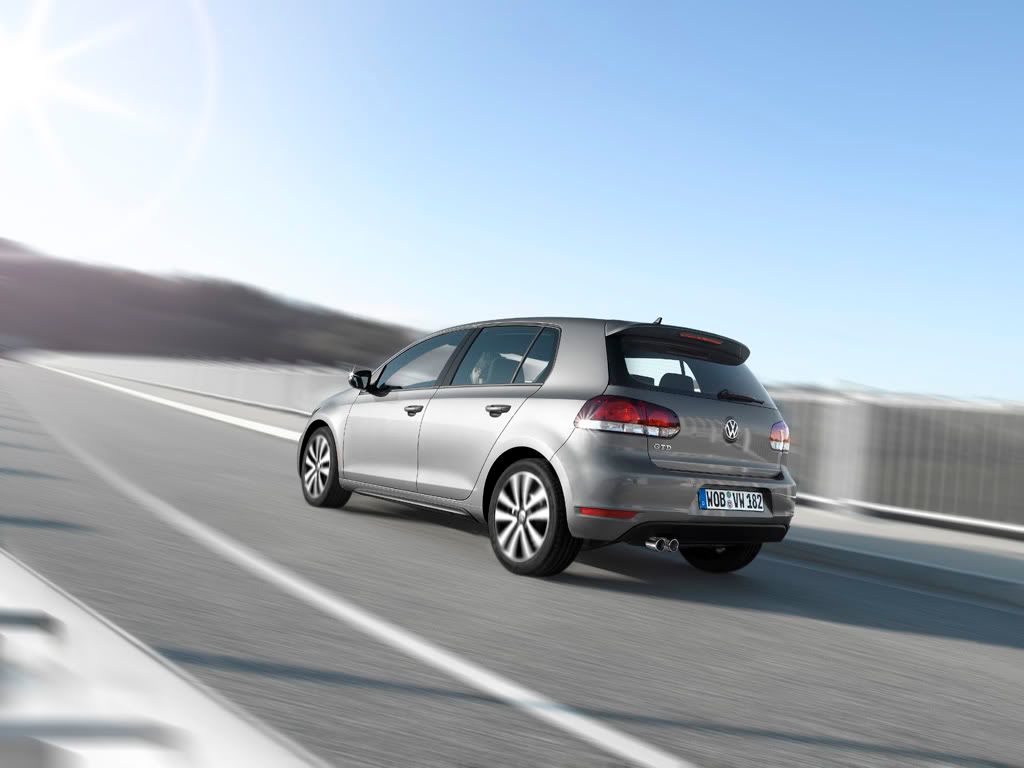
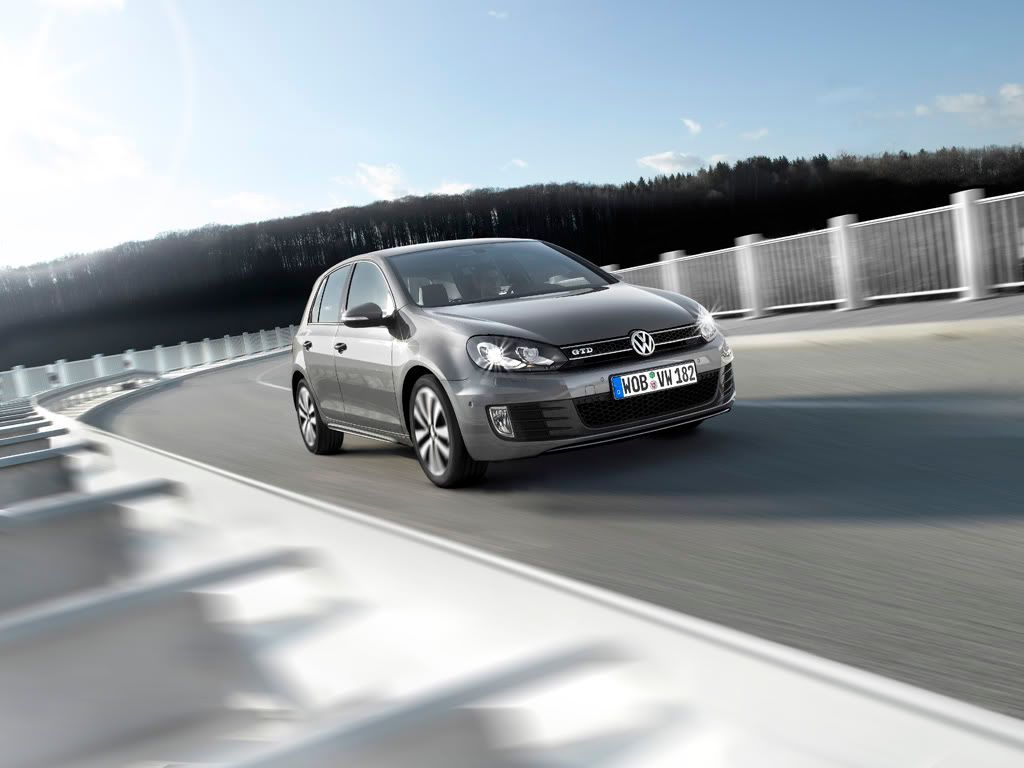
Wolfsburg / Leipzig, 27 March 2009 - After the Polo, the BlueMotion offensive and the Golf GTI, Volkswagen is pulling the next arrow out of its quiver: this time it is the Golf GTD. It is extremely fuel efficient yet exceedingly sporty, and it is debuting as a world premiere at the Auto Mobil International in Leipzig (March 28 to April 05). The GTD code letters carry on a tradition: the first Golf GTD appeared back in 1982 – it was the GTI among diesels. Now Volkswagen has perfected the various aspects of sportiness. The new Golf GTD with its 125 kW / 170 PS is aimed at all diesel fans who value a maximum in dynamic performance. This is where the GTD shows a clear affinity to the new GTI (155 kW / 210 PS). While the GTI is in its own league with an efficient turbo gasoline engine that offers the same performance as far more expensive sports cars, the Golf GTD is making its appearance with phenomenal fuel economy. Every 100 kilometers, just 5.3 liters of fuel flow through the piezo injection valves of the common rail engine that can hardly be pegged as a diesel. That is equivalent to CO2 emissions of just 139 g/km. This contrasts with a top speed of 222 km/h and 8.1 seconds for the sprint to 100 km/h.

Range of about 1,000 kilometer
As on the GTI, the GTD’s 6-speed manual transmission may be swapped out for an optional 6-speed DSG – which in the eyes of many experts is the most efficient automatic of our times. The Golf GTD with DSG reaches a top speed of 220 km/h; it accelerates to 100 km/h in 8.1 seconds and consumes 5.6 liters diesel on average (147 g/km CO2). These low fuel consumption values take both GTD variants to distances of about 1,000 kilometers on one tank of fuel (55 liters).

The GTD equipped with standard sport chassis and 17-inch alloy wheels (“Seattle” type) bears a close relationship to the GTI, in its highly agile handling properties as well as in its parallels in appearance and features.

GTD exterior
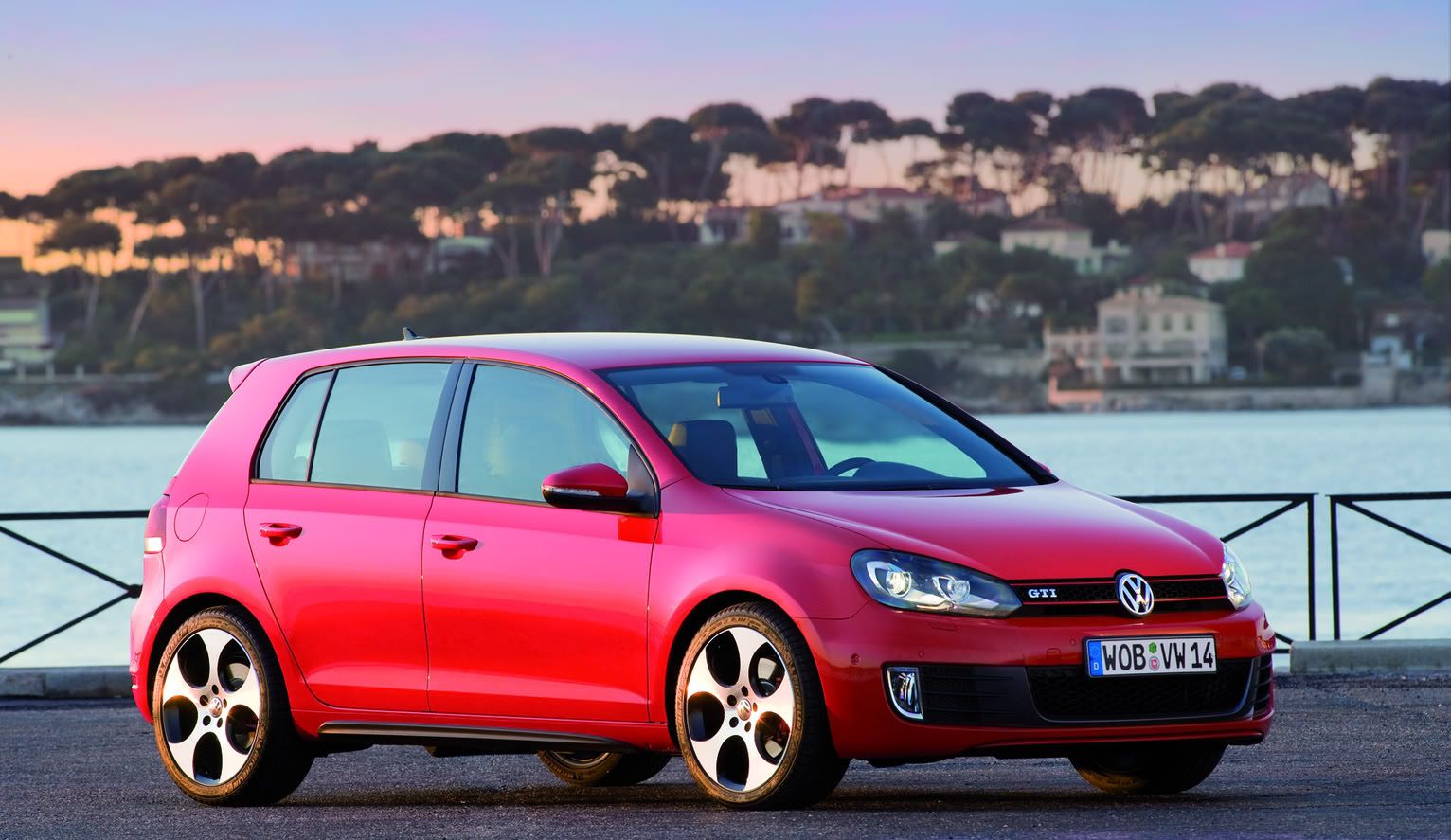
The exterior clearly indicates that this is the sportiest Golf with a diesel engine. Take the front end, for example: the bumper, radiator grille and headlights are a 1:1 match with the GTI. However, the red horizontal stripes in the radiator grille are styled in chrome on the GTD. At the rear, the turbo-diesel sports a modified diffuser. Even though no GTD emblem comes with the car purchase, the diesel version of the Golf can be recognized by its dual chrome tailpipes on the left side of the diffuser (the GTI has one tailpipe on the left and one on the right).

GTD sound
Sound – sporty sound – has not traditionally been a particular strength of diesel engines. However, the GTD’s new common rail engine is different. Since it no longer has a superimposed “hammering” sound that was previously typical of diesels, engineers were able to fine tune its acoustics for the first time. This is accomplished by a special sound generator, which outputs a sonorous tone, especially in the lower engine speed range. The electromagnetic sound generator evaluates engine speed, momentary power demand and vehicle speed data obtained via the car’s CAN bus and tunes the engine sound that can be heard in the interior.

GTD interior
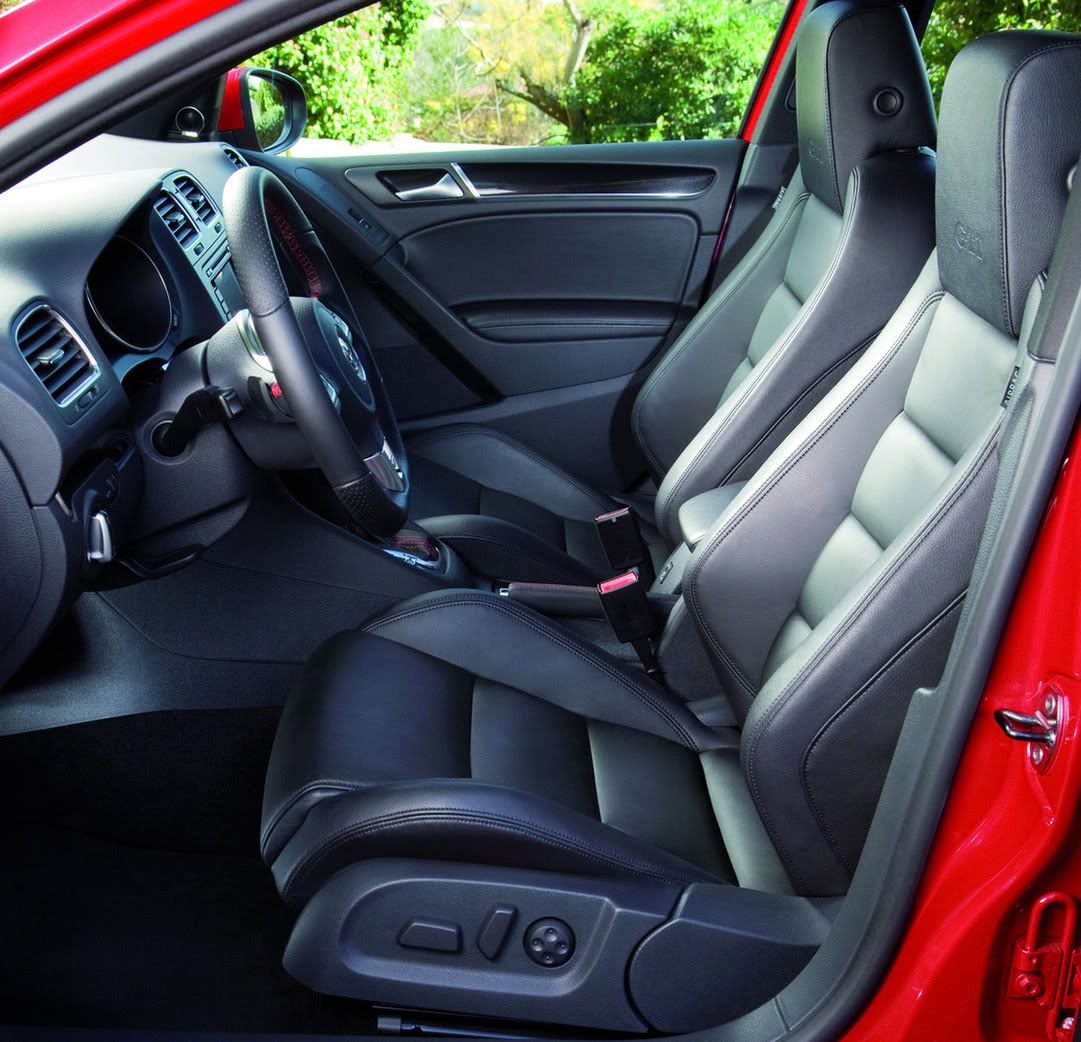
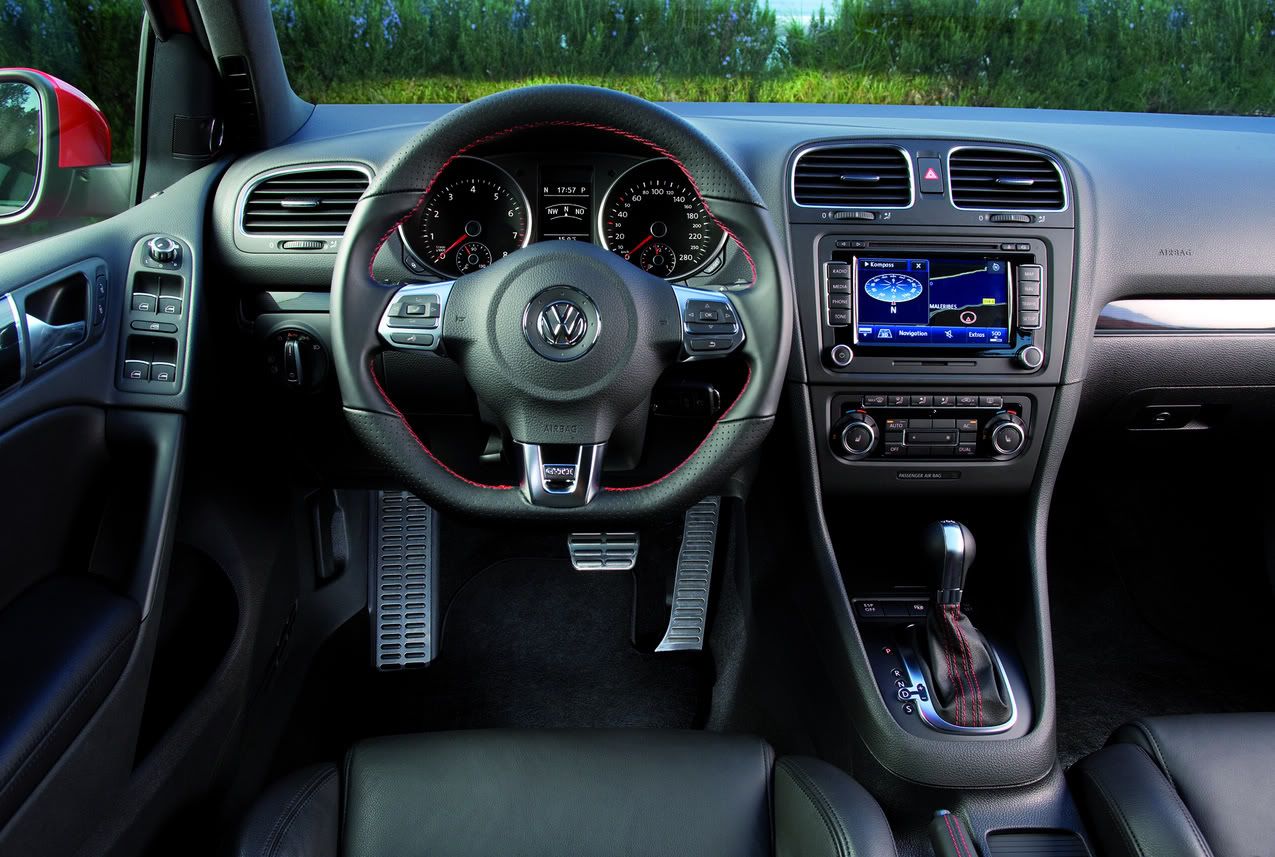
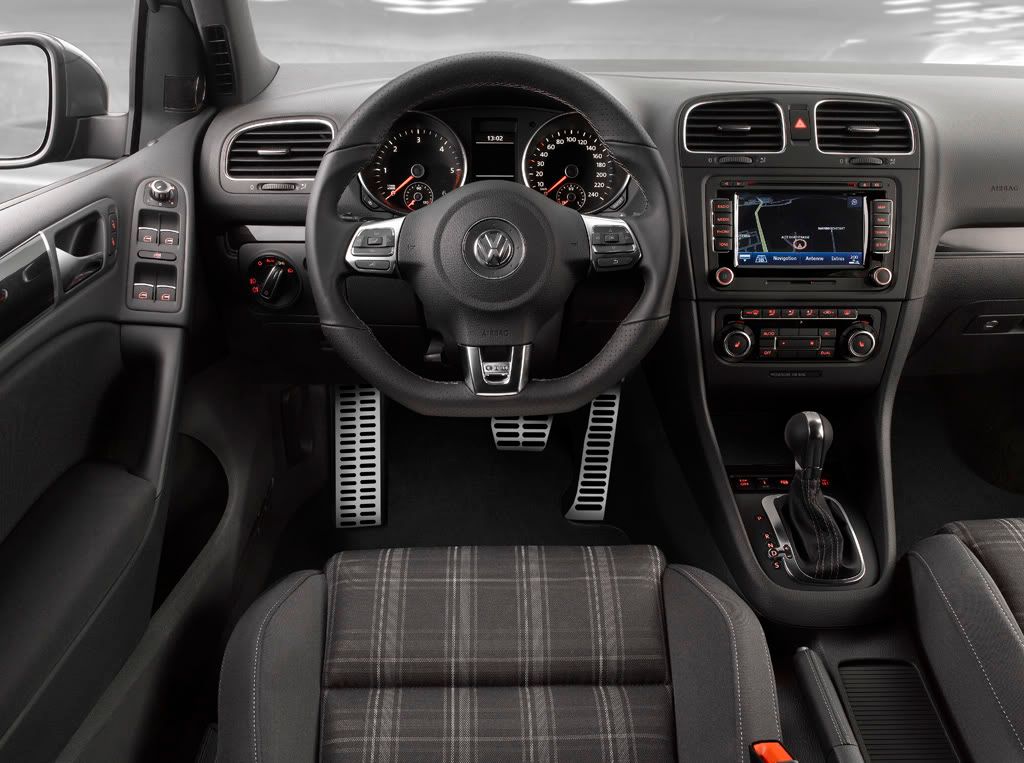
Volkswagen’s GT philosophy is also reflected in the interior. It expresses itself in standard high-end sport seats, a 3-spoke leather steering wheel whose curvature flattens at the bottom (GTD signature in the center chrome badge), leather parking brake lever and leather gearshift boot with stitching in contrasting color. However, unlike in the GTI the color is not red but light gray. The same applies to the sport seats in “Jacky” pattern: The color chosen for the flat-felled seams are an elegant light gray (“Art Grey”) instead of red (“Flash Red”). The seats themselves are styled in a “Black-White” color combination.

GTD safety and convenience
Other standard features of the Golf GTD include details such as a black roofliner and black roof pillar trim, special interior accents, seven airbags including knee airbag on the driver’s side, automatic climate control (“Climatronic”), front fog lights with chrome framing, daytime running lights, ESP, a winter package (with heated windshield washer nozzles, heated front seats, headlight cleaning system and low washer fluid indicator light) and the RCD 210 radio system. Nonetheless, the most important component of standard GTD equipment is still the Common Rail TDI with 170 PS being used in the Golf for the first time.

TDI technology in detail
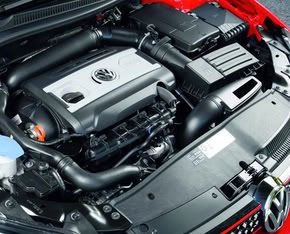
The 1,968 cm3 displacement engine is from a new TDI generation. It delivers its maximum power at 4,200 rpm. The engine – as sporty as it is fuel efficient – develops its 350 Newton-meter maximum torque between 1,750 and 2,500 rpm. Its specific torque is 177.8 Newton-meter per liter engine displacement. The upshot is that in practically any driving situation, the sixteen-valve four-cylinder engine offers power equivalent to that of a six-cylinder sports car engine.

About the technology: Fuel induction is handled by a common rail system. Fuel injection pressures of up to 1,800 bar and special eight-hole injection nozzles achieve exceptionally fine atomization of the diesel fuel. The eight-hole injection nozzles are driven by what are known as piezo in-line injectors. In this process, electrically controlled piezo crystals – boosted by hydraulics – initiate injection in fractions of a second. Compared to conventional solenoid valves, piezo technology enables more flexible injection processes with smaller and more precisely metered quantities of fuel. The results are a very quiet and pleasantly soft running engine, exceptionally quick response and the excellent fuel economy and emissions values already mentioned.

Another feature having a positive effect on the car’s acoustics is the maintenance-free toothed timing belt for the camshaft. The conversion to common rail technology and many other acoustic measures, such as a noise-damping film in the windshield, make the new Golf GTD one of the quietest diesel models in its class. In addition, the GTD will fulfill limits of the Euro-5 emissions standard. Advance sales of the Golf GTD in Germany will already begin in early May. And the prospects for a successful market launch look good. Because this sporty Volkswagen fits in perfectly with our times.
AMI Leipzig 2009: World Premiere Golf Plus BiFuel


Low-emissions Golf Plus BiFuel offers significant cost advantages
New Golf Plus BiFuel is safer and more durable than aftermarket solutions


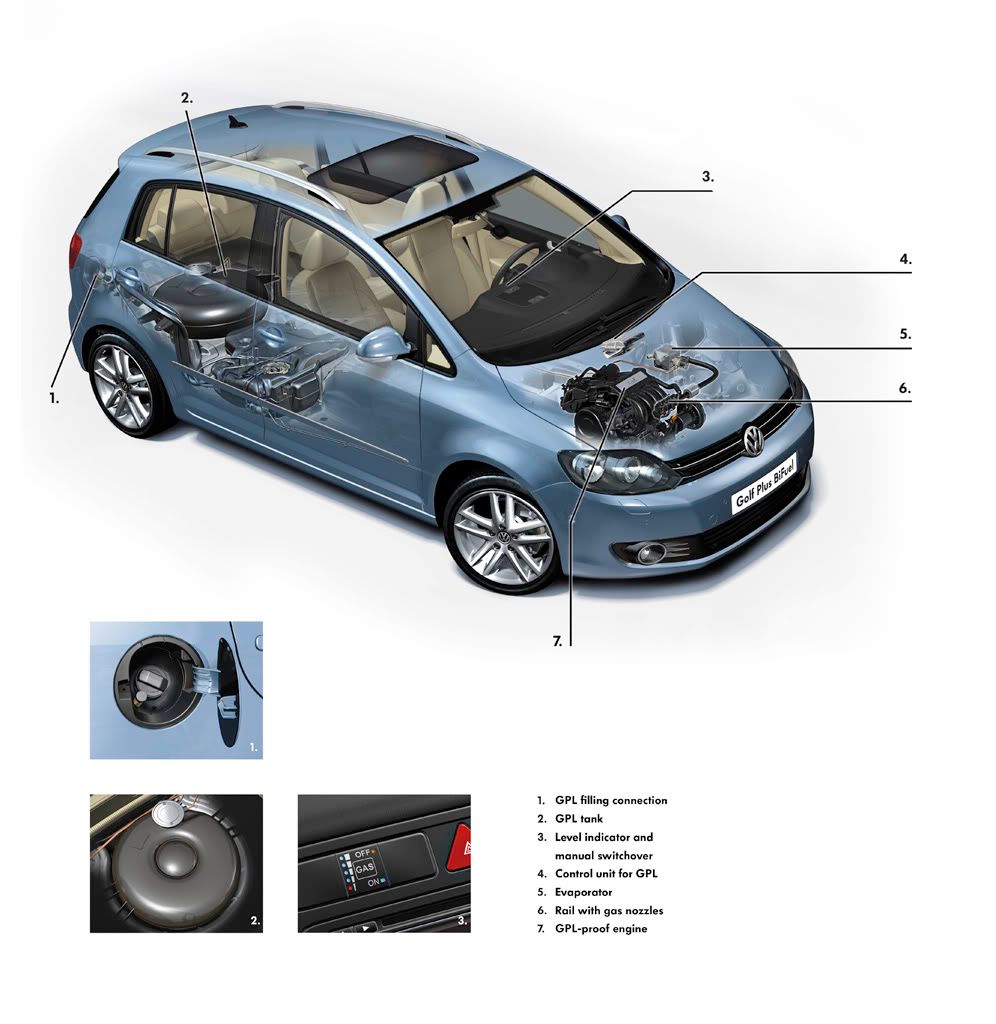
Wolfsburg / Leipzig, March 2009. In a world premiere at the Auto Mobil International in Leipzig, Volkswagen is presenting the new Autogas (LPG) version of the Golf Plus. Its bivalent drive – it is easy to switch over to gasoline driving – reduces costs and emissions. When the Golf Plus BiFuel is powered by LPG (Liquefied Petroleum
Gas), its environmen tal balance sheet shows a greater than 10 percent reduction in CO2 emissions when matched up with a comparable gasoline engine.

Safer and more durable than aftermarket solutions
The system being presented in the Golf Plus BiFuel offers significant advantages compared to aftermarket Autogas systems. For one, unlike aftermarket solutions the car has been crash tested together with allof its fuel tanks – so it is safer. Second, the engine was specificallydesigned for LPG operation and is more durable than engines originally developed for just gasoline. The long-term quality of the Golf BiFuel has been verified in extensive durability testing. A full warranty and
access to the large Volkswagen service network are pluses too. All of this is being offered at the same price as an aftermarket retrofit. In Autogas mode, the Golf Plus BiFuel’s 1.6 liter four-cylinder engine outputs a power of 72 kW / 98 PS and consumes an average of 9.8 liters of LPG per 100 kilometers (159 g/km CO2). In gasoline mode, the Golf Plus BiFuel consumes a still economical 7.5 liters Super per 100 kilometers (179 g/km CO2).

1,100 kilometer range
In addition, the Autogas tank (43 liter effective volume at storage pressure of 8 to 10 bar) – with its space-saving installation in the spare wheel recess – and the gasoline tank (55 liter) together propel the car to a theoretical range of greater than 1,100 kilometers. In pure LPG mode, the car’s range is about 440 kilometers. The network of LPG filling stations is tightly interwoven across Europe; in Germany alone there are over 4,700 filling stations. Incidentally, the filling tube for the
LPG is easy to access right next to the familiar location of its gasoline counterpart.

AMI Leipzig 2009: California Beach Cape2Cape


Special model was created as homage to 24,000 km Cape2Cape tour
Standard pop-up roof and climate control, optionally with all-wheel drive


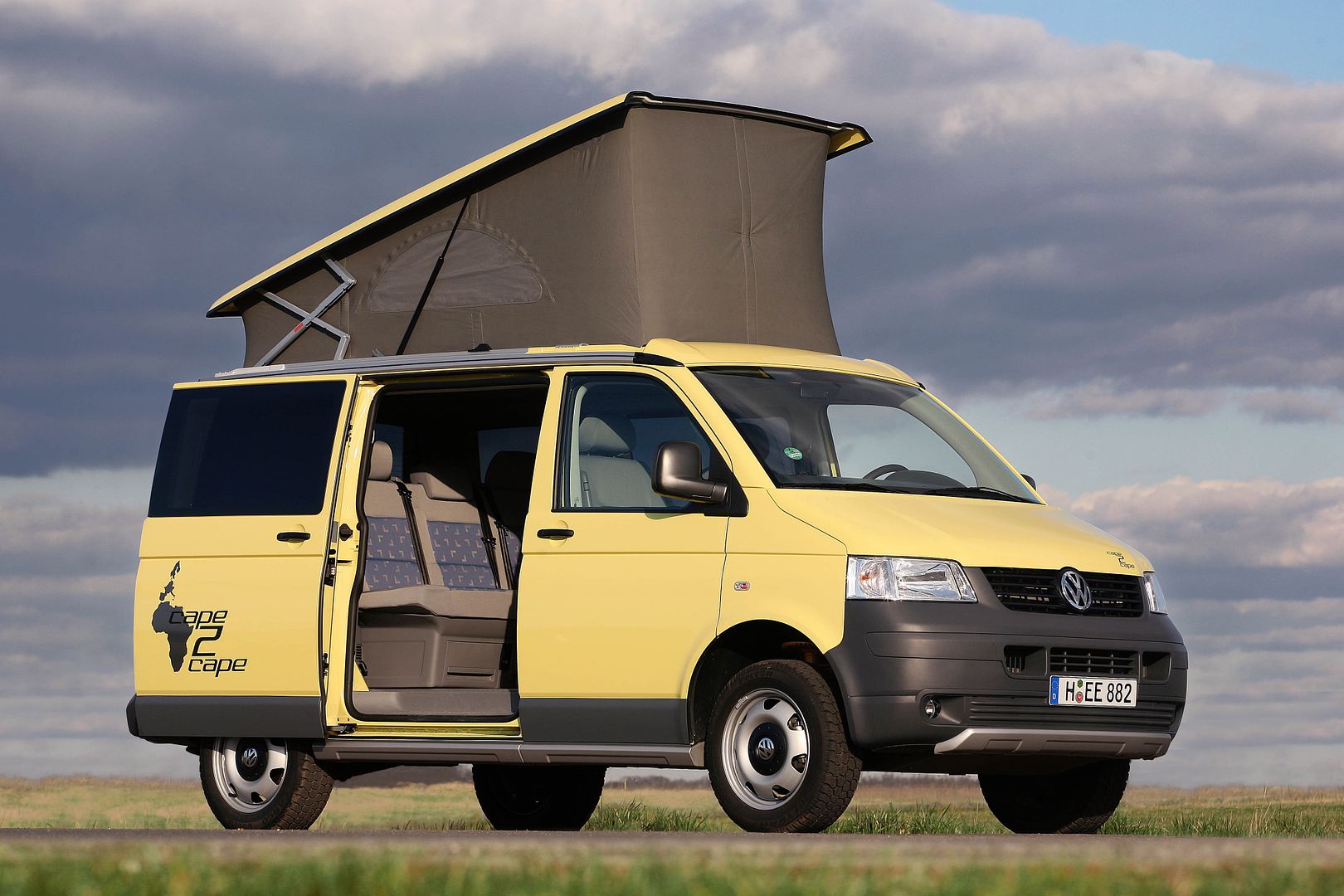
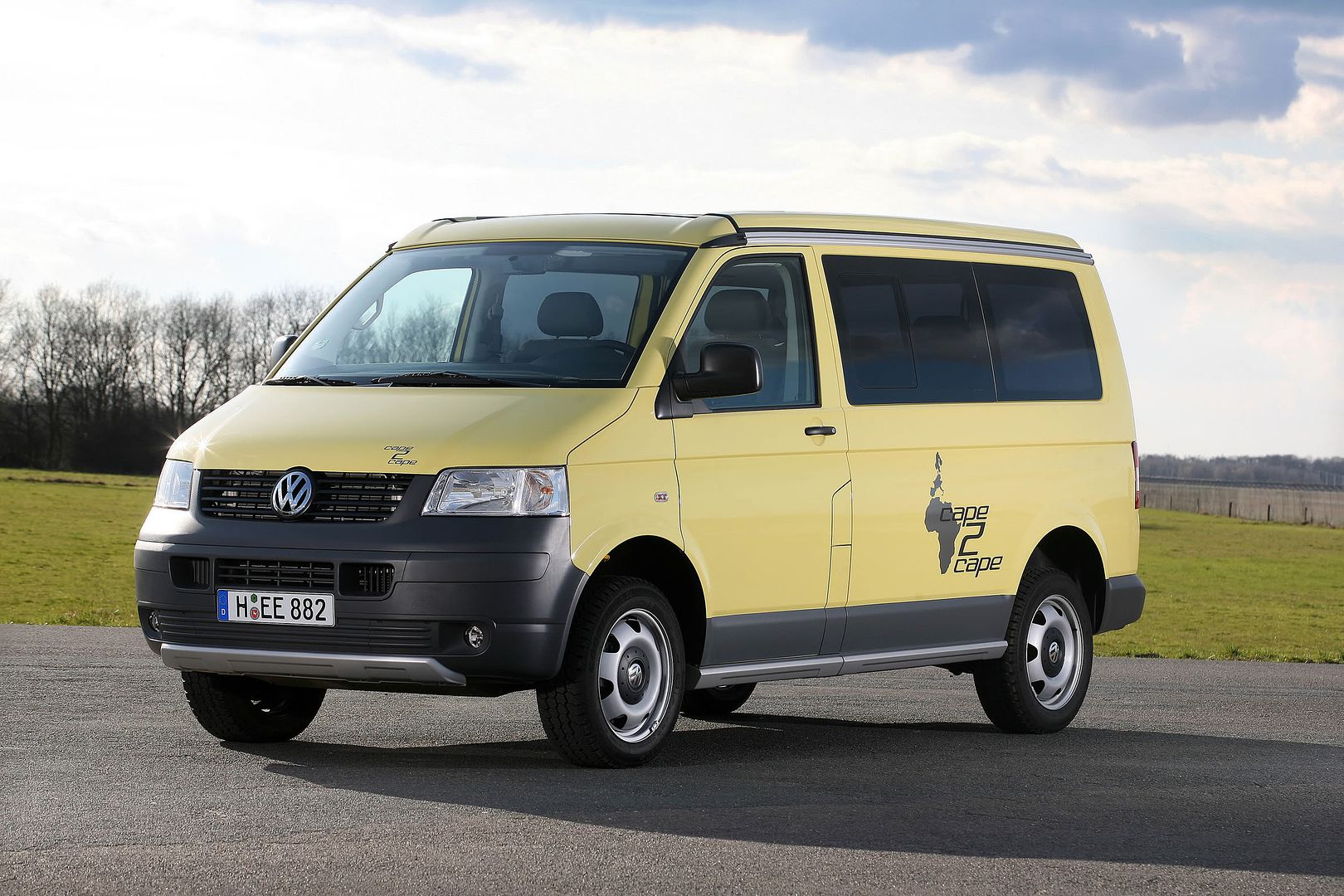
Hannover/ Leipzig, March 2009. In commemoration of the successful 24,000 kilometer long Cape2Cape tour by extreme adventurer Joachim Franz, Volkswagen Commercial Vehicles is now offering – similar to the five yellow California Beach vans that made the trip – an attractive special model. The California Cape2Cape is for customers looking for a vehicle that fits in with their outdoor activities.

In the Cape2Cape, a special model based on the California Beach with a manual pop-up roof, Volkswagen Commercial Vehicles is taking up the global adventurer theme. Inspired by the successful nine-week driving tour of extreme adventurer Joachim Franz, who started at the North Cape in Norway and finished in Cape Town, South Africa, the look of the California Beach was intentionally made to be robust.

The Cape2Cape targets recreational sports enthusiasts and adven turous outdoor vacationers seeking a vehicle that matches their lifestyle activities and who want to overnight at their destinations too.

Available with or without all-wheel drive, the camper stands on 17-inch steel wheels with size 235/55 R 17 tires. Unpainted bumpers and side skirts emphasize the van’s optional duty on trails off the beaten path.

Higher ground clearance and off-road tires are available as special equipment for the 4Motion models, together with a differential lock and air filter for dusty regions.

The van sports a variety of standard convenience features. For example, a climate control system and sunshades provide for comfortable temperatures in the interior.
The movable three-person fully reclining bench seat makes it possible to travel with up to five persons. An electrical convenience package and central locking with RF remote control simplify everyday use, while a Hill Hold Control feature assists
drivers in their “play” with the clutch and main brake.

The base price of the Cape2Cape California Beach – in which all TDI engines from 62 kW to 128 kW are available – is 39,300 Euros gross price (for the 62 kW TDI). The price advantage of the special model compared to a similarly equipped standard production model is 1,598 Euros. Savings can extend to 2,782 Euros when all optional packages are ordered, such as the comfort and convenience packages.

The California Beach was designed to be a cost-effective multi-purpose van, an entry level model to a range of recreational vehicles. It is “purist” in the best sense of the word, and it limits itself to the essentials. With just a few hand movements, the van converts into a camper for two persons.

The load-bearing structure in the Beach is a rail system embedded in the floor; it ensures secure mounting of practical and removable furniture and appliance modules.
It is easy to convert the bench seat into a bed with just a few hand movements.
Storage drawers under the bench seat in the five-seat Beach offer ample space for the accessories used by campers. A cushioned cargo area cover serves as the necessary extension for a full-length bed.

Curtains attached by magnet provide for shade. Frame inserts that are clipped at the windshield and rear window prevent intrusive glances.
Classic roundtable seating – for a maximum of five persons – is created by turning the front seats around and moving the rear bench seat to any desired position in the rear compartment.

The table needed here is housed in the side panel of the sliding door, and it can be set up on its four legs either inside or outside of the vehicle. Additional outdoor seating is provided by two standard camping chairs, which are stowed under the bed extension in the cargo area.


Wednesday, March 25, 2009

Volkswagen Commercial Vehicles achieves new record values in sales, turnover and profits in 2008

503,000 deliveries to customers in 2008
Operative profit up by 23 percent
Market share expected to increase in 2009
Business year 2009 reflects difficult market situation
Long term growth objectives stay in place


Hanover, March 25, 2009: despite the difficult background conditions in the second half of 2008 Volkswagen Commercial Vehicles sold more vehicles than ever before, and also achieved new record values in turnover and operative profit. “All in all, 2008 was a very good year for our brand”, emphasized Stephan Schaller, CEO of Volkswagen Commercial Vehicles , on Wednesday at the annual press conference in Hanover. However, Volkswagen Commercial Vehicles could not escape the effects of the dramatic worldwide drop in demand for commercial vehicles. “We are in a strong enough position to master the crisis, and to sell more automobiles than before once the difficult market situation has been resolved”, said Schaller.

Deliveries in 2008
Last year, for the first time, the company was able to sell more than half a million light and heavy commercial vehicles worldwide. With a total of 502,964 (previous year’s total: 488,726) deliveries to customers were up by 2.9 percent compared to the year before. The most-sold product in 2008, with 178,007 unit sales (previous year: 191,205) was the T5 with its Transporter, Caravelle, Multivan and California models. The Caddy also continued on the road to success, with 151,565 vehicles delivered in 2008 (as compared to 147,133 in the previous year), representing an increase of 3 percent. The Crafter, too, continued its upward trend, achieving 10.7 percent growth, with 51,101 units sold (previous year’s figure: 46,161).

Thus Volkswagen Commercial Vehicles was able to increase its lead in the European market. “With a total of more than 332,000 unit sales, we have successfully defended our ‘title’ as European champions and have pulled even further away from the runners-up”, Schaller pointed out. Volkswagen Commercial Vehicles share of the European market in 2008 was up 0.4 percent, at 15 percent.

Outside Europe, too, Volkswagen Commercial Vehicles continued to gain ground. The Saveiro and T2 models, which are both produced and sold in South America, topped their previous year’s performance by more than 17 percent, achieving unit sales of 67,270 (previous year’s figure: 57,446). The class of heavy commercial vehicles also showed positive development. The 55,021 units delivered in 2008 (as compared to 46,781 in the previous year) represented a plus of 17.6 percent – and thus also a new sales record.

Development of results 2008
The most important financial indicators also developed positively in the business year 2008, attaining new record values. “We have achieved the good figures for turnover and profits not only by making more deliveries, but also by practising stringent cost and efficiency management,” explained Klaus-Dieter Schürmann, member of the board of management with responsibility for finances and integration technology.

Turnover on the markets improved by 3.3 percent, rising to 9.6 thousand million Euro. Operative profit went up by 23 percent to 375 million Euro, an all-time record. Reduced product and materials costs made an important contribution to this figure, as did the substantially better performance of purchasing. Investments by the brand rose by 92 percent compared to the previous year, amounting to 275 million Euro. Net cash flow was once again clearly positive, at 183 million Euro. Return on capital reached double figures for the first time, with a value of 11.5 percent. The profit margin went up to 3.9 percent.

“Viewed in the context of the increasingly harsh economic situation in the second half of the year, we have attained an excellent result – the best balance achieved by our brand so far. This means that despite the present crisis we have the financial basis to continue pursuing our long term growth aims“, Schürmann stressed.

Looking ahead in 2009
Since the middle of the second half-year period, Volkswagen Commercial Vehicles has also seen itself confronted by a radically different business climate. “We cannot ignore this development, and we shall be selling fewer automobiles this year than in 2008”, Schaller said. “In this environment, we want to gain a bigger share of the market.”

He perceives the brand as a specialist for light commercial vehicles, but as being in a sufficiently strong position “to keep on course, even in stormy weather “.

At the same time, he says, the product range will continue to expand. As well as further variants of the Caddy, T5 and Crafter, the most significant addition will be the new Pickup, which Volkswagen Commercial Vehicles will be launching first on the South American market at the end of 2009, with a later launch in Europe. “The new Pickup will bring our brand into a different dimension, and enable us to gain access to new markets“, the CEO of the brand emphasized.

Strategy 2018 stays in place
The brand is continuing to stay with its long-term growth objectives and plans to be selling approximately 750,000 light commercial vehicles in 2018. Volkswagen Commercial Vehicles sees great growth potential for commercial vehicles, particularly in the BRIC countries – Brazil, Russia, India and China. “The market for commercial vehicles will grow again in the long term, and we want to make sure of a big slice of the market. We can do this by deliberately focusing on our core business: pickups, panel vans and the relevant superstructures and variants “, the Volkswagen Commercial Vehicles chief is convinced. As well as the distinctive profile of its own brand, he feels that being part of a strong enterprise is the factor that constitutes Volkswagen Commercial Vehicles’ decisive advantage over competitors.


Source Volkswagen Commercial Vehicles

Monday, March 23, 2009

Golf GTI - In Depth


Golf GTI – New edition of a 1.7 million bestseller

Hans-Joachim Stuck worked on refinements to the new GTI


Wolfsburg / St. Tropez, 18 March 2009
"What else was there in 1976?" calls out "Strietzel", also known as Hans-Joachim Stuck, from the driver’s window as he starts up a first generation Golf GTI after more than thirty years. "Whenever a person had a chance to drive a 911, it was a real experience. And then all of a sudden this experience was possible in the GTI too. Clearly on a different level, but affordable for everyone. That was the genius of this car, and it has stayed that way right up to today. The new GTI is a prime example of this." Stuck – one of the true giants of international car racing – works closely with Volkswagen AG. As a representative and driver in car racing, and as an expert in chassis and powertrain tuning in vehicle development, he also put the final touches on the new Golf GTI together with the experts of team "Hackenberg". On the Nürburgring as well, where development chief Dr. Ulrich Hackenberg and Hans-Joachim Stuck competed in parallel, driving Sciroccos for glory and professional experience in last year’s 24-hour race.

Volkswagen is right at home on the Nürburgring’s North Loop. It has always been that way. And the GTI too. Even before sales of the GTI began, it was present on the track of the "Green Hell" before thousands of spectators in 1975 – as a pace car in the prototype stage with a two-barrel carburetor instead of electronic injection. The rest is history. Automotive history. "The 110-PS engine of the GTI", recalls Stuck, "had a willingness to rev that was fun from day one. There had been nothing like it before. That is why the first GTI made such a statement."

In 2004, the fifth Golf GTI brought back this legend more powerfully than ever before. Between the debut of the first generation and the production runout of the fifth generation, more than 1.7 million car buyers made the GTI a world bestseller. Now this is being followed up by the sixth GTI, even sharper and more confident than all of the others before it. A GTI whose chassis systems – with standard electronic transverse differential lock (XDS) – redefines behavior in curves and traction. A 240 km/h fast GTI that is more fun to drive with its powerful 155 kW / 210 PS turbo engine and yet only consumes 7.3 liters super unleaded (0.7 l/100 km improvement). A GTI that delivers audible dynamics with a sound generator and new exhaust system design (two tailpipes, one left and one right). A GTI that successfully transfers the tradition of the original version to the future.

German market launch of the sixth GTI will begin in just days. Sales start across Europe just after Easter. North America and Asia will follow in late summer – long ago the GTI success became an international phenomenon.

And Hans-Joachim Stuck (58) is more than just a figurehead of Volkswagen Motorsports and more than an expert who just looks for vehicle weaknesses. "Strietzel", the nickname given to him as a baby by his godmother, and by which he is still called today by friends, is a GTI fan: "We always had a GTI in the family, from the first to the sixth. The Pirelli Editions too. There were no gaps here. Even when I was under contract with BMW, I preferred to drive to the Nürburgring in a GTI. It was in a GTI that I drove 911 drivers to distraction on the North Loop. My wife was even driving a GTI when she first caught my attention."

Engine of the GTI
In the case of the Golf GTI generation VI, the fascination for Stuck began once again with the engine: "It is extremely important that the current GTI, like the last one, should be another turbo. This boosted high-tech engine fits in perfectly with our times. It is more fuel efficient than a large displacement engine, but thanks to the turbocharger it is just as athletic." And that is a key aspect of the Golf GTI tradition too: As early as the second generation, the G60 had an impressive boosted four cylinder engine (118 kW / 160 PS). Later, the era of boosted GTI engines really gained momentum with the fourth generation in the "Golf GTI 132 kW" (the exact name). The technology and times were ready for this approach. A limited edition (3,000 cars) of the 132 kW / 180-PS version was introduced on the GTI’s 25th anniversary in 2001. Although there had already been a 150-PS turbo, it did not yet have the aggressive punch of the anniversary version. With the launch of the fifth Golf GTI, an entirely new turbocharged four-cylinder engine was employed, which delivered a power of 147 kW / 200 PS. On the 30th anniversary of the GTI, a 169 kW / 230 PS turbo engine was introduced in the Golf GTI Edition 30. Somewhat later, this new engine also powered the second Pirelli GTI.
At exactly 155 kW / 210 PS, in terms of power level the new Golf GTI’s TSI engine is positioned between the last production GTI and the 30 Year Edition. Although its performance and displacement data might suggest an advanced development of the 200-PS engine, this was actually a new powerplant of the "EA888" generation of engines whose technical origins were in the 230-PS version.

The TSI that is used in the sixth GTI is a product of the second development stage of these highly agile engines. Compared to the first "EA888" development stage, this engine – optimized for transverse mounting in the new GTI – has new components such as modified pistons and piston rings, a regulated oil pump, a new vacuum pump, a new high-pressure fuel pump and a new mass airflow sensor. When used in the most powerful Golf today, the engine fulfills limits of the Euro-5 emissions standard.

Performance of the GTI
When it comes to emissions and fuel economy, the new 210-PS engine has advanced far ahead of the two previous GTI four-cylinder engines with 200 and 230 PS. To be specific, the 1,984 cm3 displacement TSI on the new GTI is content with just 7.3 liters fuel per 100 kilometers on average. On the 200-PS GTI, fuel consumption was 8.0 liters, and the 230-PS GTI came in at 8.2 liters per 100 kilometers. So the theoretical range of the sixth GTI is about 750 kilometers between fill-ups.

At 170 g/km, the engine also shows marked improvement in CO2 emissions. "And the new GTI," says Hans-Joachim Stuck, "succeeds in bridging the gap between a serious business car during the work week, and a competitor on the Nürburgring on the weekend." In this context, it should be noted that the first Golf GTI in 1976 had a power of exactly 81 kW / 110 PS and a top speed of 182 km/h, and at that time it was also one of the few cars to perform this balancing act.

The new GTI successfully addresses these aspects while attending to the property of most interest to GTI buyers – besides the car’s appearance – which is its dynamic performance. At a low 1,700 rpm the engine already develops its maximum torque of 280 Newton-meter. And this reserve torque is available as a constant value – exhibiting an ideal plateau in the torque curve that is not really a curve any longer – up to 5,200 rpm. Stuck says: "In practice, this means impressive power in all of life’s situations." The maximum power of the sixteen-valve engine with 9.6:1 compression ratio can be tapped over a speed range from 5,300 to 6,200 rpm.

The resulting package delivers enormous propulsive force; the car completes its acceleration from 0 to 100 km/h in just 6.9 seconds, and the new Golf GTI handles a 1,000 meter sprint from a standstill in 27.3 seconds. Just as impressive is the engine’s elasticity. In fifth gear, the Volkswagen accelerates from 80 to 120 km/h in just 7.5 seconds. Even in sixth gear it only takes 9.5 seconds. Not until 240 km/h is a balance reached between air resistance (cw = 0.324) and power. The tachometer indicates 5,900 rpm at this top speed.

Like the previous model, for the new GTI an optional 6-speed dual clutch transmission (DSG) will be offered as an alternative to the 6-speed manual transmission (including standard upshift recommendation as on the BlueMotion). In this case, the Golf delivers a top speed of 238 km/h (at 5,920 rpm). Like the manually shifted GTI, the DSG version also accelerates to 100 km/h in 6.9 seconds. Its average fuel consumption of 7.4 liters (173 g/km CO2) nearly matches the excellent value of the manual transmission (7.3 liters).

Yet the numbers themselves only tell half of the story about the dual clutch transmission. Stuck: "The DSG is incredibly fast and precise. And the way in which the Golf GTI with DSG automatically double declutches when downshifting is a joy for any sports car driver. Interesting is the fact that the pedal position on the very first GTI, and of course also on the normal Golf, was laid out so that well-versed car drivers could double declutch properly." According to forecasts, about 30 percent of all GTI drivers will order the sporty Volkswagen with DSG.

Sound of the GTI
The engine and exhaust system of the new Golf GTI are making their appearance with an entirely unique and typical GTI sound. A sound that makes a very sporty impression yet does not irritate car occupants on long tours. On the exterior, the noise level is fully regulated by the newly developed GTI exhaust system. The only visible components of the exhaust system are the pair of chrome tailpipes integrated in the GTI’s black diffuser, one on the left and one on the right. Inside, a complex exhaust routing system produces the typical GTI sound. In parallel, it was possible to reduce the weight of the system and its back pressure. And that has a direct positive impact on driving performance and fuel economy. Moreover, a sound generator ensures that the sonorous engine acoustics are perfectly "mixed" in the car’s interior as well.

Chassis of the GTI
"Physical handling limits" always come into play when the safety reserves of a chassis need to be determined. The actual boundaries of the new Golf GTI’s physical handling limits are revealed when a driver like Hans-Joachim Stuck is at the wheel. Just a few laps in Hockenheim or on the Nürburgring or a few kilometers in the "Maritime Alps" on the mountain roads above Nice are sufficient for the former Formula-1 driver and endurance race world champion to very analytically describe why the Golf GTI drives at the level of significantly more expensive sports cars and – this is crucial – can also excite the drivers of such extremely expensive sports cars.

Stuck: "It becomes immediately apparent just how precisely the GTI tracks steering inputs. And this steering precision is directly reflected in driving quality. The production car chassis offers practically no hint of body roll. The car’s quasi lack of roll and pitch results in very safe driving behavior. However, the GTI not only handles with sports car stiffness; it is also very comfortable. The electronic damper control of its new DCC system, in particular, produces an ideal synthesis of great comfort and excellent handling properties in the GTI. There are of course many sporty cars that are simply too stiff. Yet this one is always right. That must be stated very clearly."

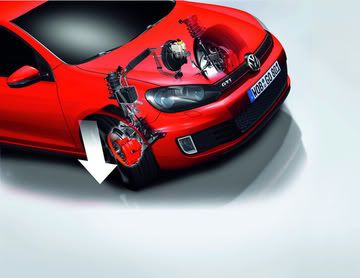
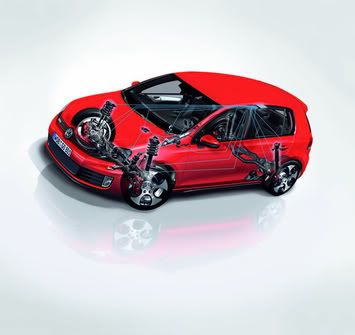
The sixth Golf GTI is equipped with a sport chassis; its front end was lowered by 22 millimeters, and its rear by 15 millimeters. The entire architecture of springs, dampers and rear stabilizers was completely re-tuned. In front, the familiar strut-type suspension operates with helical springs and telescoping shock absorbers. In the rear, an innovative multi-link suspension ensures that the ESP system seldom needs to intervene. The braking system is also extremely durable. Distinctive here are the red painted brake calipers.

Sportier and safer with XDS
For the first time in a Volkswagen, the XDS electronic transverse differential lock is being used. It significantly improves traction and handling properties. Technically speaking, XDS is a functional extension of the electronic limited-slip differential (EDS) integrated in the ESP system.

In fast curve driving, as soon as the innovative electronics detects that the wheel at the inside of the curve on the GTI’s driven front axle is insufficiently loaded, the ESP hydraulics specifically builds up braking pressure at this wheel to restore optimal traction. So XDS acts as a type of transverse differential lock that compensates for the understeering that is typical on front-wheel drive vehicles when driving fast through curves.

The results: Thanks to XDS, driving behavior is significantly more precise and neutral; drivers perceive this as more like the handling characteristics of a car with all-wheel drive than those of front-wheel drive. Hans-Joachim Stuck: "Beyond the GTI’s already good chassis layout, XDS gives the car an enormous measure of driving stability. And it leads to greater driving enjoyment, since it reduces understeering. Experienced sports car drivers will be much more active underway. Yet, XDS is a very important safety feature for normal drivers too, because they will not experience any unpleasant surprises with the GTI. It simply would no longer press ahead."

Dynamic yet comfortable with DCC
In addition, the dynamic chassis control (DCC) system mentioned by Strietzel is available on the new GTI. It continually reacts to the roadway and driving situation and modifies the damper characteristic accordingly. The driver perceives the significant advances in comfort and dynamic performance directly. During acceleration, braking and steering actions, damping is stiffened in just fractions of a second to optimally satisfy vehicle dynamic requirements and reduce pitch and roll movements as described by Stuck.

To let drivers choose the desired system behavior, besides the "Normal" program with a basic medium setting, DCC on the Golf GTI also offers the "Sport" and "Comfort" modes that are activated by a pushbutton above the shift gate. In "Sport" mode, the power steering is also tuned for greater dynamic responsiveness.

Cruising safely with ACC
For the first time, the distance control system ACC (Adaptive Cruise Control) will be offered on the Golf GTI starting in late summer 2009. When ACC is activated, the system automatically brakes and accelerates the GTI within a speed window from 30 to 210 km/h. Above all, when cruising at constant speed, e.g. at the speed limit on the freeway, ACC offers a significant plus in comfort and safety.

Distance control is implemented with a laser sensor in the rearview mirror that continually scans the distance to the vehicle in front of the car and its speed using five laser beams. The system operates successfully in curve driving too. ACC is controlled via a lever on the steering column. Important: As soon as the ACC system reaches its limits, the driver is asked to resume control by visual and acoustic warning signals.

Park Assist Generation II
Another high-end technology on the new Golf GTI is the optional Park Assist park steering assistant. The second generation of the system is used here. It enables nearly automatic back-up parking parallel to the roadway. The driver just needs to actuate the gas pedal, brake and (in the manually shifted version) clutch, while the GTI steers into the pre-scanned space by sensor control. Previously, the space had to be at least 1.4 meters longer than the vehicle; now 1.1 meters is sufficient. In addition, the system now enables multiple forward-reverse stages in parking. Park Assist deactivates itself as soon as the driver manually intervenes in steering. When the GTI is ordered with this system, the acoustic proximity warning system ParkPilot (front and rear) and Hill Hold Control are included too.

Bi-xenon headlights with curve lighting
As an option, Volkswagen is offering the Golf GTI with completely redesigned bi-xenon headlights, including dynamic curve lighting. The headlights swivel through a steering radius of up to 13 degrees to the outside and seven degrees to the inside. The styling of the headlights closely matches the GTI’s sporty character. The interior dual modules (xenon outboard, parking light / turn signals inboard) each have a chrome pod through which a very impressive visual image projects. Placed low below the bumper – and also GTI-specific in design – are the vertically aligned and always standard front fog lights.

Interior of the GTI
If there is such a thing as total ergonomic perfection, then it is to be found in the new GTI. Stuck: "This ambiance lacks nothing that a person would have in a luxury sedan. Nonetheless, the interior is uncompromisingly sporty. This begins with the seats. They offer a high degree of long touring comfort and are equally fit to run a 24-hour race. The GTI is super comfortable, super ergonomic. You can adjust everything on the seat. But there is no need to. You just climb in, move the seat forward once then back, and that is it. Sit down. Done. A perfect fit." A genuine compliment.

The Golf GTI is equipped with standard sport seats, which – as once before – are upholstered in a tartan fabric pattern ("Jacky"). Leather seats ("Vienna") are available as an option. A lumbar support integrated in the seats is positioned by a lever on the side of the seat. For safety, whiplash-optimized head restraints (WOKS) are also on board. The head restraints precisely counteract whiplash in case of an accident. The GTI logo has been worked into the WOKS material.

Additional features: Naturally, this Golf also has pedals with brushed stainless steel caps, a customized GTI gearshift lever in aluminum look, a leather steering wheel with grip recesses and GTI emblem; naturally there are decorative red seams on the steering wheel, gearshift surround and leather parking brake grip; naturally the roofliner is black, and so is the pillar trim. Naturally, because this Golf is a GTI. That is why the decorative inserts in the doors and instruments are also customized with "Black Stripe" style elements – black, high-gloss accents in metallic look. In any case, the GTI breaks through class boundaries with its high-end surfaces and features that are pleasing to the touch and the eye. The impression made by the materials and their workmanship, details like brushed chrome accents and elegant round instruments give the impression of actually sitting in a car of the next higher class, or in a far more expensive sports car. In contrast to most sports cars, however, the Golf GTI offers ample space for five persons. Its cargo capacity of between 350 and 1,305 liters also ensures that GTI drivers can handle nearly all of the challenges of daily life with confidence.

Legendary stylistic elements of sportiness shape the new era GTI

New GTI forges links to first generation of the sports car icon

The new GTI was created under the direction of Walter de Silva (Head of Group Design), Klaus Bischoff (Head of Brand Design) and Marc Lichte (Head of Exterior Design). And the car that de Silva, Bischoff and Lichte realized together does great credit to the first GTI. "We wanted a consistently clear GTI design, a car that has power, but style as well", is how Walter de Silva sums it up. "Also cast in stone was the goal of evoking the character of the first GTI a bit more", says Klaus Bischoff. "And that is why it was decided that – with the exception of the aerodynamically important rear spoiler – the new GTI would not have a single exterior add-on, unlike the usual practice in this segment", emphasizes Marc Lichte.

Wide, powerful GTI front end
Even the first GTI generation already exhibited a consistent horizontal alignment of elements in the radiator mask and headlights. The red grille surround is legendary. That made the original GTI look wider than it actually was. But it shared this basic design concept with lower-powered Golf versions. Generation V of the GTI, on the other hand, intentionally set itself apart from its less powerful counterparts. That is why – over five years ago – the team led by Lichte chose a black, high-gloss grille in V form. Since that time, any child was able to recognize it as a GTI. The new one too. It now melds stylistic elements of both of these GTI icons. Details such as the typical honeycomb radiator screen, and the V-shaped engine hood extending over the headlights, were contributed by the GTI V. The clear horizontal alignment, meanwhile, definitely originates from the GTI I.

The entire bumper plus radiator grille and inner design of the headlights are a new creation. The outer grille painted in high-gloss black is a flat surface again; a red stripe frames it at the top and bottom. To the left of the VW logo there is a GTI signature (from the first through the third generation it was always on the right).

On the level beneath, a trim strip in car color extends crosswise. At the center of the bottom section there is another air inlet that is very large. Toward the sides of the car it transitions to three cross beams, left and right, that look like gills; they end in the visually dominant fog lights that are arranged upright, or on edge. The plastic surfaces around the gills are painted in anthracite-metallic color, so that their contours do not disappear into a black hole. The fog lights – located extremely far outboard – visually draw the lower section of the bumper further outward than ever before. This stylistic touch and the basically horizontal formal styling of the front end give the 4.21 meter long Golf GTI a visual appearance that is wider (1.78 meter), lower (1.47 meter) and more dynamic than any other car of this class. A genuine GTI that can be recognized as such from five kilometers away.

Stylish GTI side profile
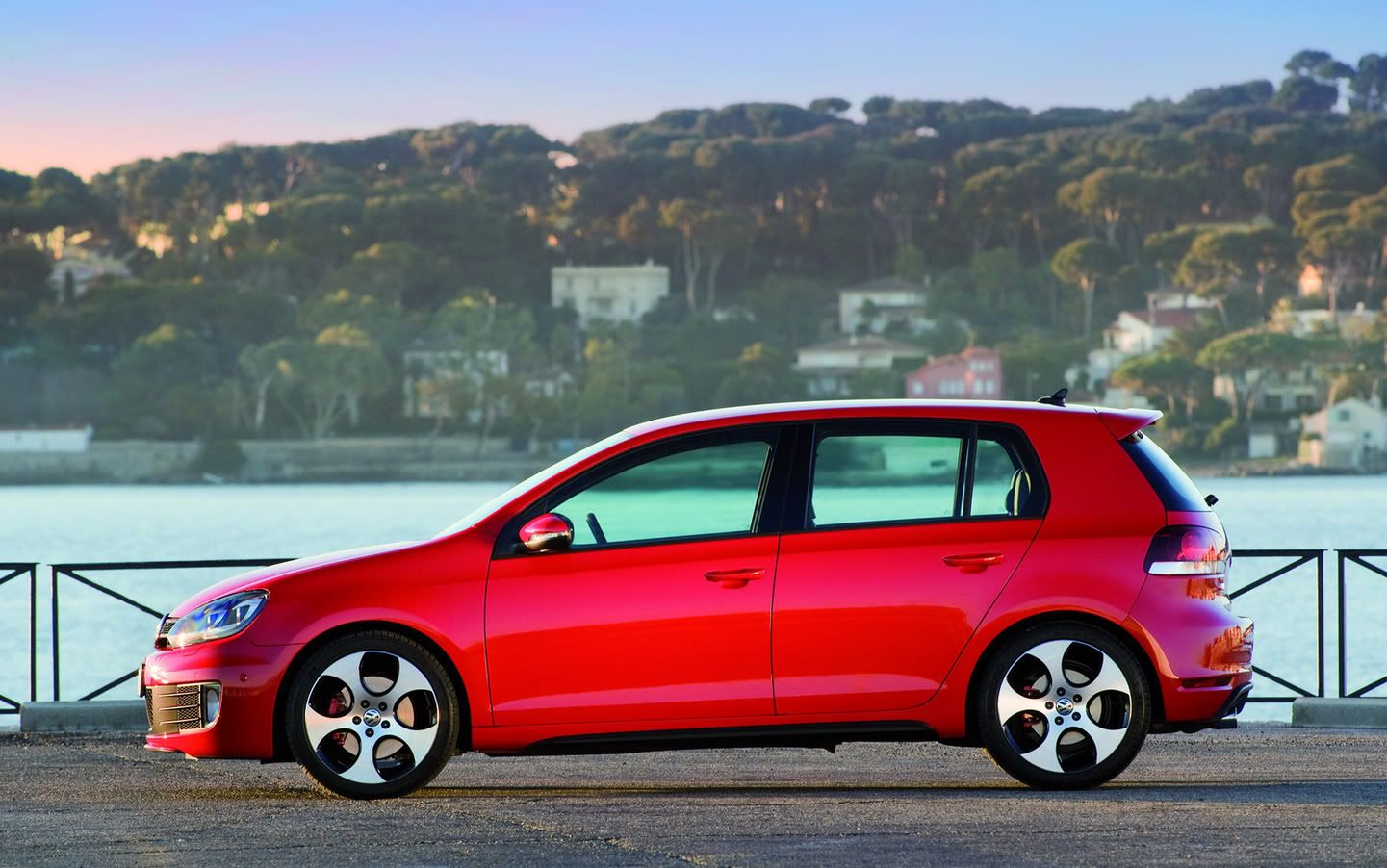
The sides of the new GTI are dominated by a very prominent character line that is drawn from the headlights to the taillights. Supported on this line – that is modeled as a muscular shoulder in the rear – is the roof. These proportions give the Golf GTI a lot of visual energy.

In its side profile, it is the bumpers extending far outboard and the unique form of the door sills that distinguish this GTI. The Golf GTI V had black sills set above the actual longitudinal beams, which extended from one wheel well to the other. The sills of the GTI VI are also black – but that is where the commonalities end. The aerodynamically sensible sills on the new car do not extend the full length, and this gives them a considerably more refined appearance and make the car appear lighter. The standard 17-inch "Denver" type alloy wheels – and the highly polished 18-inch "Detroit" alloy wheels available as an option – make a powerful statement. Both are classics of GTI styling. While the five U-shaped openings on the 17-inch wheels are designed in silver, the 18-inch wheels have a black piano paint look.

Rear of a GTI
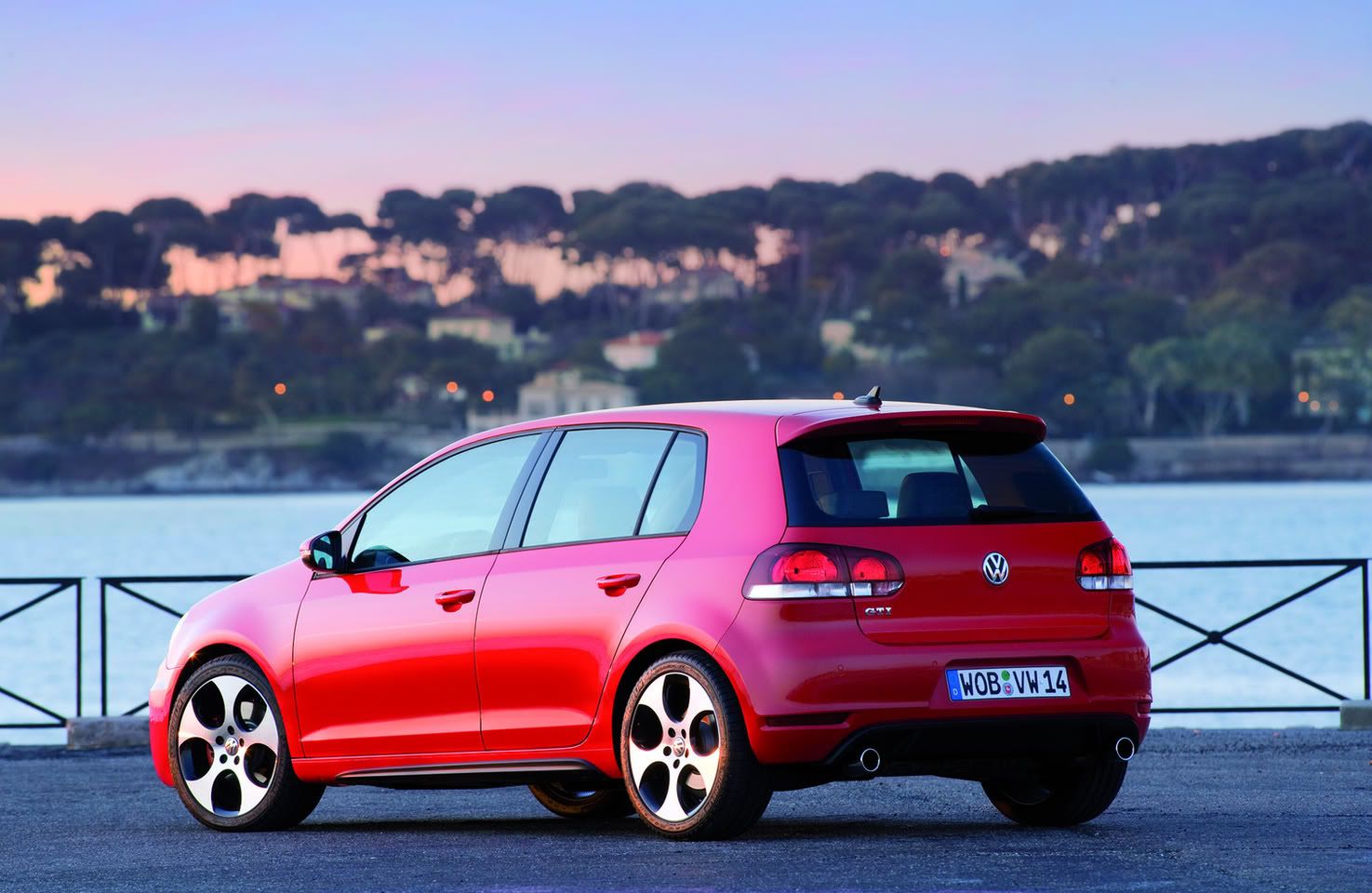
There is hardly a rear section that is so unmistakable as that of the new Golf GTI. Here too the wide bumper was completely redesigned. Under the bumper is a black diffuser that channels air from beneath the vehicle and generates added downforce at the rear axle. A pair of chrome tailpipes is integrated in the outer regions of the diffuser, right and left.

Also redesigned was the roof-edge spoiler. The new rear spoiler – working in tandem with the diffuser – perfects the car’s orientation to the road at very high speeds. Since the rear spoiler is larger than its counterpart used on the "normal" Golf, it extends further into the rear window and makes it visually flatter and wider; yet it does not impair the driver’s view.

The GTI Phenomenon

78 percent of all GTI drivers have always dreamed of this car;

For 30 percent of all GTI drivers, the GTI is their absolute dream car

When car drivers are asked why they purchased a GTI, they first mention the car’s exterior styling, followed by its overall performance, i.e. the combination of a sporty chassis and an agile engine. Precisely these two aspects – styling and performance – were rearranged by the Generation VI development team to bring the sports car’s character into even greater harmony with the original GTI concept. And that means: clear styling plus pure dynamics. No more, no less.

And because the Golf GTI is no ordinary car – it is also an automotive perspective on the world – it is worth taking a look at the facts behind the "GTI phenomenon": the Golf GTI is the global market leader in the high-performance section of its class. The same holds true in Europe and Germany. 84 percent of buyers are men, and six out of ten of them are married. 70 percent of all GTI drivers have more than one car, have no children and are under 50 years of age (average age is 39). Their three favorite colors are black, white and red. 78 percent of new customers always wanted to drive a GTI sometime. Volkswagen also asked the GTI drivers about their dream car. The key wording here: if money were no object. And the response was truly resounding: for nearly 30 percent the GTI would be their first choice, even if they had all of the money in the world. An extraordinary compliment. Incidentally, taking places 2 and 3 of this hit list were the Porsche 911 and the Audi R8, two super sports cars from the same Group.

History of the origins of the first Golf GTI
Vision of a world success originated in 1973

The Golf GTI is a phenomenon, a brand within the Volkswagen brand, an automobile world view and an unmistakable design statement that has now attained sales of 1.7 million units. It is an original among sporty compacts. Spectacular stories have always circulated about how the first GTI (Gran Turismo Injection) came into being. At the center of these stories there is always a "secret society" of people who pushed through the GTI right up to production stage against the clock and opposition from their superiors. Many of the tales about these developments that have been passed down are true, but just as many of them have become distorted over the decades and are often wrong. The fact is that the Golf GTI was the ingenious idea of a few men. This is their story and the story of the first GTI.

Everything began, as always, with the Beetle
Let us fade back to 1973 when Volkswagen launched a very sporty version of the Beetle. The "Yellow and Black Racer," as it was called, differed from the normal Beetle in that it had a black hood and engine cover, slightly wider tires (5.5 instead of 5 inches), sport seats with head restraints (!) and a proper leather steering wheel. Technically, it was still the same old Beetle with 1,600cc, 50 horsepower, no more. Despite its relatively modest output, this "aggressive model from Volkswagen" even caused a stir in the German parliament.

Yet, to the dismay of a few insider experts it was popular among the public. This fast looking Beetle model sold out in no time at all, and this paved the way for a two-year project in Wolfsburg that – even within the company – only a handful of people would know about.

The founders emerge
It is still 1973, March 18 to be precise. On this day, memorable from today’s perspective, test engineer Alfons Löwenberg wrote an internal memo to a few colleagues from the Research & Development department. He proposed that Volkswagen should consider putting together a proper sports model. After all, a new vehicle with the project code EA 337 (the internal code name for the future Golf) had reached the final stages of development – and a modern front-wheel car with high-performance would open up a completely new group of customers for Volkswagen.

Recipients of the memo were reluctant at first. Only chassis specialist Herbert Horntrich and development chief Hermann Hablitzel were at least somewhat receptive to Löwenberg’s idea. However, Löwenberg kept at it and found other like-minded colleagues such as marketing man Horst-Dieter Schwittlinsky and Anton Konrad, Volkswagen’s PR director at the time. Konrad – who had been manager of the Formula V association for many years and enjoyed race car driving as a hobby – was particularly taken with the idea. He was also aware, however, that the seedling called sportiness needed to be cultivated with extreme discretion within the company. The high development costs for the new model that would be launched as the Golf in 1974 had already put a strain on the company’s finances.

Secret meeting over beer and sandwiches
Konrad invited the secret developers of this "Sport Golf" work group to meet at his home. Over beer and sandwiches, Hablitzel, Horntrich, Konrad, Löwenberg and Schwittlinsky sorted through the possibilities like co-conspirators. Hablitzel was now definitely on board, and his tacit approval allowed Löwenberg and Horntrich to get down to work. Taking a Scirocco prototype with a rock-hard chassis, they lowered the suspension dramatically, souped up the basic 85 PS 1.5-liter Scirocco engine to about 100 horsepower with a two-stage carburetor and crowned it with an exhaust pipe that resembled a stove pipe and sounded like one too.

Prototype 1 is over the top
Today, Konrad remembers the car as "a roaring monster". The secret team soon agreed that this was not what they wanted. The Sport Golf should have a sporty image, but it should be civil. So, Löwenberg and Horntrich decided to build a more reasonable version. The result was not quite as ferocious, but it was still quite fast. The whole undercover group felt much better about this new model, and Hablitzel plucked up some courage. He informed development chief Professor Ernst Fiala about the sporty car and asked him what he thought. Fiala delivered a fatal blow: "It’s far too expensive, you’re all mad," he retorted briefly and succinctly.

However, Hablitzel and his men would not be deterred. The prototype based on the Scirocco was officially declared a chassis test platform, but its development continued unofficially. Löwenberg fine tuned the engine, while Horntrich configured the chassis for the proposed beefy tires. 205/60 HR 13 would be the tire size, which back then would have even put a Porsche 911 to shame – the quintessential Teutonic sports car still ran on 185/70 tires in 1974.

Management says it’s a "go" in Spring 1975
Not surprisingly, the "chassis test platform" caused a great stir when Hablitzel & Co. demonstrated their latest projects to Volkswagen management at the Ehra-Lessien test center in Spring 1975. Even Professor Fiala was now taken by the Sport Golf in a Scirocco outfit – and he gave his approval. At the end of May, an official vehicle proposal was sent to the development department: A sporty version of the Golf is needed.

The Golf becomes the GTI
At the same time, Sales sensed the good market opportunities for a sporty Golf, and Volkswagen still needed a crowd pleaser for the upcoming International Motor Show in Frankfurt. The project suddenly acquired momentum from all quarters. Six prototypes with different configurations were created, ranging from a speedster trimmed for maximum sports car performance to a modestly understated version. Chief designer Herbert Schäfer was responsible for all the fine details that would set the future GTI apart from its less powerful rivals. The red stripe on the radiator grille, for example, and the larger front spoiler, modest plastic wheel well extensions, matte black frame on the rear window, black roofliner, golf ball knob on the gearshift lever and checked pattern of the seat covers.

Technical fine tuning
Herbert Schuster, the new test manager, immediately declared chassis development a top priority. To cut costs, he reduced the width of the wheels from 6.0 to 5.5 inches and shrunk the tire size to 175/70 HR 13. He did, however, also add stabilizers for the front and rear axles and developed a spring/damper configuration that provided a perfect synthesis of comfort and sportiness. In collaboration with Audi, an ultra-modern 1.6-liter fuel-injected engine delivering 110 PS was produced.

World premiere in 1975 at the IAA in Frankfurt
The former undercover team finished its work right on schedule. When the 46th Frankfurt International Motor Show opened its gates to the public on September 11, 1975, a red wonder celebrated its debut at the Volkswagen booth: the Golf GTI concept car. "The fastest Volkswagen ever" boasted the advertisement – and that was no exaggeration. The GTI accelerated from a zero to 100 km/h in about nine seconds, leaving considerably larger and more expensive cars behind. The cautiously announced price of "under 13,000 German Marks" was still at least 5,000 German Marks less than its key German rival. As a result, car show visitors were so enthusiastic about the car that company management had no other choice than to build a special series of 5,000 cars.

GTI mania begins
The GTI ended up costing 13,850 German Marks when it was launched in mid-1976. Despite the higher price, dealers still managed to sell ten times the planned sales volume in its first year on the market. And that came as no surprise: "Climbing an Alpine pass in the GTI – this is one of the most exciting driving tasks that a car enthusiast can have" is how the German automotive magazine "auto motor und sport" extolled the GTI. That sums it up, even 33 years later.

1976 to 2009 – key events in the history of the GTI

1.7 million GTIs – the world’s most successful compact sports car


June 1976 marked the production launch of the first Golf GTI. The planned output of what was originally a limited edition: 5,000 GTIs. But it turned out entirely differently. The 81 kW / 110 PS strong and 182 km/h fast Golf GTI won over a new group of customers and founded the GTI class. Over five GTI generations, the original 5,000 units turned into more than 1.7 million. No other compact sports car in the world even comes close to being that successful. What follows is an overview of the key events in the history of the Golf GTI up to market launch of the sixth generation:

1976: Debut of first generation Golf GTI
(1.6 liter with 81 kW / 110 PS)

1979: Facelift

1982: Performance boost of the Golf GTI
(1.8 liter with 82 kW / 112 PS)

1983: Introduction of the "Pirelli GTI"
(officially "Special Model Golf GTI", features included special wheels)

1984: Debut of second generation Golf GTI
(1.8 liter with 82 kW / 112 PS)

1984: Introduction of catalytic converter
(79 kW / 107 PS instead of 82 kW / 112 PS)

1985: Facelift, dual headlights and dual tailpipes

1986: Introduction of the Golf GTI 16V
(1.8 liter with 102 kW / 139 PS and 95 kW / 129 PS with catalytic converter)

1990: Introduction of the Golf GTI G60
(1.8 liter with 118 kW / 160 PS)

1991: Debut of third generation Golf GTI
(2.0 liter with 85 kW / 115 PS)

1992: Introduction of the Golf GTI 16V
(2.0 liter with 110 kW / 150 PS)

1996: Presentation of anniversary model "20 years of GTI"
(2.0 liter with 85 kW / 115 PS and 110 kW / 150 PS
and for the first time 1.9 TDI with 81 kW / 110 PS)

1998: Debut of fourth generation Golf GTI
(1.8 T with 110 kW / 150 PS, 2.3 V5 with 110 / 150 PS
and 1.9 TDI with 81 kW / 90 PS);
later 2.3 V5 with 125 kW / 170 PS,
1.9 TDI with 85 kW / 115 PS and 96 kW / 130 PS)

2000: Introduction of the most powerful Golf GTI TDI to date
(1.9 TDI with 110 kW / 150 PS)

2001: Introduction of the Golf GTI "25 years of GTI"
(1.8 T with 132 kW / 180 PS)

2004: Debut of fifth generation Golf GTI
(2.0 TSI with 147 kW / 200 PS and optional 6-speed DSG)

2006: Presentation of anniversary model "Golf GTI Edition 30"
(2.0 TSI with 169 kW / 230 PS)

2007: Presentation of special edition "Golf Pirelli GTI"
(2.0 TSI with 169 kW / 230 PS)

2008: World premiere of sixth generation Golf GTI
in October as concept car at Paris Motor Show

2009: Debut of sixth generation Golf GTI
International press presentation in March / April in Southern France; start of market launch phase in Europe
(2.0 TSI with 155 kW / 210 PS and optional 6-speed DSG)

Source: Volkswagen


Friday, March 20, 2009

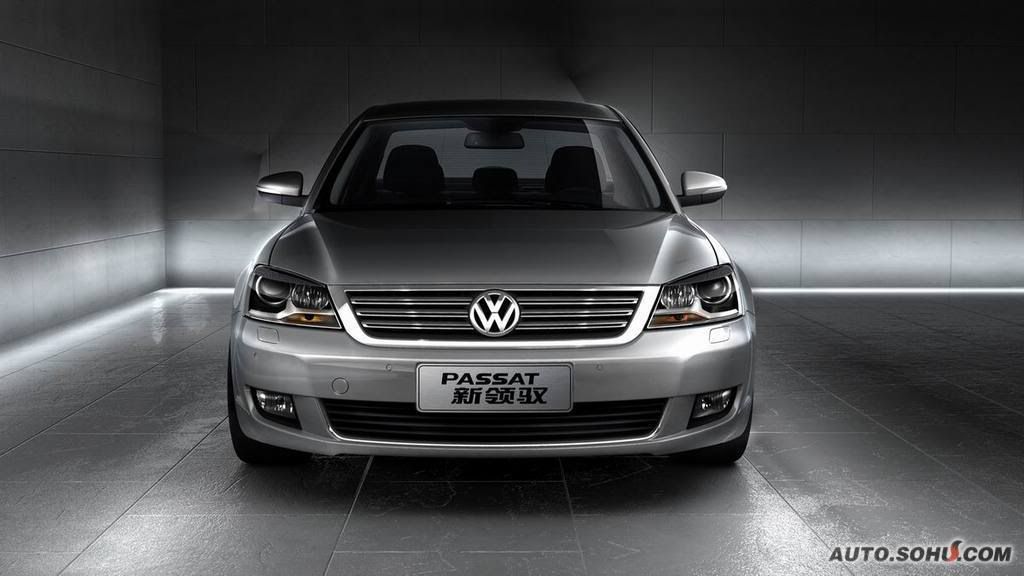
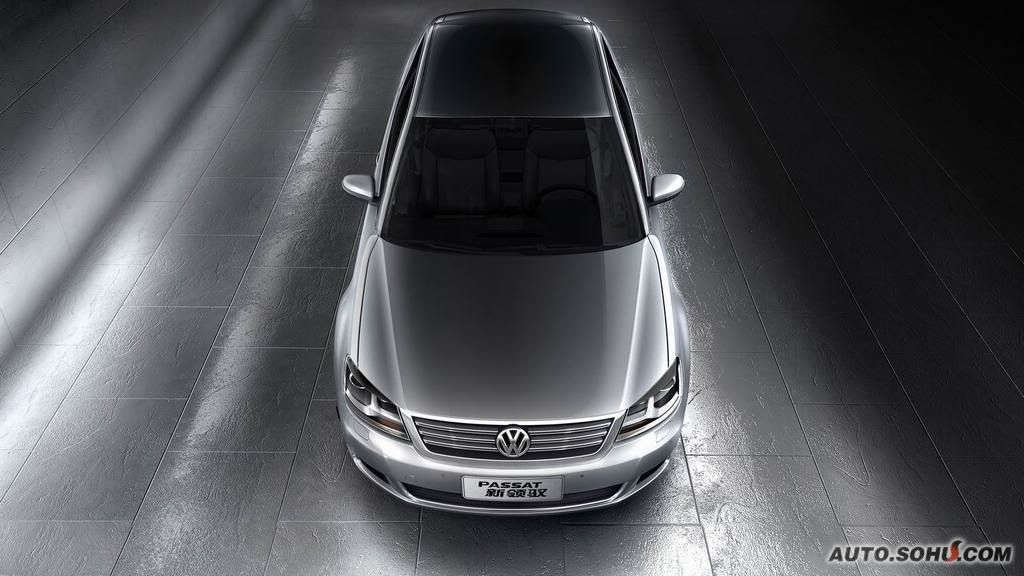
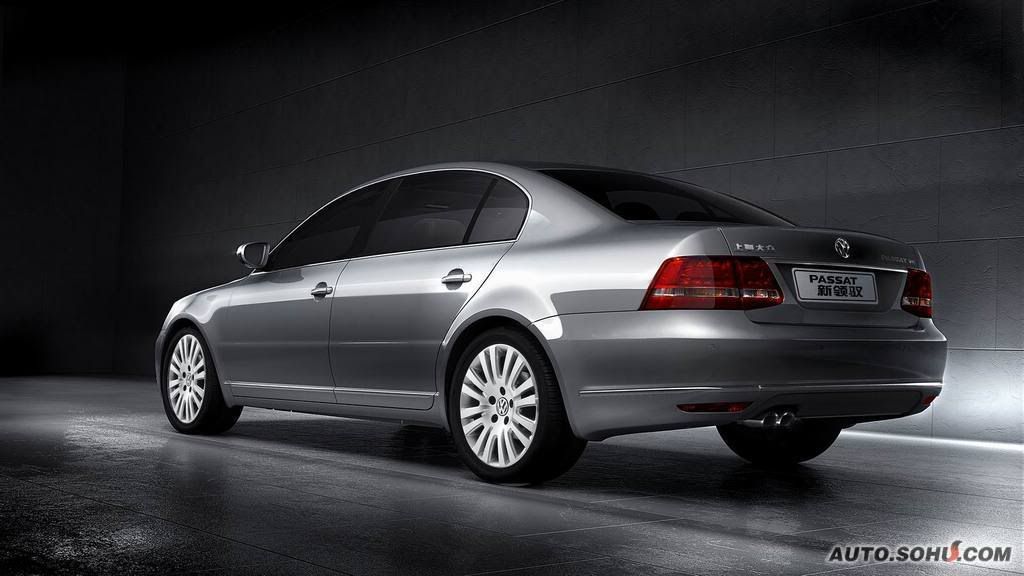
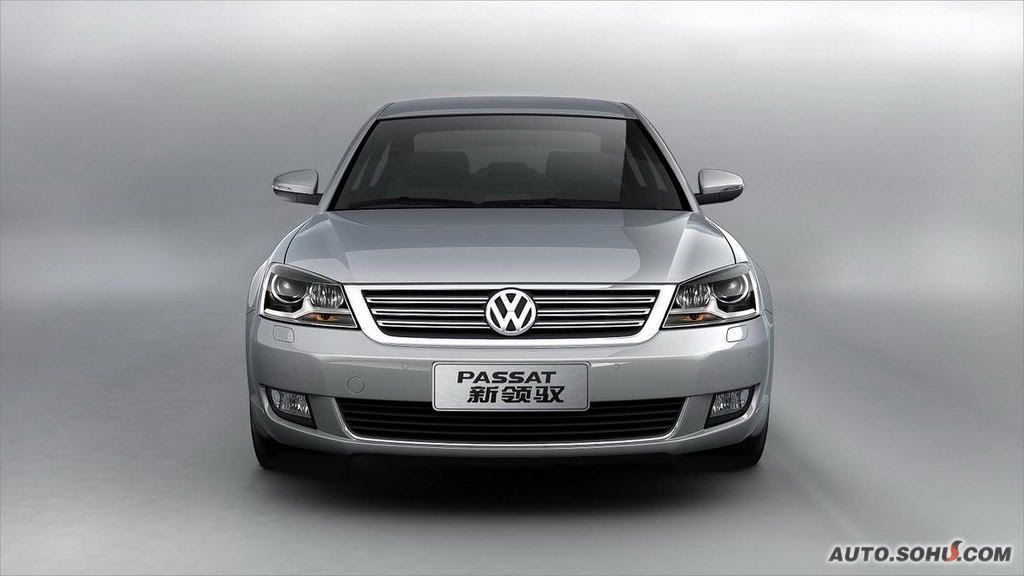
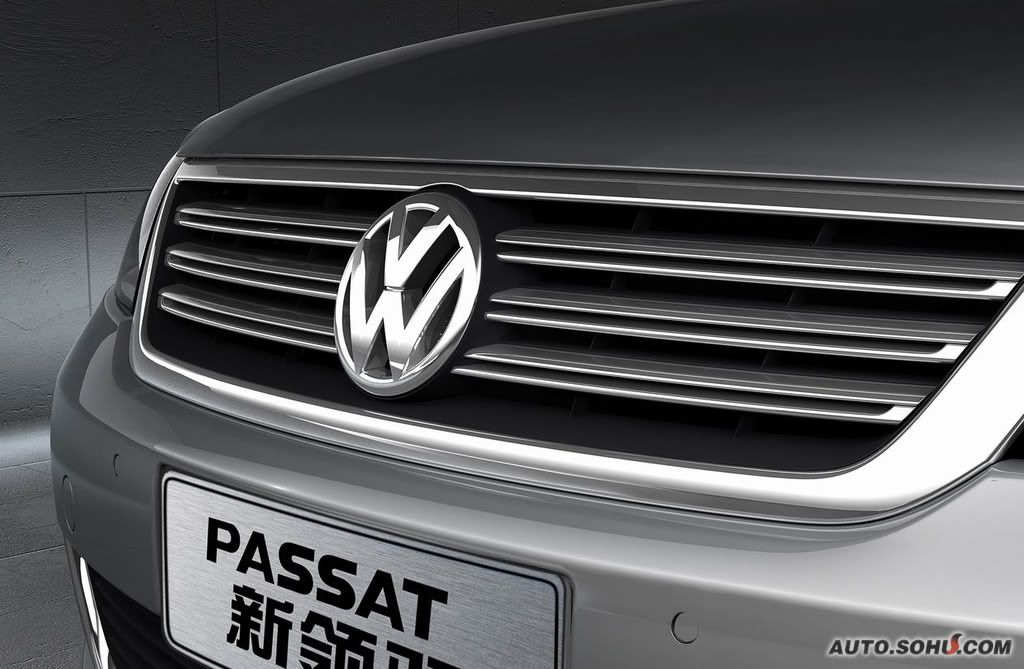
2009 Passat Lingyu - First Official Pictures


Ahead of the 2009 Shanghai Auto Show, Shanghai Volkswagen have released first images of it updated Passat Lingyu before New Midsize Sedan arrives next year.

Going from google translations it has all the safety needs in a Midsize Sedan class eg ABS, EBD, ESP and Curtain Airbags etc; it will also have a DVD entertaiment system as well.

Stay Tuned for Official Press Release due in April at Shanghai of course !!!

Source Shanghai Volkswagen and Auto Sohu.com

Sunday, March 8, 2009

Volkswagen to take on "Dakar" challenge again in 2010

Volkswagen will again participate in the legendary Dakar Rally in 2010. After the one-two victory and the historic first "Dakar” triumph of a diesel-powered car this year, the automobile manufacturer from Wolfsburg will yet again take on one of the major challenges of international motorsport.

"No doubt, the 2009 Dakar Rally contributed to the fact that the Volkswagen brand is now shining even brighter around the world,” said Prof Dr Martin Winterkorn, Chairman of the Executive Board of the Volkswagen Group, on the occasion of the "Dakar” victory celebration at the Wolfsburg "Autostadt”. "Therefore, our participation in this event is a good investment in the future of our company and that’s why we decided to again compete in the Dakar Rally in 2010.”

In the Race Touareg powered by a 280-hp TDI diesel engine Giniel de Villiers/Dirk von Zitzewitz had won the "Dakar” that was staged for the first time in South America; as the runners-up, Mark Miller/Ralph Pitchford gave Volkswagen a one-two victory. In 2010, the Dakar Rally will be held in Argentina and Chile again, from 02 to 17 January.”

"Besides our joy about this sporting exploit, the positive response by media around the world convinced us,” said Dr Ulrich Hackenberg, Member of the Executive Board of the Volkswagen Brand with responsibility for Technical Development including the manufacturer’s motorsport commitment. "Our ‘Dakar’ win stands for enormous reliability and innovative technology – and these are values which substantially stand for all Volkswagen vehicles. Particularly in TDI technology, the development activities for motorsport result in valuable synergies benefiting our production vehicles as well,” commented Dr Ulrich Hackenberg.

Preparations for the two-week cross-country rally covering 9,500 kilometres across the desert and the pampas have already started. "We’ve got quick drivers, a reliable car and an experienced team – in other words, everything we need to again contest the ‘Dakar’ and to fight for victory,” said Volkswagen Motorsport Director Kris Nissen. That is why in 2010 the victorious Race Touareg 2 will compete in the event yet again.

Volkswagen Motorsport