Key Aspects: The New Polo – World Premiere at the 2009 Geneva Motor Show
Fifth generation Polo brings new dimension of quality to the supermini class
Five new engines; TSI and Common Rail TDI in the Polo for the first time
3.8 liter fuel consumption and 96 g/km CO2 set new benchmark for five-seaters
ESP is standard equipment; significantly improved crash propertiesWolfsburg / Geneva, 25 February 2009 - World premiere in Switzerland: Volkswagen is introducing the fifth generation of the Polo at the Geneva International Motor Show (March 5 to 15) – the new edition of one of the most influential German cars of our times. Prof. Dr. Martin Winterkorn, Chairman of the Board of Management, Volkswagen Group: “Through the combination of the car’s design and technology, aligned with forthcoming market requirements, we have repeated our achievements in the recently launched new Golf in the class below. This takes us to an entirely new level of high customer value and efficiency among small cars and indeed at prices that are still affordable.”
The new Polo - Design and quality philosophy
1:1 transfer of Volkswagen “Design DNA” to the fifth generation Polo;
compact Volkswagen was designed under the leadership of Walter de SilvaVisually speaking, the 2009 Polo was developed 1:1 from the principles of the new Volkswagen "Design DNA". The Scirocco, the first model with this pedigree, was sent to the races in 2008 to take pole position among the world’s best cars. Today, this coupé retains its value more consistently than any other car in Germany. The second wave of the new DNA also debuted in 2008 in the new Golf and its high-roofed counterpart, the Golf Plus. These models have since regained number 1 rankings in the eyes of buyers, a fact born out in car registration statistics. And now comes the third model based on the new Volkswagen Design DNA – the Polo.
Close network of designers, development engineers and production expertsA precondition for implementing this design philosophy which is characterized by the greatest precision and clarity, are progressive and highly innovative development and production methods. Designers, development engineers and production experts at Volkswagen work together in a more closely connected way than is otherwise usual. Their goal was to produce a level of quality, both technical and visual, which is generally only found in cars several classes above. This alliance has been implemented with great success over the past two years by a new leadership team under the direction of Prof. Dr. Martin Winterkorn. Here, experts such as Prof. Dr. Jochem Heizmann (Member of the Board of Management, Volkswagen Group; Production), Dr. Ulrich Hackenberg (Member of the Board of Management, Volkswagen Brand; Development) and Walter de Silva (Head of Group Design) combine their creative energies to design and produce cars like the new Polo.
Sharp, precise linesThanks to the new design DNA defined by Walter de Silva, the impression that this Polo makes – in contrast to many other cars in the so-called A0 or supermini class – is not contrived or ‘cute’; instead it is mature but contemporary. The Polo, with its distinctive new Volkswagen family face, is instead a purposeful and impressive car, which – measuring just 3,952 millimeters in length (+36 millimeters compared to previous model) and 1,682 millimeters wide (+32 millimeters) – offers space for up to five people and luggage (280 to 952 liters). The car’s generous gain in width combined with a reduction in height (-13 to 1,454 millimeters) lends the Polo a more dynamic stance and purposeful appearance. The design itself is defined by sharp, precise lines without stylistic gimmicks that quickly fade in popularity; because in the long run, less is more – and the consistently high resale values of Volkswagens are longstanding proof of this claim.
Walter de Silva’s creative touch in a style of "Semplicità"This explains why Walter de Silva intentionally declared "La Semplicità" – "the simplicity" – as his credo here. "La Semplicità" in no way means a diminishment of features. The opposite is the case. Walter de Silva: "Elegance and emotionality, sportiness and dynamics, continue to guide design and styling. But styles have changed. In pursuit of simplicity and clarity, one must carefully consider how to express the intentions of designers while speaking to those of the observer."
The starting point for all of these deliberations is the car’s reflection on the Volkswagen brand, its history and its values. "Certain distinctive design elements", says de Silva, "have evolved as typical of the brand. Mastery of the architecture and balance of proportions form the foundation, the emphasis on horizontal lines has evolved into a unifying characteristic across models, and a literal love for details has become an essential means of expression." Above all, there is a very high level of quality that can be clearly seen in the unmistakable precision of the car’s lines and in the treatment of its surfaces. The new Polo reflects these design principles par excellence.
The new Polo - Exterior
Impressive design with clear, dynamic forms;
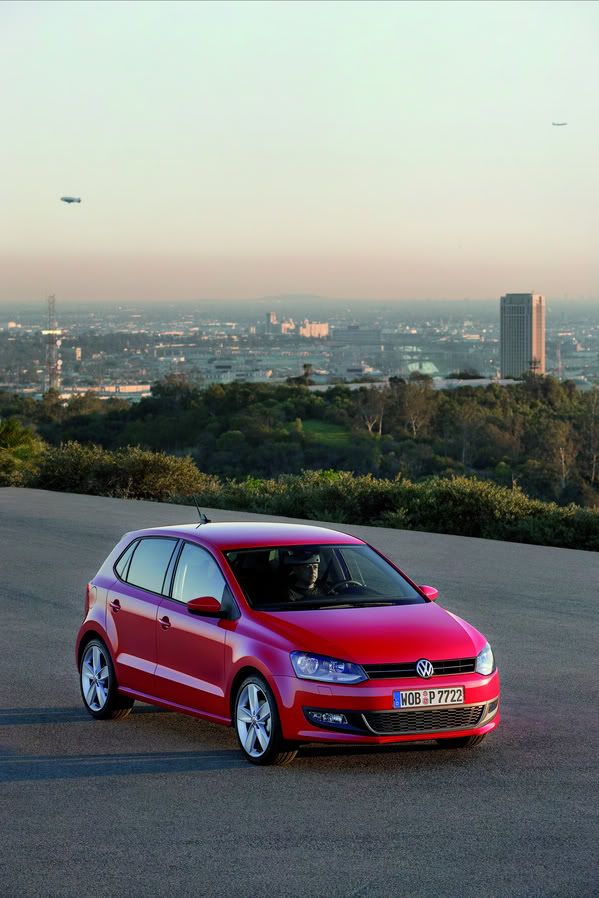
fifth generation Polo shows its new Volkswagen family faceAs soon as you see the Polo, you are struck by its self-assured proportions. The car’s basic layout looks dynamic, while the design is clean and the overall appearance very purposeful. Better resolved surfaces, tight seams and extremely sharp panel edges in its side profile, engine hood and tailgate underscore the car’s logical design concept. Above all, the gain in width leads to a very full, powerful image from every perspective.
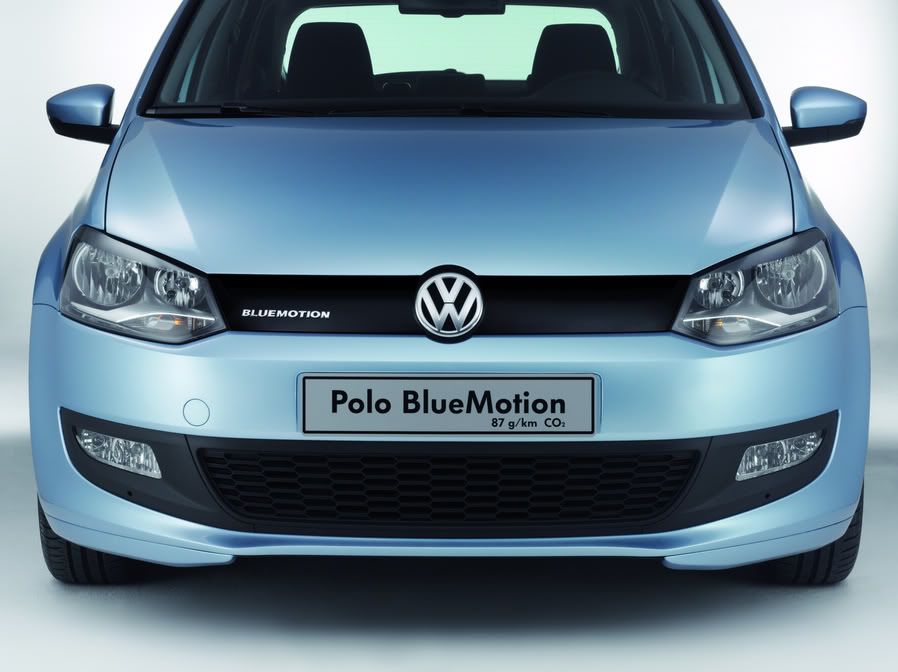
Front endThe Volkswagen family face that has been specially adapted to the Polo – with its flat grille and band of headlights that has typified the brand ever since the Scirocco – emphasizes the new car’s additional width. Moreover, it conveys an image of the car’s very low center of gravity. Harmoniously integrated in this face are the Polo’s body-colored bumpers beneath the black grille.
In a third horizontal line below this, there is another large air inlet that supplies the engine and brakes with ample air. At its sides, this black band incorporates the daytime running lights and fog lights with integrated turn indicators. The daytime running lights save up to 0.15 liter of fuel per 100 kilometers compared to conventional continuous running lights. Just a few centimeters above the road, the narrow body-colored front spoiler catches the eye. This spoiler has been moved forwards, and makes a decisive contribution towards the car’s exemplary pedestrian protection credentials.
Volkswagen offers the Polo with two or three different headlights, depending on selected options: the "Trendline" base version is fitted with H4 headlights. H7 dual headlights are installed starting with the "Comfortline". The H7 headlights offer ten percent greater lighting power compared to headlights on the previous model. Also integrated in the headlights are the turn signal lights. Stylistically, outer and inner design features of the headlights with their different lighting elements join together with the lines of the radiator grille to form one unit.
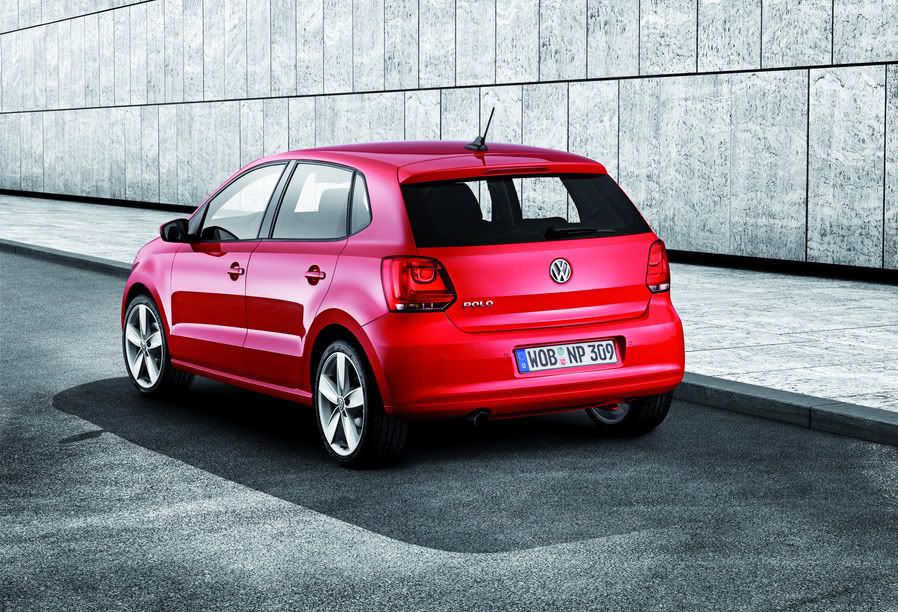
Rear endThe rear of the car is characterized by geometric order and sportiness. The design cue from the headlights, with their line breaking off with an upward turn, is taken up again in the taillights. These also display a very distinctive night image and extend into the Polo’s broad shoulder. Supported on these shoulders – in the area of the lateral "character line" that can be seen from every perspective – is the roof section. Meanwhile, the tailgate extends right down to the bumper. Just as on the Golf, the Polo’s tailgate is opened with the VW logo, which swivels up and acts as a handle. Standard equipment: a roof edge spoiler integrated in the tailgate.
The car’s image is also exceptionally powerful from the rear. From this angle it becomes clear how the designers exploited the increased track width (+30 millimeters both front and rear) and stretched the outer wheels along a vertical plane right up to the wheel wells as though carved out with a knife. That is also why the Polo can easily accommodate very large wheel-tire combinations. The range of optional tire dimensions extends all the way to 215/40 R17.
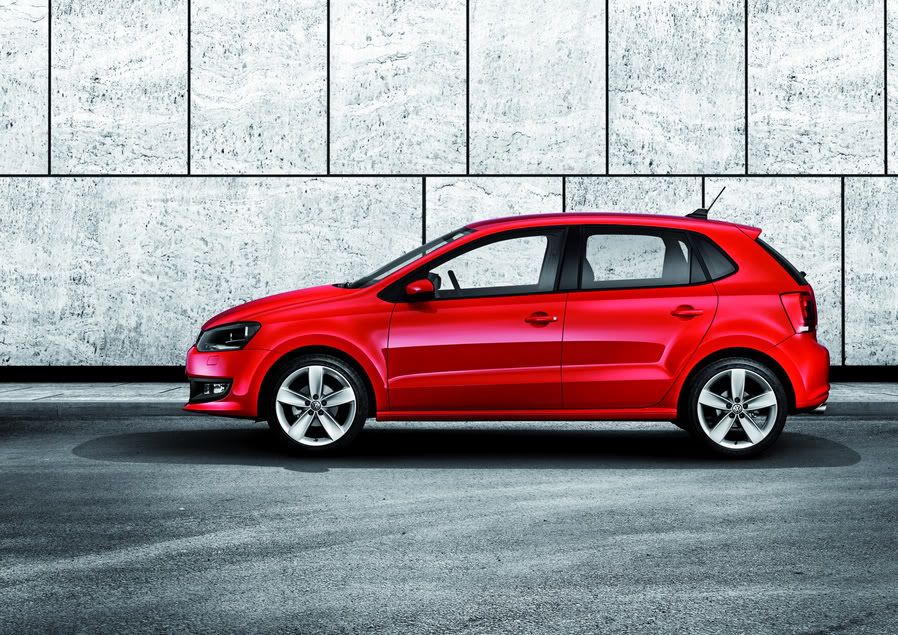
Side profileThe lateral profile line is, among other things, dominated by the distinctively sporty front overhang and extremely short rear overhang, the clearly modeled "character line" and low roof that slopes towards the rear. The prominent shoulder line also gives the vehicle a new lateral structure and underscores the generally more masculine appearance. Since the fourth generation, the five-door Polo has also sported what is known as a "three window look". This refers to the third side window integrated in the C pillar. This design characteristic is especially prominent on the new Polo. In the area of the A and C pillars, the lower window line also takes an upward sweep, a reference to the styling of the headlights and taillights. Also striking are the pronounced side skirts, whose shape offers aerodynamic benefits. The Polo’s underbody is also optimized for optimal airflow. Also enhancing aerodynamic performance are the newly developed outside mirror housings, whose air resistance has been reduced by 20 percent compared to the previous model.
The new Polo - Interior
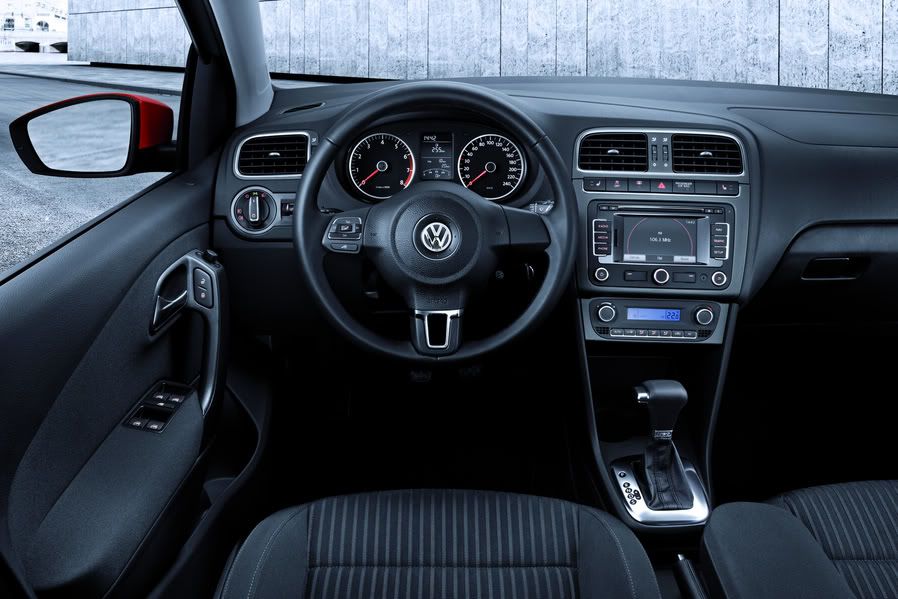
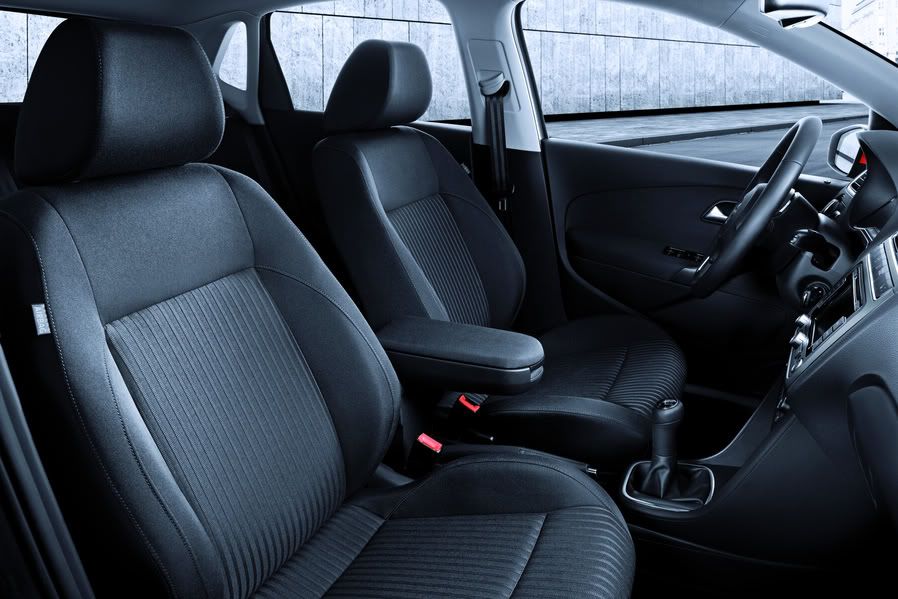
Interior brings new level of quality to the class to the small car class; new cockpit in the five-seater has decidedly driver-oriented ergonomicsAll Volkswagens are recognized for having intuitive user controls and excellent ergonomic properties – regardless of the proportions of their driver and passengers. These are clearly properties of the new Polo too. The entire interior was redesigned. Starting with the "Comfortline", the surface of the instrument panel is upgraded by so-called slush technology (a high-end surface structure that is soft to the touch). The lower area of the cabin as well as the door inserts and interior trim panels may be ordered in either "Anthracite" or "Seashell".
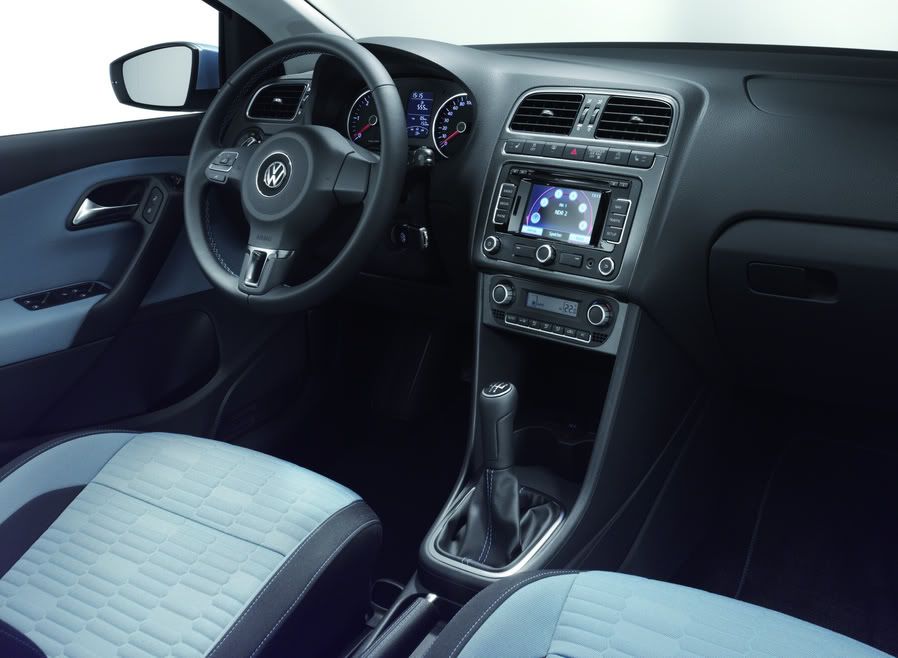
Driver-oriented ergonomicsNoteworthy here is the center console that is now turned more toward the driver for convenience. The controls on this console are organized as on the previous model, but have been completely redesigned. At the very top there are two central air vents, which have high-end bezels in aluminum look from the "Comfortline" up ("Trendline": high-gloss black). On the level below, Polo drivers will find a familiar row of switches with details like the hazard lights switch, which is readily accessible and visible, and push buttons for the heated rear window and optional heated seats. The next level down contains controls for the new radio and radio-navigation systems that are all being introduced on the Polo for the first time. Top of the line equipment here is the RNS 310 – a radio-navigation system with touchscreen, multimedia interface (MEDIA-IN), MP3 functionality (via CD, DVD or SD card) and AUX-IN socket on its front panel. The RNS 310 may also be upgraded to include a hands-free telephone unit.
Finally, the lowermost console level is home to the completely redesigned user controls for the ventilation or climate control system ("Climatic" is standard equipment starting on the Comfortline). Practical: The glove box can also be cooled in this case. Also integrated here are a sunglasses compartment, the deactivation switch for the front passenger’s airbag and – if included as options – the switches for the tire monitoring indicator (air pressure monitoring) and an MP3 port. The vehicle service book is stored in a space-saving storage slot at the base of the glove box. Directly in front of the gearshift lever are a 12V outlet and an AUX-IN socket for integrating another player.
White instrument backlightingThe instruments of the Polo were also redesigned; they now have white backlighting and are styled like those on the Golf. The fuel gauge is digital in the new generation Polo. Like the bezels for the air vents, the rotary light switch – still located on the left – gets a high-end metallic look from "Comfortline" up.
Similar to other new models of the Volkswagen brand, new three-spoke steering wheels were also developed for the Polo. The top version sports a leather steering wheel that is somewhat more compact than on the Golf. An optional multifunctional steering wheel (with user controls in the left spoke) will be offered too. Making a decidedly ergonomic impression are the armrests in the door trim panels (with storage bin for a 1.5 liter bottle) and a front center armrest (folding with storage compartment) that can now be ordered on the Polo for the first time.
More space at all seating positionsThe driver’s seat, front passenger’s seat and rear bench seat were all redesigned. More space is now offered at all five seating locations in the Polo. In particular, knee room in the rear is greater due to the growth of the interior length to 1,674 millimeters (+8 millimeters). Shoulder room in front (1,372 millimeters) is also increased by 22 millimeters. Thanks to these new dimensions, the new Polo offers an interior ambiance that is considerably more spacious. The Polo also proves to be very versatile: Folding the rear bench seat (with standard 60:40 split starting on the "Comfortline") is very simple; the car then offers a level cargo surface due to the dual cargo floor that is standard equipment from the "Comfortline" up. The dual cargo floor can be mounted at two different heights.
The new Polo - Engines
Seven engines will be offered on the new Polo in 2009;
new TSI with 5.5 liters fuel consumption or the new BlueMotion TDI with 3.8 litersSeven engines will be offered on the new Polo during its first year of production – four gasoline and three diesels. Five of these engines are brand new or are being used for the first time in the Polo; three of them can be paired with the innovative 7-speed dual clutch transmission (DSG) as an option instead of the manual 5-speed or 6-speed transmission. The gasoline engines, two three-cylinder and two four-cylinder engines, sport a power range extending from 44 kW / 60 PS to 77 kW / 105 PS. New to the lineup are the two strongest gasoline engines, the 1.4 liter with 63 kW / 85 PS and the 1.2 TSI with the noted 105 PS that is shifted by a standard 6-speed transmission.
Also new to the Polo are all three common rail turbo-diesels. These high-torque four-cylinder engines produce between 55 kW / 75 PS and 77 kW / 105 PS. A BlueMotion version based on the mid-range power level of 66 kW / 90 PS will also debut in 2009; this Polo BlueMotion will consume just 3.8 liters of fuel per 100 kilometers and emit only 96 g/km CO2. A summary of all engines being offered on the Polo in 2009.
The new Polo - Chassis
McPherson strut type suspension in front and semi-independent suspension in the rear; standard ESP and larger brake boosterVolkswagen has completely redesigned the Polo chassis with its McPherson strut type suspension in front and semi-independent suspension in the rear. Its track width was increased by 30 millimeters front and rear (giving new dimensions of 1,464 mm front, 1,456 mm rear). The result: enhanced vehicle dynamics.
Improved directional stabilityIn front, Volkswagen has integrated a completely redesigned McPherson strut type suspension with a thirty millimeter wider track width. The front wheels were moved five millimeters forward to achieve a greater caster angle, and this offers greater directional stability. Furthermore, new strut bushes are used on the Polo; on the one hand they are lighter, and they also improve ride comfort. Larger wheels can now be used as well, and this further improves comfort. At the same time, these wheels have a positive effect on driving performance. The Polo is being sold in Germany and in other markets with electronic stabilization program (ESP), including Hill Hold Control, as standard equipment. Overall braking system performance was adapted to the new generation Polo; among other elements, the 8.5 inch brake booster is being replaced by a higher performance 10 inch system.
To attain its five star rating in the EuroNCAP crash test, the steering column – with its continuously variable height and reach adjustment – was completely redeveloped. This redesign resulted in reduced weight. The standard electro-hydraulic power steering was taken from the previous model and adapted to the new front suspension kinematics. Engineers came up with entirely new tuning of the steering system. Steering feel and responsiveness as well as the center point – which defines steering feel in the straight-line tracking position – now set new standards.
The new Polo - Features
“Trendline”, “Comfortline” and “Highline” offered at market launch;
standard semi-automatic climate control system starting on the “Comfortline”Compared to the previous model, Volkswagen has realigned the hierarchical structure of its equipment lines with their progressively added features: "Trendline" continues to represent the entry-level variant, and "Comfortline" still refers to the mid equipment level. New to the lineup – and bringing the Polo in line with the Golf here – is the top version called "Highline".
"Trendline"The Polo Trendline already sports an interior with features that include a number of accents in an elegant high-gloss black. In addition, the Polo Trendline offers extensive safety and convenience features. Take active safety, for example: Standard on-board features include the electronic stabilization program (ESP), antilock braking system (ABS) and Hill Hold Control.
And passive safety: As well as front airbags and combined head/thorax airbags (front passenger airbag can be deactivated), the Polo also offers five head restraints, five three-point harnesses (height-adjustable in front), belt tensioners and belt force limiters in front, and Isofix-compatible child seat preparation (at the outer seating positions on the rear bench seat). The front heat restraints were also designed so that they counteract the risk of whiplash injury.
Consider these convenience features: Standard equipment includes electro-hydraulic power steering, power windows in front, central locking, cargo area lighting and load-lashing points, warning buzzer if lights are left on, height adjustment for driver’s seat, illuminated make-up mirrors in the sun visors and green tinted windows. The interior offers a perceptibly high level of elegance with "Titanium black" trim and "Metric" fabric.
"Comfortline"Outward identifying characteristics of the Polo Comfortline include body-colored outside mirror housings and door handles, H7 dual headlights, daytime running lights and 15-inch wheels with special full wheel covers. On the convenience side, the range of standard equipment is complemented by such features as semi-automatic climate control (Climatic), electrically-adjustable and heated exterior mirrors, additional height adjustment on front passenger’s seat, storage drawers under the front seats, various accents in aluminum look (instruments, air vents, rotary light switch, radio and climate system controls), asymmetrically split and folding rear bench seat and seatbacks, dual cargo floor, storage pockets on front seatbacks and remote control central locking.
Inside, the Polo Comfortline features center seat panels in embossed "Fonzie" fabric. At this equipment level, besides "Anthracite", "Seashell" is also offered as a trim color. If the car buyer chooses "Seashell", the lower instrument panel area has a two-tone color treatment.
"Highline"The top model of the new generation Polo is called "Highline" – a classic Volkswagen equipment line designation. From the outside, this most luxurious of all Polos is distinguished by chrome trim on the radiator grille, 15-inch alloy wheels and standard front fog lights starting at the "Comfortline" equipment version. Inside, details like a three-spoke leather steering wheel (lower middle spoke in chrome), front center armrest, multifunctional display and tire monitoring indicator, height-adjustable front sport seats, leather trimmed parking brake lever and gearshift knob, and an elegant striped pattern on the seats ("Livon" design), which lend the "Highline" model a special, elegant flair. All three equipment versions will be offered at market launch.