Tuesday, September 23, 2008

Individualized – the most luxurious Caddy of all times


-Exclusive Style Edition has leather interior, 16-inch aluminum wheels and Climatronic

First Caddy with removable cargo floor arrives on market in November
Volkswagen Commercial Vehicles is presenting a fireworks show of new products at the IAA in Hanover. Debuting in one world premiere is the exclusive Style Edition of the Caddy Life. This new top model extends the model range upward, above the Caddy Style already launched on the market. That is to say, the Style Edition delivers more exclusivity and greater comfort than any Caddy before.

Like the Caddy Style, the Edition also includes features such as body-colored bumpers, door handles and outside mirror housings. Other features shared by both models are their leather steering wheel, overhead cargo net, ESP electronic stabilization program, RCD 310 audio system with MP3 functionality, MEDIA-IN port for MP3 player with USB plug, Park Distance Control, seat heating in front and cruise control plus multifunctional display.

Yet, the new Style Edition adds an entirely new level of features to this already exclusive package. And it includes refinements with which the Caddy Life surpasses boundaries to the next higher van segment without stretching price limits. On board the Style Edition are details such as a leather seat system in “Date” pattern (in front with sport seats), matching leather door trim, color coordinated floor mats, now with height adjustment for the center armrest for the first time, inside door handles in silver-aluminum look, steering wheel badge in the same material, “Climatronic” automatic dual-zone climate control and – a new Caddy feature – a practical, removable cargo floor.

The exterior of the Style Edition was also extensively customized. Beyond the cited features of the familiar Caddy Style, the Style Edition offers painted add-on parts along its side profile, 16-inch alloy wheels, a radiator grille with so-called chrome lip, chassis lowered by 30 millimeters, spoiler at the rear wheel housings and unique “Style Edition” signature on the sliding doors. The new Caddy Style Edition will be launched on the market in Fall 2008.


The first Caddy with four-wheel drive


-The newest generation of four-wheel drive
-World premiere at the IAA Commercial Vehicles

Hanover, 16 September, 2008: Volkswagen Commercial Vehicles writes a new chapter in the success story of the Caddy with the world premiere of the Caddy 4MOTION at the IAA in Hanover. For the first time, permanent four-wheel drive is available for the talented all-rounder. The tractive force of the Caddy 4MOTION is distributed by an electronically regulated Haldex coupling of the newest generation.

Volkswagen Commercial Vehicles has modified the Caddy 4MOTION in numerous points compared with the front-wheel drive version and equipped it with new technical elements. In addition to the electronically regulated fourth-generation Haldex coupling, changes include the propshaft, an exhaust system adapted to the rear final drive and propshaft, a newly designed fuel tank and reinforced longitudinal members in the rear. A manual six-speed gearbox, standard hill-hold assist as well as the electronic stabilisation programme ESP, also standard, are ideal for use in the Caddy 4MOTION. While the front axle could be completely carried over from the front-wheel drive Caddy, the rigid axle at the rear had to be modified extensively for use with four-wheel drive.

Standard equipment in Germany for the Caddy 4MOTION includes, among other things, fog lights, heat-reflective glass, 15-inch wheels with 195/65 R15 tyres, a multifunction display and a sliding door in the back on the right (and also on the left in the Life version). The Caddy 4 MOTION can also be ordered with an upward-opening hatch or split doors in the rear, as desired.

The Caddy 4MOTION is powered by a four-cylinder turbo diesel with 77 kW (105 PS). The thrifty TDI has a diesel particulate filter (DPF) as standard and fulfils the Euro 4 emissions standard.

The power train combination of a TDI with DPF and 4MOTION attains CO2 values of 172 g/km in the panel van version and 176 g/km in the window van and Life versions, very good values for vehicles of this size. The Caddy 4MOTION attains accordingly low combined fuel consumption, using 6.6 and 6.7 litres of diesel per 100 km for the panel van and Life versions respectively. All versions of the Caddy 4MOTION have a top speed of 164 km/h. Prices for the Caddy 4MOTION will be announced at the IAA.


Volkswagen Commercial Vehicles seeks continued growth with new products


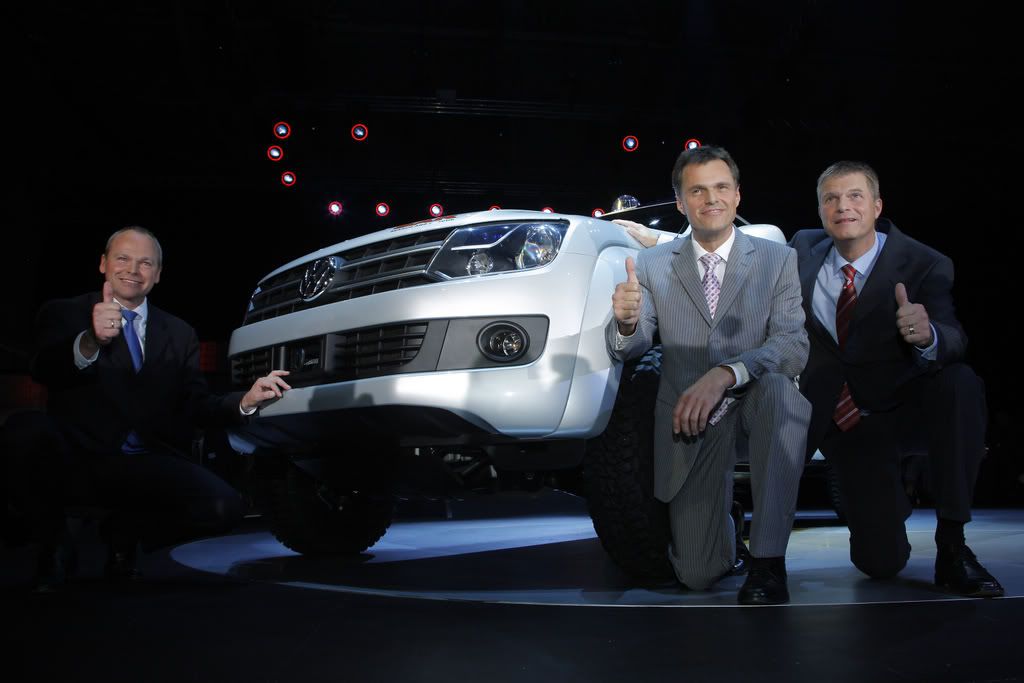
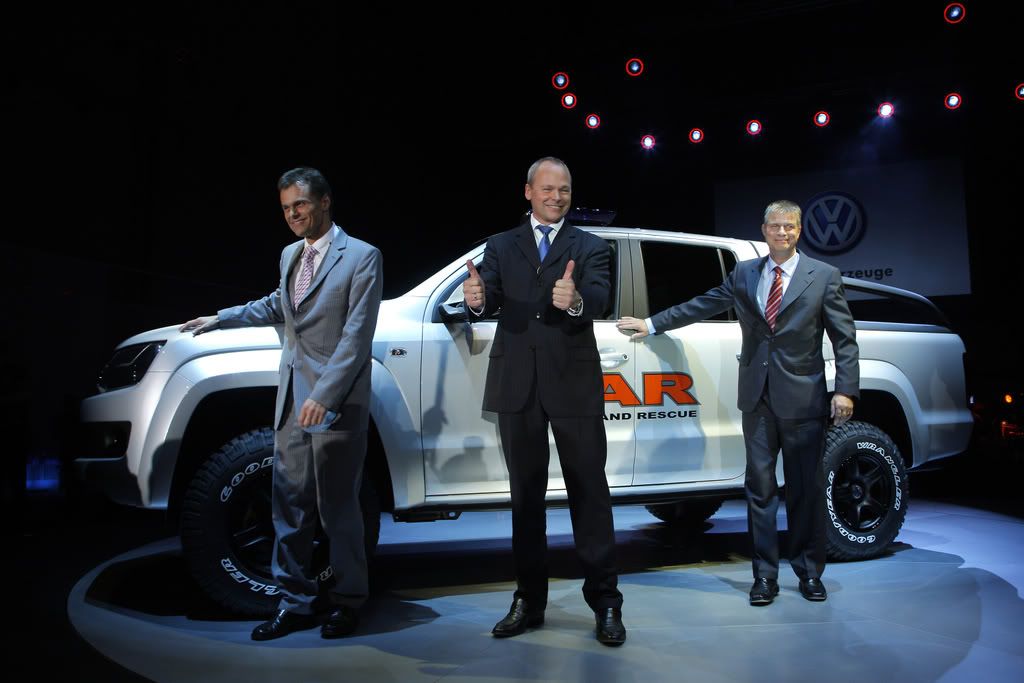
Pictured left to right of screen VWCV Board Members Stephan Schaller (CEO), Dr Wolfgang Schreiber (Product & Development) and Harold Schomburg (Sales & Marketing).

• Five world premieres at IAA Commercial Vehicles
• New series: Volkswagen Pickup show car
• Worldwide deliveries up 9.3 per cent to end of August

Hanover, 23rd September 2008. Volkswagen Commercial Vehicles is presenting five world premieres at IAA Commercial Vehicles, including a preview of the Volkswagen Pickup which will be launched as the fourth new series of light commercial vehicles towards the end of 2009. The Volkswagen Commercial Vehicles brand is on a growth track – deliveries to customers on a worldwide basis rose by 9.3 per cent to 343,100 light and heavy commercial vehicles by the end of August.
“New products, new markets, new technology – the Volkswagen Commercial Vehicles brand continues to experience sustainable and profitable growth”, emphasised Stephan Schaller, CEO of Volkswagen Commercial Vehicles at today’s press conference.

The brand intends to increase its worldwide deliveries of light commercial vehicles to 800,000 units by 2018. According to Schaller, this growth is to be achieved by introducing new products and by developing variants of the existing product range, some of which can be seen for the first time at IAA Commercial Vehicles.

The most spectacular highlight of the trade fair from VWCV’s perspective is its first ever presentation of a Volkswagen Pickup show car. This adds a fourth series (in addition to Caddy, T5 and Crafter) to the brand's range of light commercial vehicles, which already boasts an extensive set of variants.

This means that Volkswagen Commercial Vehicles will be the first volume manufacturer in Europe to enter the 1-tonne Pickup segment, with its high growth global potential. According to Schaller, the key markets for the Volkswagen Pickup are the countries of South America – especially Brazil. He also sees South Africa, Australia and South East Asia as being important markets for this universally adaptable commercial vehicle. And the vehicle will also be introduced into the European market. Overall sales projections for the new Pickup amount to around 100,000 units per year.

Schaller was confident of achieving worldwide total deliveries of over 500,000 light and heavy commercial vehicles in 2008. He was optimistic of achieving this annual target, despite difficult economic conditions at the present time in certain European countries.

Schaller: “Markets are getting harder – but Volkswagen Commercial Vehicles will continue to grow this year.”

This is borne out by sales figures from the most significant markets.

• In Germany deliveries of vehicles in the Caddy, T5 and Crafter series grew by some 7.5 per cent between January and August – a total of approximately 79,800 vehicles.
• In Western Europe product delivery numbers grew by 3.2 per cent to 190,900 units.
• In the booming eastern European markets, deliveries rose by nearly 30 per cent to more than 32,900 light commercial vehicles. In Russia alone the brand sold 6,630 units, up 87 per cent.
• In South America deliveries of light and heavy commercial vehicles increased by around 25 per cent to 82,300 units.

The President of Volkswagen Trucks and Buses, Roberto Cortes, predicted that 2008 would see a new worldwide delivery record of 60,000 heavy commercial vehicles and buses. Volkswagen has been the market leader in Brazil for the last six years, and now has a market share of some 31.6 per cent.

In addition to the Volkswagen Pickup show car, the brand is presenting four other world premieres in Hall 12 at this year’s IAA Commercial Vehicles, taking place between 25th September and 2nd October.

• The Caddy 4MOTION opens another chapter in the success story of this series. With the sales launch planned perfectly for the start of winter, it will at last be possible to buy a delivery van with a permanent four-wheel drive option. In the Caddy 4MOTION, power is distributed via an electronically controlled latest generation Haldex gearbox.

• The Caddy PanAmericana Studie is a variant of the Caddy 4MOTION for globetrotters. With its 16 inch all-terrain wheels, off-road look and feel, not to mention its high-quality yet robust leather interior upholstery, the Caddy PanAmericana Studie turns heads.

• With the Caddy Life Style Edition, Volkswagen Commercial Vehicles is presenting the most exclusive series Caddy of all time – a top-of-the-range Caddy variant due to be launched in November 2008.

• Another world premiere is the Crafter BlueMotion Studie. This 3.5-tonne diesel estate has a fuel economy rate of 31.04 mpg and already complies with the Euro 5 emission standard due to come into force in autumn 2009.

As Schaller said, with the Volkswagen Pickup, with the world premieres and also with other models adapted to meet the needs of global growth markets, Volkswagen Commercial Vehicles is well positioned to continue along the track of profitable growth.


Monday, September 22, 2008

VW Pickup Revealed !!!!!!!


Volkswagen Commercial Vehicles shows concept of new generation of pickups

-Pickup concept vehicle offers exciting look forward to the year 2009
-Volkswagen Pickup has special equipment for lifeguards

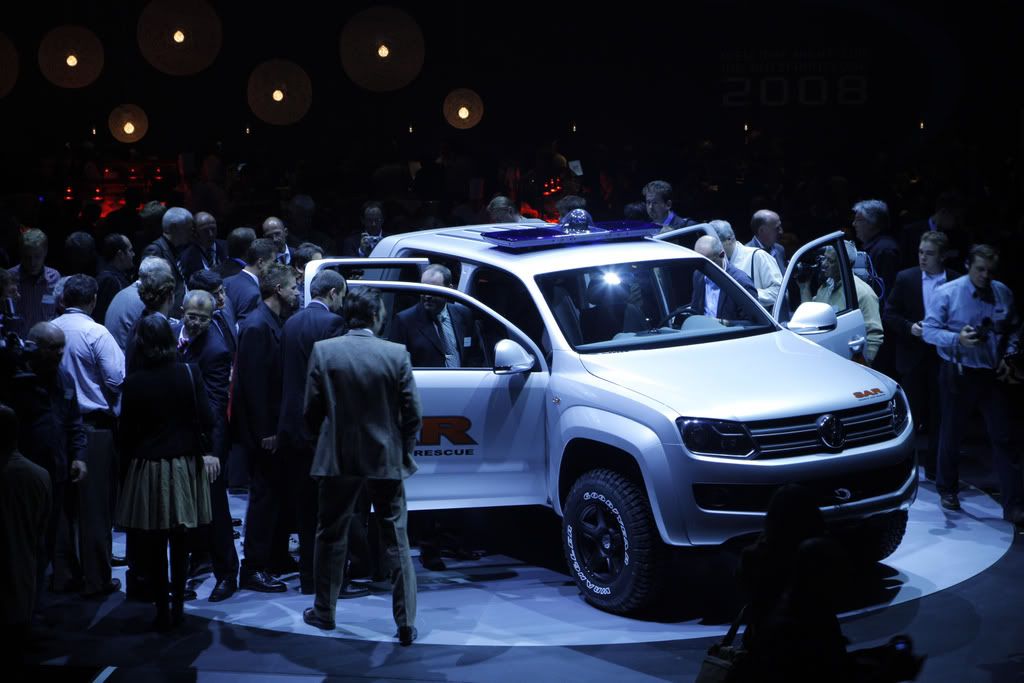
A highlight being presented by Volkswagen Commercial Vehicles at the International Automobile Exhibition in Hanover (September 26 to October 02) is the world premiere of an innovative concept vehicle: a pickup in the 1-tonne class. The concept vehicle – executed in this case as a cleverly designed rescue vehicle for marine use – offers a preview of the fourth model series by the commercial vehicle manufacturer. The first pickup of this sort from any high-volume European automotive manufacturer is expected to set new standards in its segment. Key markets for future production vehicles are South America, South Africa and Australia; these are regions with some the greatest demand for pickups for recreational and business use – due to their great versatility. Production of the new Pickup will begin in Fall 2009 at Volkswagen’s “Pacheco” plant in Argentina.

Features of the four-door and four-seat pickup concept vehicle were conceptualized after intensive discussions with emergency services and in-house specialists for emergency vehicles. It was specially designed as a “Search and Rescue” version (SAR) for protecting swimmers and surfers from worst case scenarios. That is, it is a vehicle for lifeguards, such as those found at many large beaches around the globe. The basic technical layout of this pickup from Volkswagen – with dual cab and all-wheel drive – makes it the vehicle par excellence for such services.


It can be said in general that the pickup has been entirely re-developed by Volkswagen Commercial Vehicles. The 5.18 meter long concept vehicle is not based on any familiar model series of the Group. However, synergies do exist between individual models. For example, the latest generation of highly advanced, torque-strong and at the same time fuel-saving common-rail turbo-diesels (TDI) is being used. To date, no pickups have made an appearance on the market with such pioneering fuel economy and emissions benefits of direct injection gasoline and diesel engines, especially those being developed in Germany. The pickup from Volkswagen will be the first to fulfill these requirements.


The styling of the concept vehicle also evolved from a blank sheet of paper. The Pickup follows the new Volkswagen Design-DNA initially presented by the Volkswagen passenger car division in the form of the Scirocco and the sixth Golf generation just introduced. The pickup concept vehicle is the first commercial vehicle under the Volkswagen label to exhibit this DNA. Group design chief Walter de Silva had this to say: “We have created a selection of core elements that can be described as ‘historical DNA’. Successful new Volkswagen designs will take on this DNA to generate a feeling in the eye of the beholder that is familiar and yet new.”


Familiar and yet new –precisely this formulation also applies to the Pickup concept vehicle. The clear and powerful surfaces of its body are familiar. As is the precision with which individual body sections merge with one another. One especially noteworthy aspect, for example, is the contour above the door handles that Klaus Bischoff, design chief responsible for the Volkswagen brand, refers to as the character line. On the one hand, it emphatically delineates the door and window surfaces from one another. On the other hand – and this is unusual and therefore all the more eye-catching – the line extends from the pickup’s C-pillar over the doors and into the front fender and bumper. It is a line that gives the overall vehicle a very unique contour. Conveying high-end quality, meanwhile, are style elements such as the uncompromisingly horizontal layout of the radiator grille in which the VW logo is integrated, and the headlights that are incorporated into the lines of the grille. They give the 1.9 meter wide front end an impressive and yet pleasing look. When it comes to width, the Pickup also scores points in the rear. Specifically, in the cargo bed: unlike its direct competition, it is easy to load a Euro pallet sideways here.


The pickup-specific features of the concept reveal an entirely new visual aspect of models by Volkswagen Commercial Vehicles. In general, all body components are designed to be very robust. Specifically, the concept vehicle’s look is marked by details such as the flared wheel wells, the charismatic structure of the C-pillar (that merges into the rear end), the roll bar on the side sections of the cargo bed and the large tailgate with integrated VW logo.


The Pickup study from Volkswagen Commercial Vehicles was uncompromisingly designed as a type of automotive lifesaver. Take the exterior, for example: particularly noticeable here is the very flat and therefore aerodynamic blue-light roof module with integrated searchlight that can be electrically swiveled in any direction from the interior or by remote control. During daylight hours, the blue light is also equipped with a very conspicuous high-power LED system. A similar intermittent strobe function (in blue light) in the front and rear flasher lights also operates when the system is activated; that is why the actual turn signal function of the front flashers was integrated in the in the lower bumper section in the mounting area of the fog lights. Also located in the front bumper is a cable winch. But none of this reduces the impact of features offered by the interior and cargo bed.


The scenario for a typical use of the SAR Pickup might be as follows: the operations center reports a surfer in an emergency situation, on the Australian coast, for example. The specific area of the large expanses of Bondi Beach where the surfer took off and where the surfer is now waiting in the water are known. Based on localization of the call at the operations center, the GPS data of the position are fed into the Pickup’s navigation system – by no means is this science fiction. The radio-navigation system is controlled by a multifunctional touchscreen and a completely redeveloped infotainment head unit. Also integrated here is a CB radio and a menu level for all climate control functions. The system display is located in the upper area of the center console for ideal viewing and control by the driver and front passenger. Besides display of a map and pictograms, satellite images of the terrain can also be displayed. On the level below this there are buttons for adjustments to the chassis and all-wheel drive (e.g. differential locks). Thanks to off-road-navigation, the lifeguards can reach the emergency location extremely quickly. A compass is also mounted in the upper instrument panel area for general use.


The fact is: the pickup supports you better than any other vehicle now that the rescue operation has begun. Integrated in the front center console, together with their charging shells, are two mobile CB radios; there are two others in the rear of the dual cab. In addition, powerful flashlights are located next to the front seats. Also housed in the center console between the front seats and the individual seats in the rear: two mobile navigation systems. Directly behind it: a modular case with the most important first aid medications, a defibrillator and binoculars. Two safety helmets are mounted in the roofliner in the rear for use on bodies of water with strong currents. In front of these, within easy reach of the driver and front passenger is the switch panel for operating the blue light and the signal horn. Other components in the roof console: the loudspeakers of the mobile radio system. The saltwater resistant interior was designed to be washable, so that it can be cleaned lightning fast after an operation. Specifics: the seats are covered with neoprene, and the liners also have zippers for easy removal and cleaning. Reflective fibers were also worked into the doors, making entry and exit safer at night; thanks to its large reflective surfaces, the pickup can generally be recognized – even in darkness and from great distances.


Customized for special duty in coastal regions was the 1.55 meter long cargo bed of the Pickup, which can also carry a broad-format Euro pallet. When they arrive at the emergency location, the lifeguards find a special SAR jet ski here so that they can quickly approach the site of the incident. Integrated in the side walls of the cargo bed are life vests and rescue buoys, lights, special throw lines, fire extinguishers, blankets, and – in the tailgate – a tool set. Whether SAR features will actually be introduced to production at some later time is still entirely open. What is certain is that Volkswagen Commercial Vehicles will begin introducing the pickup to initial markets at the end of 2009. At first, it will be introduced to South America, South Africa, Australia and Europe; other markets will follow.


Saturday, September 20, 2008

VW Commercial Vehicles UK expands Sportline range with the Caddy.


The success of the Transporter Sportline series in the Volkswagen Commercial Vehicles UK line up has spurred the marketing team to introduce the new Caddy Sportline and Caddy Maxi Sportline vans.

I just wish Volkswagen Australia could bring the Sportline series Down Under.

Heres the Press Release..............


INTRODUCING THE NEW CADDY AND CADDY MAXI SPORTLINE

Volkswagen Commercial Vehicles has released the first images of two exciting new models in its stylish Sportline range – the Caddy Sportline and Caddy Maxi Sportline vans, set to go on sale next month.

They join the existing Transporter Sportline panel van (short and long wheelbase) and Transporter Sportline kombi to make a range of five models in Volkswagen’s dynamic Sportline range. Each vehicle combines aggressive yet tasteful styling additions while retaining the versatility for which the vehicles are renowned to provide customers with a vehicle that’s equally suited to commercial or leisure applications.

Full details of the specification and prices will be announced in October, but as the preview photographs indicate the distinctive styling of the Caddy Sportline and Caddy Maxi Sportline includes alloy wheels, a lower front spoiler with fog lights, chrome upper and lower grilles, chrome side rails, body coloured bumpers and door mirror housings, plus a rear roof spoiler.

‘We’re excited by the potential for the Caddy Sportline and Caddy Sportline in the small and medium-sized van market,’ said Gemma Cox, Product Manager, Volkswagen Commercial Vehicles.

‘Judging by the popularity of the Transporter Sportline with customers wanting to create a distinctive and dynamic image for them and their business, we’re sure the Caddy Sportline and Caddy Maxi Sportline will be just as successful,’ she continued.

VW Brazil revives the Voyage nameplate.


2009 Voyage

Volkswagen of Brazil has confirmed that their new 2008 Gol series based sedan will revive the 1980s badge Voyage.

Voyage was released in 1981 to the Brazilian market with many upgrades over its lifetime until it was dropped in 1994.
Outside of Brazil it is probably best recognized in North America where it was sold under the Fox nameplate from 1987 to 1993.

The new Voyage is based on various module components from the Volkswagen Group’s PQ24 and PQ25 (Polo) platforms; due to this the Voyage will have a transverse east-west engine instead of the north-south configuration.

Voyage will be powered by two engines the 1.0L TotalFlex producing around 72-76hp (55kW) and 1.6L TotalFlex producing 101hp-104hp (76kW); TotalFlex is fuelled by a combination of 100% Ethanol or a mixture of normal Unleaded combined with Ethanol.

VW of Brazil will launch the new Voyage at the Sao Paulo Auto Show in October.


2008 Gol

2008 Gol Interior

Friday, September 19, 2008

Ten years in the making – The VW Pickup story.


1999 Advanced Activity Concept

Ten years ago at the Detroit Auto Show Volkswagen unveiled the Advanced Activity Concept (AAC).


1999 Advanced Activity Concept

Volkswagen’s intension was clear it would build a pickup sooner or later: At the Detroit Auto Show VW was previewing the AAC Concept a precursor to the Touareg design and the V10 TDI engine which would power the production Touareg.

Now with the AAC pickup study in the open it was time to register public opinions and gauge possibly customer reactions.
Of course VW Enthusiasts such as me fell in love with the idea but would it make it to production?


1999 Sportstar Study

On the other side of the globe at the 1999 IAA Frankfurt Show the fifth division of the Volkswagen Group, Volkswagen Nutzfahrzeuge (aka Volkswagen Commercial Vehicles to You and I) introduced the Sportstar Study a pickup derived from the successful Multivan (Europe) - Eurovan (US) series.

Unfortunately the Concept D the precursor to the Phaeton luxury saloon took the attention from the Sportstar Study which was developed by German company Stahl with VW Commercial Vehicles.

The Sportstar was highly equipped with the luxurious alcantara leather captain chairs and it was powered by the T4 series evergreen 102hp TDI engine with syncro all wheel drive for added comfort.

So what happened for nearly ten years?

As both Volkswagen and its Commercial division both had presented studies it was time to debate which division would build and develop it.


1999 Advanced Activity Concept

The passenger division wanted a luxury truck but the commercial division wanted a more robust pickup; one that could carry and tow heavy loads and do everyday duties at the same time.

During this time VW CEO Ferdinand Piech was trying to push Volkswagen upmarket with products such as the Passat W8, Touareg and the Phaeton.
Unfortunately this did not work mainly due to the Volkswagen Group already pushing its Audi brand upmarket.

Subsequently the Volkswagen Group under new CEO Bernd Pischetrieder scaled back its luxury VW push; first dropping the Passat W8 then dropping the Phaeton out of North America which was seen as a failure.

There were internal studies during this time; but the quibble between the two divisions delayed the greenlight, fast forward to 2005 and Volkswagen Commercial Vehicles unveiled its intention to build a Microbus and a family of Robust Pick Up’s.

Obviously this year is very big year for Volkswagen Commercial Vehicles with the unveiling of the new one tonne midsize pickup the fourth line within the division.

Now we have already seen the Robust undergoing testing since April this year; next week we will finally know its production name and be able to see its face in production concept guise at the IAA Commercial Vehicle Show.

This Tuesday the 23rd. of September the embargo will be lifted and full details will flow.


1999 Advanced Activity Concept